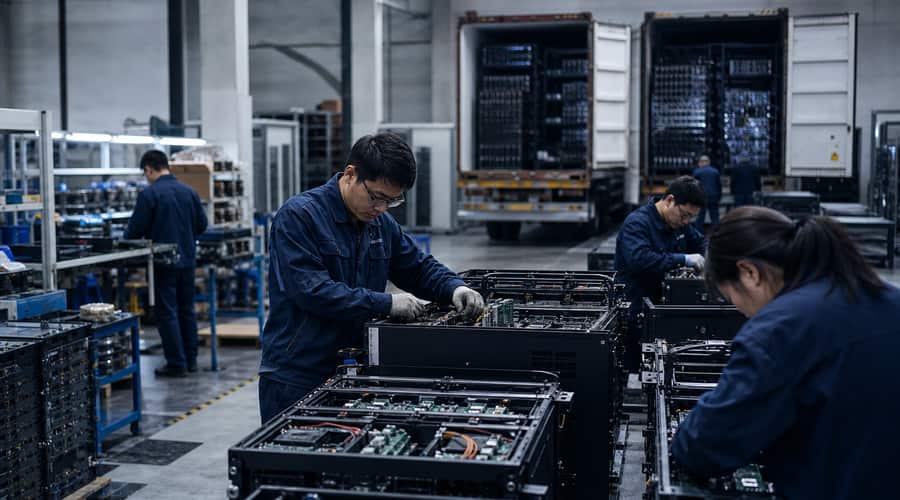
OpenAI's leadership admits the company is passing on projects and making painful trade-offs because it simply cannot secure enough computing power to meet surging AI demand.
Sarah Friar, OpenAI's chief financial officer, has a problem most companies would envy and few can relate to. She is sitting on $122 billion in fresh funding, serving roughly 900 million consumers and over a million businesses, yet she spends her days hunting for available compute capacity. "We're making some very tough trades at the moment and things we're not pursuing because we don't have enough compute," Friar told ARK Invest CEO Cathie Wood in an interview released this week. The bottleneck is especially sharp right now, with demand for AI models outpacing the global supply of the specialised chips needed to train and run them.
As Business Insider reported, Friar was blunt about the stakes: without compute, there is no revenue. That single constraint is shaping which products OpenAI builds, which it shelves, and how aggressively it can chase the next wave of artificial intelligence applications.
OpenAI president Greg Brockman reinforced the same pressure in a separate appearance on the "Big Technology Podcast," describing what he called very painful decisions about where to allocate limited resources. The company has already pulled back from certain initiatives, including its video generation app Sora, to concentrate on core products like its personal AI assistant and complex task-solving tools. Brockman said the company is deliberately narrowing its focus to a handful of use cases because it "can't possibly get to all of them" under current capacity limits.
The AI industry's defining shortage is not money or talent. It is hardware. Training and running large language models requires enormous clusters of Nvidia GPUs, particularly the H100 and newer H200 chips, and the data centres to house them. Those chips take months to manufacture, require specialised cooling and power infrastructure, and are subject to geopolitical supply chain risks tied to Taiwan Semiconductor Manufacturing Company's dominance in advanced chip fabrication.
OpenAI is not alone in feeling the squeeze. Anthropic recently tightened usage caps for its Claude model during peak hours, signalling that even top-tier AI labs with deep-pocketed backers are bumping against physical infrastructure limits. Microsoft, Google, and Meta have collectively committed hundreds of billions of dollars to building out data centre capacity over the next decade, but those facilities take years to come online.
For startups and smaller AI companies, the implication is sobering. If OpenAI, with its vast war chest and close partnership with Microsoft, cannot secure enough chips to pursue every opportunity it sees, the barrier for newcomers is considerably higher. The compute crunch effectively narrows the field of companies that can compete at the frontier of AI development, consolidating power among a small number of well-capitalised players.
Strategic trade-offs already in motion
Friar's comments confirm what product watchers have suspected for months: OpenAI is rationing its compute budget across competing priorities. The decision to pull back from Sora, its much-hyped video generation tool, was not about a lack of demand or technical capability. It was a resource allocation choice. The same engineering hours and GPU clusters that could power a video tool can instead be directed toward improving ChatGPT's reasoning capabilities or scaling its enterprise API business, which generates recurring revenue.
This kind of forced prioritisation is not necessarily a weakness. It pushes companies to sharpen their focus on the most valuable use cases rather than spreading thin across every trendy application. But it does mean that some promising ideas will stall, not because they lack merit, but because there are not enough chips to go around.
Friar noted that OpenAI is making multi-year commitments to lock down future capacity, a strategy that requires enormous upfront capital but guarantees a pipeline of compute as new data centres come online. That approach mirrors how cloud providers like Amazon Web Services and Azure built their empires: by investing heavily in infrastructure before demand fully materialised, then reaping the rewards as usage scaled.
What to watch next
The compute shortage is unlikely to ease significantly until late 2027 or beyond, when new chip fabrication plants in the United States, funded partly by the CHIPS Act, begin producing at scale. In the meantime, expect to see more AI companies making public concessions about capacity, tightening free-tier access, or raising prices to manage demand. For investors, the companies best positioned in this environment are not just those with the best algorithms, but those with the strongest infrastructure supply chains. Watch for OpenAI's next moves in enterprise services, where higher margins can justify the compute costs, and for any signs that competitors like Google DeepMind or Anthropic are gaining ground by securing their own chip supplies more efficiently.