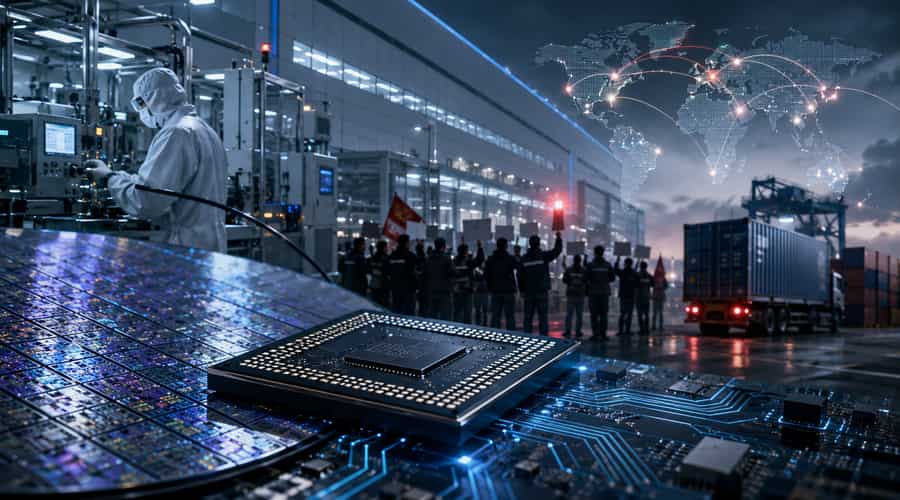
Samsung is heading into its biggest labor confrontation in years, and the timing could hardly be worse for the AI chip market.
Nearly 48,000 workers at Samsung Electronics are set to strike after wage talks broke down, according to Reuters, raising the risk of disruption at the company's semiconductor fabs just as demand for memory and foundry capacity remains under pressure. The walkout is scheduled to begin on Thursday, May 21, and could last 18 days, making it the largest labor action in Samsung's history and a direct test of how much slack still exists in the global AI supply chain.
This is not just a labor story. Samsung sits at the center of the memory market, and any slowdown in its fabs can quickly reach data centers, device makers, and AI hardware startups that already struggle to secure HBM and DRAM. The company and its union failed to close the gap over bonus payments after government-mediated talks and last-minute negotiations, moving the dispute from bargaining table to operational risk.
Samsung's chip plants are built around tightly choreographed production, which is why labor disruption can be more damaging than it sounds. The strike plan involves tens of thousands of workers walking off the job, while local reports say the company has already begun pre-emptive measures, including reducing wafer intake and warm-down steps at memory fabs, to limit damage if production is interrupted. That preparation helps, but it also signals how seriously Samsung is treating the threat.
The latest wrinkle is legal. A South Korean court has granted Samsung a partial injunction that restricts the union from occupying facilities, blocking entrances, or disrupting safety and production systems. That does not make the labor dispute disappear. It narrows the field of action and makes a full plant shutdown less likely, but it also pushes the fight into a more complicated phase where workers, management, courts, and the government are all trying to shape the outcome.
The market is especially sensitive because Samsung is already fighting on several fronts. In advanced logic, TSMC remains the benchmark. In high-bandwidth memory, SK Hynix has been the sharper operator, and HBM is the component most directly tied to AI training demand. That means Samsung is not simply trying to keep factories running. It is trying to avoid losing more ground in the one part of the industry that matters most right now.
There is also a pricing angle. Analysts have warned that a prolonged stoppage could tighten supplies of DRAM and NAND, with one Reuters-cited estimate putting the potential disruption at 3% to 4% of global DRAM supply and 2% to 3% of NAND supply if the strike runs the full 18 days. For data center operators, that means higher costs. For AI hardware startups, it means another layer of uncertainty in a market where lead times, component availability, and pricing can shift fast enough to damage a product roadmap.
The bonus fight inside Samsung
At the core of the dispute is how Samsung shares the gains from the AI boom. The union wants a bigger bonus pool tied to operating profit, while management has resisted the demand and argued for a different approach to payouts. The disagreement is not just about one year's compensation. It reflects a deeper divide over who benefits when Samsung's chip business performs well, and how that money should be distributed across workers in memory, foundry, and other divisions.
That distinction matters because Samsung's chip workforce is not uniform. Memory has been the company's stronger business, helped by AI-driven demand, while the foundry side has faced a tougher road. The union's position is straightforward: workers across the business have carried the load, and the rewards should not be isolated to one group. Management's problem is equally clear. It must protect incentives without setting a precedent that could spread costs across a company already trying to regain competitiveness.
There is a broader strategic tension behind all of this. Samsung is racing to close a yield gap in foundry manufacturing, where process execution is everything. Any slowdown, even a temporary one, makes that task harder. Customers in semiconductor manufacturing do not forget missed deliveries or operational instability quickly, especially when they are deciding where to place orders for expensive, long-cycle products.
What happens next
The immediate question is whether the strike proceeds at scale after the court order, or whether pressure from the government and business groups forces another settlement attempt. South Korea has already signaled that it is prepared to use emergency arbitration if the dispute threatens the economy, and Prime Minister Kim Min-seok has warned that a single day of suspended chip production could cause direct losses of about 1 trillion won, roughly $668 million.
Even if the strike is blunted, the episode has already done damage by showing how fragile the balance is between AI demand and chip supply. Memory makers have benefited from the boom, but they are also being asked to deliver more, faster, and with better economics. Samsung's labor dispute is a reminder that the bottlenecks in AI infrastructure are not only technical. They are human, operational, and financial too.
If the walkout goes ahead and lasts, the effects will be watched far beyond South Korea. Every major AI buildout depends on a narrow set of suppliers, and Samsung is one of them. When a company this central is forced into an 18-day standoff, the market does what it always does, it starts pricing in scarcity before the first wafer is lost.
Also read: Hyperliquid's fee surge sends a clear signal to Solana and DeFi builders • Nvidia's deal spree shows how AI power is shifting from chips to control • China's Nvidia chip ban shows how far the tech fight has widened