Samsung's 26-year run as South Korea's most valuable listed company is over, at least for now. SK Hynix took the crown on June 22, 2026, because the AI boom has turned high-bandwidth memory from a specialist chip into one of the most important parts of the data center supply chain.
The gap was almost absurdly small. Reuters reported that SK Hynix's market value reached 2,082.5 trillion won on Monday, just ahead of Samsung Electronics at 2,081.3 trillion won, excluding Samsung's preferred shares. Less than $1 billion separated the two companies after a 26-year stretch in which Samsung had not been dislodged from the top of South Korea's market.
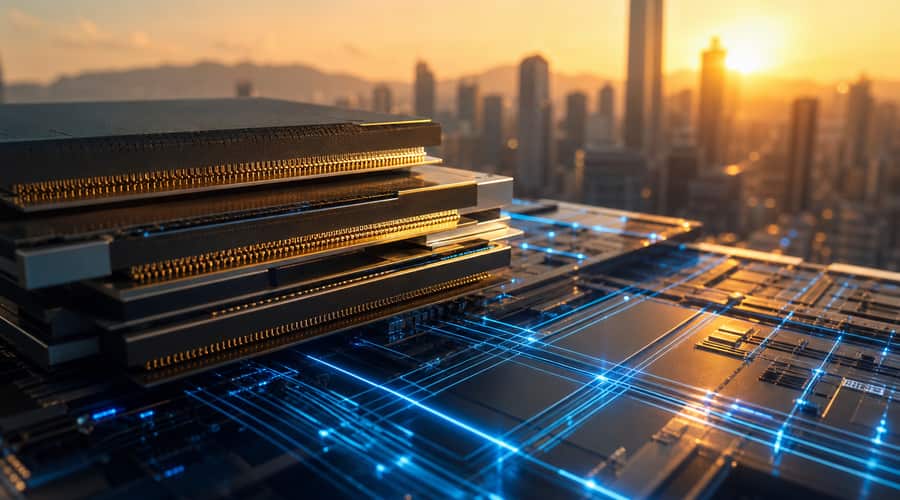
You don't need to love chip architecture to understand the shift. High-bandwidth memory, or HBM, stacks DRAM chips vertically and connects them with thousands of tiny through-silicon vias, giving AI processors the bandwidth they need to train and run large models. Nvidia's H100 and H200 GPUs use HBM. So do the AI chips being pushed by Google and Amazon. Without that memory sitting close to the processor, the accelerator story falls apart quickly.
That is where SK Hynix got the timing right. Counterpoint Research put SK Hynix's global HBM revenue share at 57% at the end of 2025, ahead of Samsung at 22% and Micron at 21%. Other current estimates put SK Hynix above 60%. The exact number will move by quarter, but the ranking is the point. Samsung remains a giant in ordinary DRAM and NAND, yet it has been fighting from behind in the specific memory product that AI buyers are desperate to secure.
Samsung's problem has been qualification, not brand recognition. Its HBM products have faced repeated questions around thermal performance, yields, and approval for Nvidia's most demanding accelerators. Reports on Samsung's next-generation HBM4 effort have pointed to weaker yields than SK Hynix, while the company is still trying to win a larger piece of Nvidia's 2026 demand. That deal would matter. But catching up in HBM is not like launching a new phone color. Customers qualify these parts slowly, and mistakes can break expensive AI systems.
Here's the thing: this is not just a stock-market curiosity. It is a reminder that the AI buildout rewards the supplier with the bottleneck part, not necessarily the company with the most famous logo. Samsung makes phones, televisions, home appliances, memory chips, foundry wafers, and plenty more. SK Hynix is narrower. In this market, narrower has been better.
There is a hard history behind that reversal. In 2002, Hynix Semiconductor was nearly sold to Micron after a collapse in memory prices left the company under enormous debt pressure. The board, management, and labor union rejected the deal. SK Group later stepped in, with chairman Chey Tae-won backing the acquisition of a major stake in 2012 for about 3.37 trillion won. The company that Micron once almost bought is now worth more than Samsung Electronics on Seoul's exchange, at least by common-share market value.
That line is worth sitting with for a moment.
SK Hynix's shares have risen roughly 350% this year, according to Reuters, as investors have chased the clearest AI memory winner. The demand is real enough that memory shortages are no longer a vague warning. Samsung and SK Hynix have both told investors that AI-driven memory tightness could stretch into 2027. Customers are reserving supply years ahead because no cloud company wants to have expensive GPUs waiting around for memory that hasn't arrived.
Samsung still has power, but not the prized position
Samsung is not suddenly weak. It remains one of the world's most important semiconductor companies, with a huge conventional memory business and a foundry arm that competes with TSMC. It also has consumer electronics, displays, phones, and financial affiliates across the wider Samsung group. A one-day market-cap ranking is not a verdict on the entire empire.
But the market is saying something specific. Conventional DRAM has always been a brutal business, with pricing cycles that punish even the biggest producers. HBM is different. It is harder to make, harder to qualify, and more directly tied to AI accelerator demand. SK Hynix's lead in that segment gives investors something they can price with unusual clarity: a bottleneck product in a spending cycle that still has force behind it.
Frankly, Samsung's HBM gap is too large to dismiss as a short-term stumble. Money helps, and Samsung has plenty of it. Engineering depth helps too. But SK Hynix made its HBM bet earlier, won key AI customers earlier, and built the manufacturing learning curve while the product was still moving from specialist memory into strategic infrastructure.
The next fight is HBM4. SK Hynix has already said it completed development of the product and is preparing mass production, while Samsung and Micron are pushing hard for share. Goldman Sachs has said SK Hynix should keep a dominant position in HBM3E through at least 2026, but no lead in semiconductors is permanent just because investors want it to be.
For now, SK Hynix owns the moment. Samsung lost the top spot not because it stopped being important, but because AI has made one memory category more valuable than a much broader empire. If you're watching the chip market, that is the signal: in the AI cycle, the scarce part gets the power.
Also read: Sakana AI launches Fugu Ultra and its orchestration model matches Fable and Mythos without training a single frontier model • Bain is vibecoding replicas of software acquisition targets and the results are rewriting M&A • Tencent's WeChat AI Agent Is a Bet That the Super App Swallows the AI App