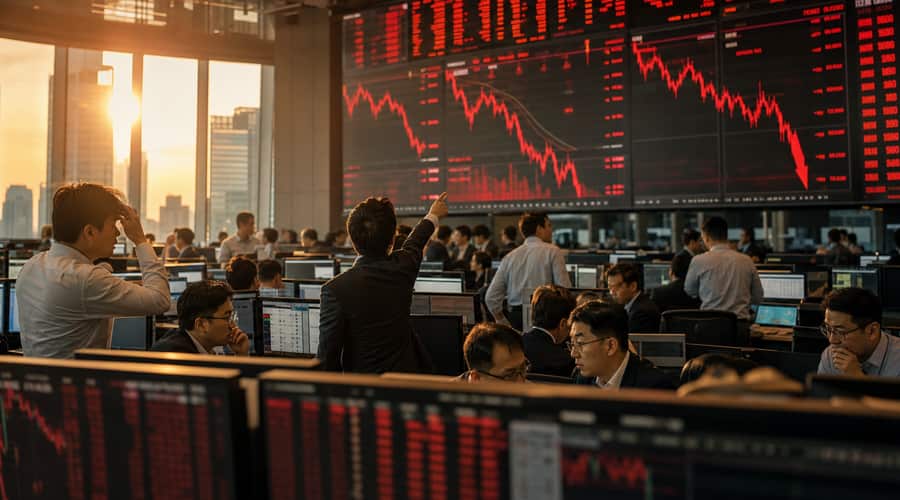
South Korea's June 23 rout showed what happens when a real AI chip boom gets strapped to retail leverage. The demand for memory chips is genuine, but the trade built around Samsung and SK Hynix is now fragile in a way you can't ignore.
The selloff in Seoul was not a normal bad day for a hot market. It was a warning about structure. South Korea's Kospi had more than doubled this year before the break, according to recent market reports, while Samsung Electronics and SK Hynix had become so large that two memory-chip stocks were doing the work of a national index. When both fell by more than 12% on June 23, the Kospi dropped 9.99% and the Korea Exchange triggered a 20-minute circuit breaker.
You can believe in the AI chip cycle and still see the danger here. SK Hynix has been lifted by real demand for high-bandwidth memory, the expensive memory used in Nvidia's AI systems. Samsung is still one of the world's two dominant memory makers. South Korea's government under President Lee Jae Myung just announced a chip investment plan worth about 800 trillion won, or roughly $520 billion, alongside Samsung and SK Hynix, according to Tom's Hardware and the Financial Times. None of that makes a leveraged retail trade less risky.
The sharpest problem was the single-stock ETF experiment. South Korea's financial regulator approved sixteen single-stock leveraged and inverse ETFs on May 27, targeting twice the daily moves of Samsung and SK Hynix. KED Global reported that the products pulled in about $3 billion on launch day and held more than $9 billion by June 23, with retail investors making up roughly 92% of holders. Relative to Korea's local market, Goldman Sachs estimated that the SK Hynix leveraged ETF looked like a $750 billion leveraged product on one U.S. stock.
That is not a side bet. That is market plumbing.
KED Global also reported that the leveraged ETFs were accounting for about 31% of Samsung's daily trading volume and 38% of SK Hynix's. Once the Financial Supervisory Service publicly regretted approving the products, sellers did not need much more encouragement. Samsung fell 12.31%. SK Hynix dropped 12.47%. Bloomberg reported that the ETFs then had to rebalance into the decline, forcing roughly $6 billion of stock sales. By the time U.S. investors woke up, Micron and other memory names were already under pressure.
Frankly, this is the part investors should care about most. The ETFs did not create AI demand, and they did not invent the rally in memory stocks. They changed what happens when the rally pauses. A daily leveraged product has to reset exposure after big moves, so selling can create more selling at precisely the moment the market has the least patience for it. If you bought the top because the index looked unstoppable, you were not just betting on SK Hynix's earnings. You were betting on the flows staying friendly.
Taiwan has its own concentration problem
Taiwan is not running the same product experiment at the same scale, but the shape is familiar. TSMC is more than 40% of Taiwan's benchmark, and Bloomberg has cited data showing margin debt rising by more than $13 billion to levels last seen around the dot-com peak. The TAIEX hit 47,741 on June 23, the same day Seoul was breaking. A market can keep rising for perfectly rational reasons and still become badly balanced.
The local concern is not only valuation. Taipei Times coverage has pointed to the gap between the AI-linked stocks and the broader domestic economy, while Taiwan's central bank has warned about societal wealth divergence. You don't need a theory for that. If one stock carries more than 40% of the benchmark, a cautious guidance call from TSMC or a softer demand signal from Nvidia can hit households that thought they were buying the market, not making a concentrated semiconductor bet.
This is where the usual debate gets lazy. Some coverage asks whether the AI boom is real or fake, as if those are the only choices. The better answer is less tidy. HBM demand is real. TSMC's capacity constraints are real. SK Hynix's surge had earnings and customer demand underneath it. But real fundamentals can still support a bad market structure, and a bad structure punishes late retail buyers first.
South Korea is now considering measures to curb risks in leveraged single-stock ETFs, and regulators have postponed planned single-stock options. Those are sensible repairs after the damage. They do not answer the larger question facing Korea and Taiwan: what happens when national benchmarks become shorthand for two or three AI suppliers, and the products built around them force everyone to trade in the same direction at once?
The June 23 rout was current, specific and ugly enough to take seriously. It was not proof that AI chips are over. It was proof that even a good story can be overleveraged.
Also read: Former DeepMind researchers who beat professional poker players raise a $500 million Series A to trade stocks and crypto • Nearly 1,700 UK investors are suing Binance and CZ for £150 million over unauthorized derivatives sold to retail customers • Bending Spoons prices its Nasdaq IPO above range as Wall Street bets on AI-powered software roll-ups