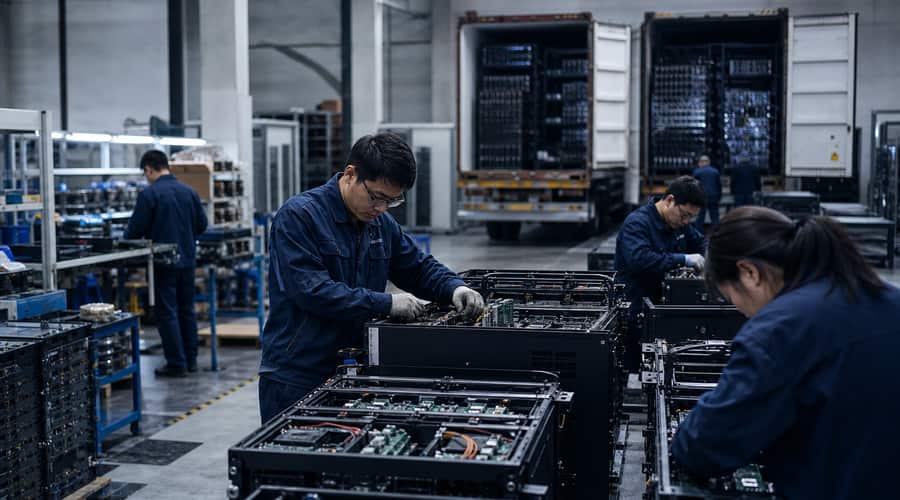
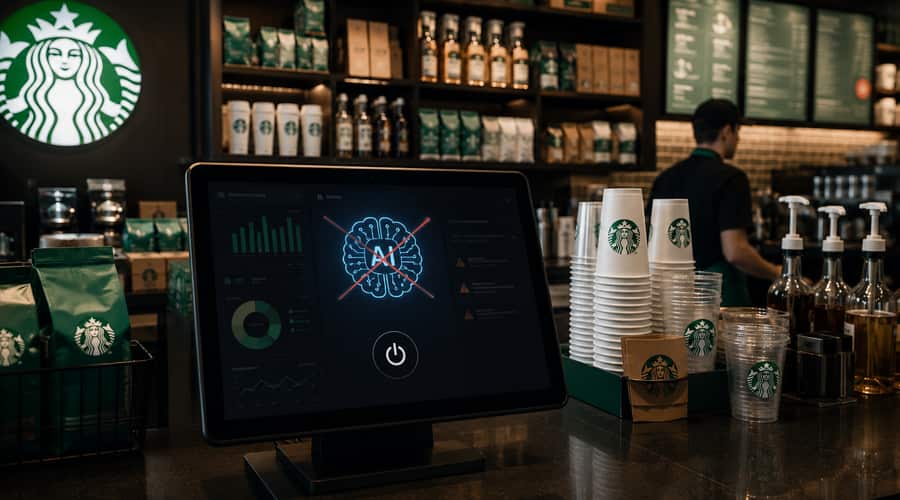
Starbucks wanted AI to make store inventory faster and cleaner. Instead, the company is retiring the tool after repeated counting errors turned a labor-saving idea into another operational headache.
Starbucks has pulled the plug on an AI inventory system it rolled out across North America only nine months ago, a quick retreat for a company trying to prove that technology can help fix the basics inside its stores.
The tool, called Automated Counting, was meant to help workers scan shelves with tablets and get faster reads on products such as milk and other beverage ingredients. That sounds simple enough. In a Starbucks store, where shortages can mean longer waits, frustrated customers and wasted staff time, better inventory data should be a practical advantage. But the system reportedly struggled with the very job it was built to do.
According to Reuters, which reviewed an internal company newsletter and spoke with people familiar with the decision, Starbucks terminated the program this week after it frequently miscounted or mislabeled items, including similar milk products. The company said the move was part of an effort to standardize how inventory is counted across coffeehouses while it focuses on consistency and execution at scale.
That is the careful corporate version. The more useful business lesson is sharper: AI that cannot work reliably in messy real-world conditions is not a productivity tool. It is just another task employees have to manage.
Starbucks did not launch Automated Counting as a side experiment hidden in a lab. NomadGo said last year that its Inventory AI had been deployed across more than 11,000 Starbucks owned and operated coffeehouses in North America. The pitch was that store employees could use camera and LiDAR data on mobile devices to scan backroom shelves and make inventory counts much faster than manual checks.
For a company the size of Starbucks, even small improvements can matter. Inventory accuracy affects product availability, ordering, waste, labor planning and the customer experience at the register. If oat milk is out, or a syrup is missing, the issue shows up quickly in daily sales. It also gives baristas one more problem to solve during already crowded shifts.
That is why the failure matters beyond one discontinued app. Restaurant and retail operators are under pressure to make stores more efficient without making service feel colder or more chaotic. AI vendors have rushed into that opening with promises around forecasting, computer vision, scheduling and supply chain automation. Some of those tools will work. Many will not survive contact with the floor.
Counting cartons and bottles sounds easier than generating a marketing campaign or writing code, but store environments are difficult places for software. Packaging changes. Shelves get crowded. Lighting varies. Products are stacked imperfectly. Workers are moving quickly. A system that performs well in a controlled demo can still miss the details that matter during a busy Tuesday morning.
Why This Hurts The AI Pitch
Starbucks has been trying to simplify operations under CEO Brian Niccol, who has pointed to product shortages as one factor weighing on the business. In that context, an inventory tool was not a shiny extra. It was supposed to support a larger effort to get stores running with more consistency.
The timing is also awkward because Starbucks had positioned Automated Counting as part of a broader technology push. When companies talk about AI in retail, the story usually starts with labor savings and better decisions. The harder question is what happens when employees do not trust the output. If a barista has to check the tool, correct the tool and then still complete the count manually, the software has not removed work. It has moved the work around.
NomadGo, for its part, has said it continues to learn from customer and user feedback to improve its products. That may be true, and failed deployments do not mean the underlying category is finished. Computer vision will almost certainly become more useful in stores over time. But buyers are getting a clearer view of what separates a promising AI system from a reliable operating system.
This is especially important for startups selling into large enterprises. A pilot can win attention. A press release can win a week of headlines. But a chain-wide deployment lives or dies on whether frontline workers can use the product without slowing down. Enterprise AI companies that ignore that gap will keep finding out that adoption is not the same thing as installation.
There is also a capital markets angle. Investors have rewarded companies for talking seriously about AI-driven efficiency, and restaurant chains have been no exception. But the Starbucks reversal is a reminder that AI savings are not automatic. They have to show up in cleaner operations, lower waste, fewer shortages or better service. If they do not, management teams will eventually choose the boring process that works.
For Starbucks, the immediate move is a return to a more standardized way of counting inventory across stores. That is less exciting than an AI rollout, but it may be exactly what the company needs while it works through broader execution challenges. The next thing to watch is whether Starbucks narrows its AI efforts toward tools that support employees quietly in the background, rather than systems that ask store teams to become quality control for unfinished automation.
The broader market should pay attention. AI is still moving into retail, restaurants and logistics, but the winners will be the companies that understand the operating environment first and the model second. In a store, accuracy is not a feature. It is the price of entry.
Also read: AI allegations are forcing literary prizes to rewrite the rules • Starbucks retires its AI inventory tool after nine months. • DeepSeek is making its 75 percent API discount permanent