Suno's Spark program still asks unsigned artists to sign a non-disparagement promise that survives the deal, but the current fine print is narrower than the first criticism suggested. That distinction matters, because the company is asking for trust while lawsuits over its training data are still live.
The offer is easy to understand if you're an unsigned artist trying to get a record finished. Suno launched Spark on June 25, promising grants, marketing help, writing camp access, a partner manager, free Suno Premier access and editorial placement on its platform. Suno says artists keep creative control and commercial rights to their work. For someone paying for studio time, videos and distribution out of pocket, that is real money and real exposure.
Then you get to the fine print.
Music Business Worldwide first flagged the problem in its June 25 coverage: Spark's terms included a clause headed "Good Vibes Only" that stopped participants from making negative statements about Suno, its personnel, products or services during the program and thereafter. The Verge later pointed readers to the same issue, along with the broader package of rights Suno asks artists to accept, including making songs available for remixing and agreeing to Suno's standard arbitration terms.
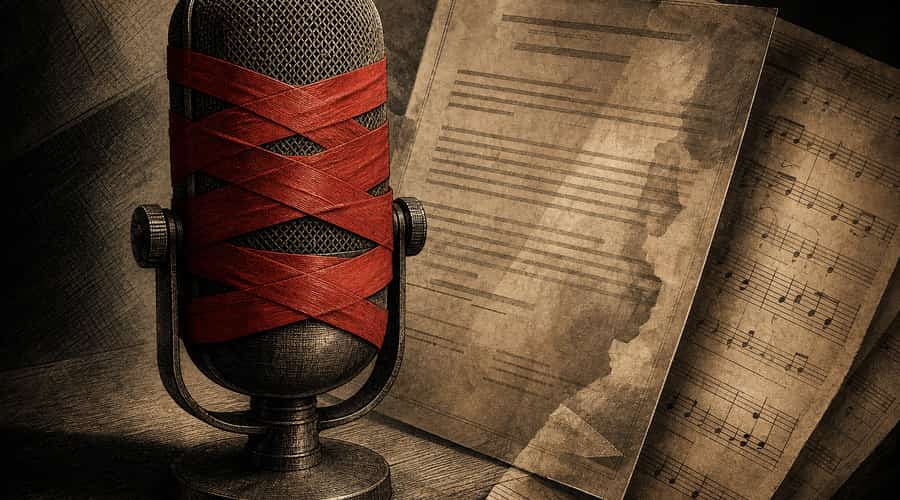
Suno's current Spark Fine Print, effective June 26, is different. The clause now says participants can't make statements that disparage Spark or its participants "during the Term and thereafter," and adds that it doesn't stop artists from speaking honestly about their experience in the program. That's a narrower promise than a blanket ban on criticizing Suno forever. But it still survives the deal. It still sits inside a paid artist program. And it still gives Suno a contractual tool to challenge speech it decides crosses the line.
Don't wave that away as harmless boilerplate. If a company is paying artists to use and promote its AI music platform, you want those artists free to say what happened after the money clears. If the tool helped them, say so. If the relationship felt one-sided, say that too. A grant program should buy deliverables, not future caution.
The rest of the terms are just as important. Suno says Spark artists must publish between one and 12 songs to Suno, make the music available to remix, and promote the work across multiple social platforms while noting that Suno was part of the process. The Fine Print also lets Suno ask artists to remove, re-shoot or modify content, and it bars them from paid or formal promotional work with rival AI music companies for 60 days after the final content post goes live. The named list includes Udio, Mureka, Riffusion, ElevenLabs, Soundful and others.
That competitor restriction at least expires. The speech promise does not.
The timing is why this story has teeth. Suno is not a neutral arts foundation handing out checks. Earlier this month, the company said it raised $400 million in a Series D round at a $5.4 billion valuation, more than double the $2.45 billion valuation attached to its November Series C. It is also still fighting major copyright litigation over whether its AI music models were trained on copyrighted recordings without permission.
According to Music Business Worldwide, Warner Music Group settled its claims against Suno in November and struck a partnership with the company, while Universal Music Group and Sony Music Entertainment remained in active litigation as of June 25. The majors first sued Suno and Udio in June 2024 through the Recording Industry Association of America, alleging mass copying of copyrighted sound recordings to train AI music-generation systems. Suno has argued that its training is protected by fair use.
That backdrop changes how you should read Spark. A company under legal and reputational pressure is recruiting independent artists into a program that asks them to make Suno-assisted songs, promote those songs publicly, and accept a speech restriction that continues after the term. The grant may be useful. The marketing help may be useful. But the company also gets something valuable: a group of working artists publicly attached to Suno at the exact moment the music industry is arguing over whether Suno's core technology was built lawfully.
Suno's public framing is straightforward artist support. Paul Sinclair, its Chief Music Officer, and Rosie Nguyen, its Head of Creative Economy and Monetization, wrote in the launch blog that Spark is meant to help independent artists bring projects to life through funding, mentorship and dedicated marketing support. Fine. Take that at face value as far as it goes.
It doesn't go far enough.
If Suno wants artists to trust Spark, it should make the speech terms clean. Let participants talk honestly about Suno, Spark, the tool, the money and the experience after the program ends. If an artist takes the grant and later thinks the company is good for music, that endorsement will mean more because it wasn't protected by a contract. If they think the opposite, readers deserve to hear that too.
The real issue is not whether Spark has benefits. It clearly does. The issue is whether struggling independent artists are being asked to trade more future freedom than they realize for short-term support. When the company offering the check is valued at $5.4 billion and still defending how it built its model, you don't need to be hostile to AI music to ask that question. You just need to read the contract.
Also read: AI coding agents are turning code review into the next startup risk • Micron Technology has become the AI infrastructure bet that most investors are sleeping on • Sakana AI CEO David Ha argues that orchestrating many small models will beat the frontier giants