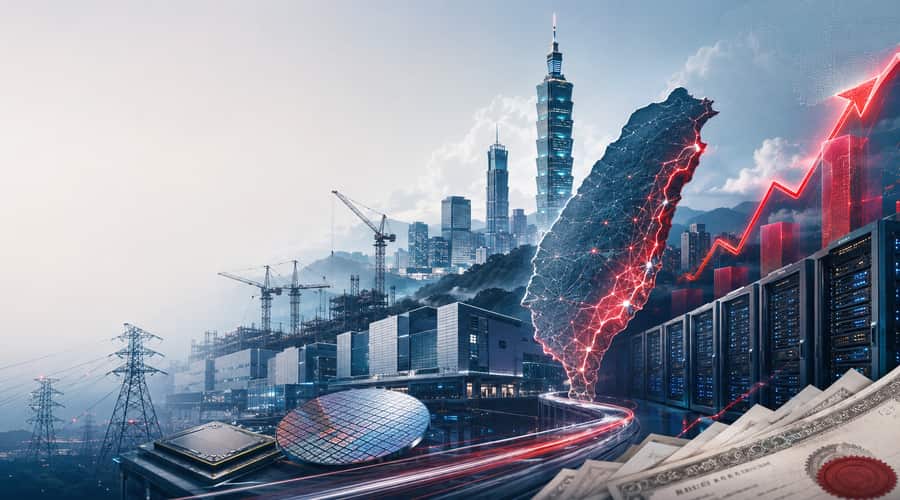
Taiwan's tech lenders are carrying more AI risk than the stock market suggests. The money is flowing into servers, chips, and factory capacity, and the leverage is adding up fast.
Taiwanese tech firms have now completed a record 14.5 billion dollars of debt deals so far this year, according to Bloomberg data published on May 27, a sign that the island's AI exposure is no longer just an equity story. The borrowing wave is being driven by chipmakers, server builders, and component suppliers that need fresh capital to keep up with orders from global AI customers.
The number matters because Taiwan sits at a critical point in the AI supply chain. Nvidia, Microsoft, and OpenAI depend on Taiwanese firms to fabricate chips and build servers, and that dependence is pushing procurement costs and capital spending higher across the industrial base, as the Business Times reported from Bloomberg. In other words, the AI boom is no longer just lifting the largest names, it is pulling smaller suppliers into a wider funding race.
The clearest sign of that shift is the mix of financing. Of the 14.5 billion dollars raised so far, loans account for 6.2 billion dollars, convertible bonds for 5.9 billion dollars, and corporate notes for 2.4 billion dollars, according to Bloomberg-compiled data cited by the Business Times. That blend tells you firms are using every available channel to fund inventory, new facilities, and production upgrades while demand remains hot.
It is also a faster pace than last year. The borrowing volume is nearly double the 7.5 billion dollars raised in the same period in 2025, and the pipeline still has room to expand, Bloomberg said. That matters for investors because once companies start financing growth with more debt, the market has to think not only about revenue upside but also about refinancing risk, margins, and how much of the AI cycle has already been pulled forward.
Randy Abrams, head of research at UBS Taiwan, told the Business Times that AI has substantially scaled up the value and complexity of traditional server hardware. That is a useful frame for the current moment. The hardware is more expensive, the lead times are tighter, and the working capital burden is rising even before a finished product ships.
For the biggest players, internal cash still does a lot of the work. TSMC, the world's largest chipmaker, can lean on operating cash flow to support capex. Smaller firms do not have that luxury, which is why the debt market has become such an important release valve for the rest of the ecosystem.
Who is borrowing and why
Hon Hai Precision Industry, best known globally as Foxconn, has become one of the most visible examples. Bloomberg said it has an up to 1.5 billion dollar convertible bond in the pipeline to fund procurement of materials from overseas, following a 1.1 billion dollar-equivalent loan in February. Hon Hai now expects AI hardware to be its key growth driver this year, and AI has already overtaken smartphones as its biggest contributor to sales, according to the Business Times report.
Other names show how broad the trend has become. Giga Computing Technology, which makes high-end AI servers, has launched its first syndicated loan as it looks to raise about 1 billion dollars. Its parent, Gigabyte Technology, recently sold 500 million dollars of convertible bonds. Phison Electronics, a memory controller supplier, wrapped up a 400 million dollar facility in about a month, faster than the six weeks that are typical for most Taiwanese loans, a sign that lenders still see enough AI demand to move quickly.
Matthew Liaw, head of structured finance at CTBC Bank, told the Business Times that many Taiwanese tech firms will require significant capital to contribute to global AI development, and that syndicated loans are expected to grow substantially. That is the key investor question now. If lending keeps widening, Taiwan's AI machine can keep feeding the global buildout. If the cycle cools, the same leverage could become a drag.
The broader backdrop is still supportive. Bloomberg has previously reported that Taiwan's stock market has surged on the back of the AI rally, with TSMC and Hon Hai among the biggest beneficiaries. But the debt side of the story is where the more delicate capital allocation decisions are being made, because borrowing hardwires expectations into balance sheets long before the payoff is certain.
There are also external risks. Bloomberg noted concerns over geopolitical tensions and shifting trade policy, both of which could disrupt funding flows and equipment plans. That is the part investors should watch most closely: not whether AI demand exists, but whether the financing structure built around it can survive a slowdown in orders, a delay in delivery, or a reset in spending by the biggest buyers.
For startup and VC readers, the lesson is straightforward. AI infrastructure is not only being funded by the megacaps on the demand side, it is being leveraged across the suppliers that make the whole system work. That makes Taiwan one of the clearest places to watch how much financial stress the AI boom is quietly accumulating, even while the headlines still focus on valuations and stock gains.
Also read: JPMorgan Signals Up To 20B War Chest, Threatens Fintech M&A Landscape • Nvidia's Taiwan bet shows where AI chips still really live • MCP security flaws are turning AI infrastructure into a supply-chain risk