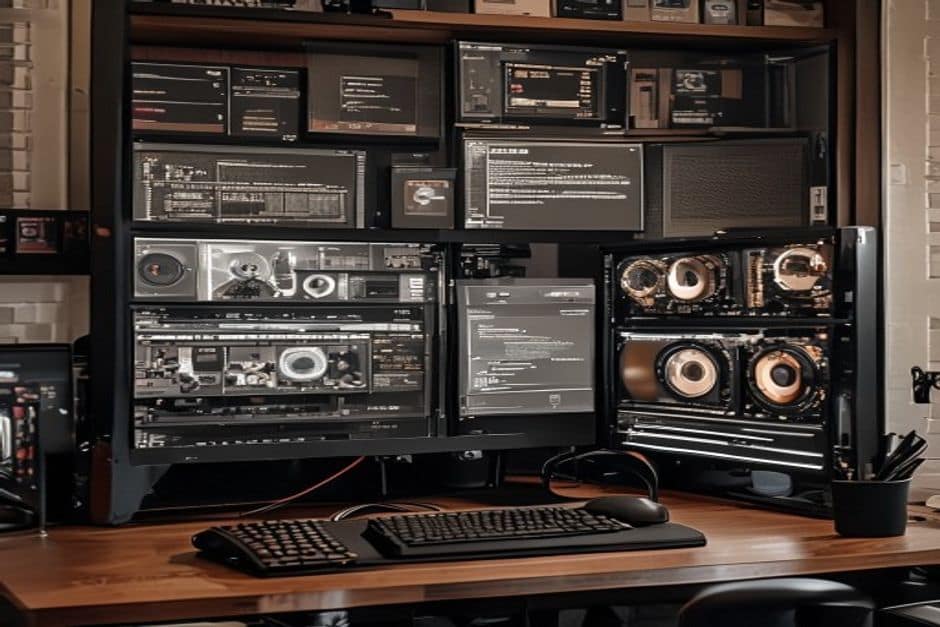
An r/LocalLLaMA analysis of the 100 most popular hardware configurations appearing on Hugging Face shows that local AI deployment is still heavily concentrated around Nvidia consumer and prosumer cards, with 24GB VRAM being the dominant tier and dual RTX 4090 setups appearing in enough configurations to be considered the current power-user standard, giving founders a practical baseline for understanding the hardware floor that local inference actually requires.
The Hugging Face data is useful precisely because it reflects real-world deployment rather than vendor marketing or benchmark claims. When a user runs a model and publishes results, their hardware configuration is often logged and visible. The LocalLLaMA post aggregated those configurations across the 100 most popular models and found a clear concentration pattern. Single RTX 3090 and RTX 4090 cards dominate the accessible end of the distribution, serving users running 7B to 13B parameter models. Dual RTX 4090 setups appear frequently for users running 30B to 70B parameter models who need 48GB of combined VRAM. A smaller tier of server-grade hardware, including A6000 and A100 configurations, handles the largest open models and professional deployments. Apple Silicon appears in the mix but less prominently than the community discussions on the topic might suggest, concentrated in Mac Studio and MacBook Pro setups where unified memory gives 16GB to 64GB VRAM equivalents without a discrete card.
The 24GB VRAM tier matters because it is the crossover point where model quality gets genuinely useful and hardware cost stays under $2,500 for a single card. A single RTX 4090 at current market prices runs between $1,800 and $2,200 depending on the model and vendor. That buys 24GB of GDDR6X memory with 1,008 GB/s bandwidth, which is enough to run 7B and 13B parameter models at full precision and quantised versions of 30B models. For a developer doing serious local AI work, that is the minimum credible setup for anything beyond experimentation. Two of them at 48GB combined is the setup that makes the current generation of large open models practical without paying cloud API rates. A dual 4090 workstation with a capable CPU and 64GB of system RAM can be built for around $6,000 to $8,000 fully configured.
The market has not standardised around AMD despite community momentum for alternatives. Nvidia cards appear in roughly 85 to 90 percent of the documented configurations in the LocalLLaMA analysis, with AMD RX 7900 XTX and RX 7900 XT appearing in a small but growing minority. The AMD cards offer 24GB of VRAM at a lower price point than the 4090, and ROCm support has improved enough that most popular inference frameworks now run on AMD hardware. But the software ecosystem advantage still sits firmly with Nvidia. CUDA compatibility is essentially universal across inference tools, quantisation libraries, and fine-tuning frameworks. AMD users occasionally encounter missing operator support or slower execution on specific kernels. For a developer who wants to set up and iterate quickly, Nvidia is still the path of least resistance even if AMD cards are cost-competitive on hardware specifications alone.
For AI startup founders, the hardware distribution data connects directly to product and pricing strategy. If most local AI deployment is happening on single or dual 4090 setups, then the models, quantisation approaches, and inference tools that work well on those configurations represent the practical product target for anyone building local-first products. A model that requires 80GB of VRAM might be impressive but reaches a tiny fraction of the actual deployment base. A model that runs well on a single 4090 with 24GB VRAM has a market of hundreds of thousands of developers who already own that hardware or can credibly acquire it. The Hugging Face configuration data is therefore a market sizing tool as much as a technical reference.
The inference economics are also clarifying. A dual 4090 workstation amortised over three years costs roughly $220 to $270 per month including power, which for a startup running moderate local inference workloads is competitive with API costs that can reach $500 to $3,000 per month depending on usage volume and model size. The breakeven point shifts depending on query volume and the mix of model sizes, but the principle is clear: at any meaningful inference volume, local hardware becomes cost-competitive with hosted APIs within a year. The variable that founders consistently underestimate is the engineering time required to manage local inference infrastructure, which adds overhead that pure API users do not face. The honest comparison includes that cost.
The hidden constraint the LocalLLaMA analysis surfaces is supply and availability. RTX 4090 cards are in limited supply in some markets, used prices have risen as the local AI community has grown, and the next generation of consumer Nvidia hardware has not yet arrived in volume. Founders planning a hardware-first local inference strategy should budget for procurement delays and price premiums, especially if they need multiple units. That constraint does not invalidate the strategy but it means hardware planning needs to start earlier than the software work, which is a shift from how most software-trained founders think about infrastructure.
Also read: Work is descending to meet machines, and the moat belongs to whoever redesigns the process first • Apple's Mac Studio memory cuts are squeezing the local AI builders who made it a workstation • Morgan Stanley's low-fee crypto pilot on E*Trade means the normalization race has reached mainstream retail brokerage