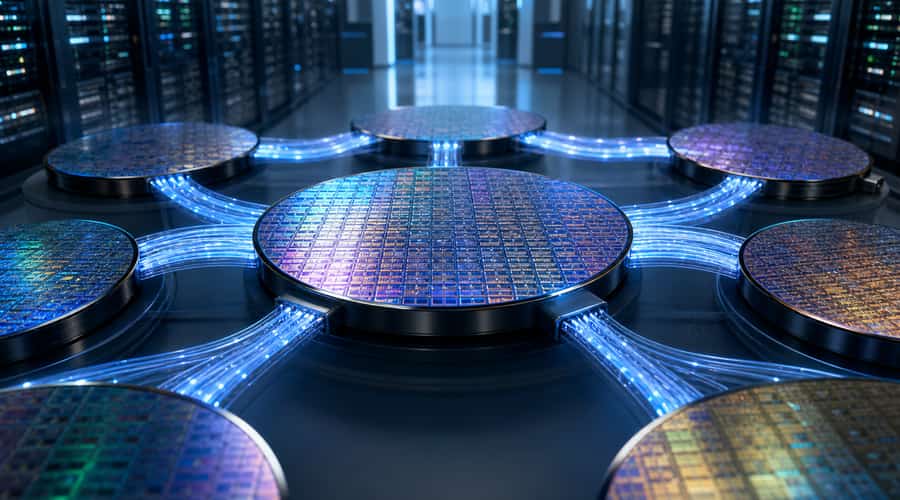
Tower Semiconductor has turned AI data center demand into hard silicon photonics commitments, and that changes how investors should think about the next bottleneck in AI infrastructure.
The AI buildout is no longer just a story about who can buy the most GPUs. Tower Semiconductor just reminded the market that moving data between those processors may be just as important as the processors themselves.
The Israeli analog and mixed-signal foundry said on May 13, 2026 that it had signed silicon photonics contracts worth $1.3 billion for 2027 revenue with its largest customers. It also said it had received $290 million in customer prepayments to reserve capacity, a detail that matters because it turns future demand into something much closer to a financial commitment.
According to Reuters, Tower also forecast second-quarter revenue of $455 million, ahead of the roughly $436.4 million expected by analysts surveyed by LSEG, after reporting first-quarter revenue of about $414 million. The company reiterated its 2028 model of $2.8 billion in annual revenue and $750 million in net profit, putting a clearer frame around how much AI infrastructure demand it believes can capture.
That gives this announcement a wider meaning than one strong quarter. AI infrastructure is moving into a phase where the scarce assets are not only Nvidia accelerators, high-bandwidth memory, or power contracts. The optical links, modulators, and foundry capacity that keep clusters working as one machine are becoming strategic assets in their own right.
Silicon photonics uses light to move data at high speed, which is exactly what data centers need as AI clusters become larger and more demanding. Training and inference systems are now vast networks of compute, memory, and switching infrastructure that must move data quickly without wasting too much power.
This is where Tower has found its opening. The company is not trying to compete with Nvidia in GPUs or with TSMC at the bleeding edge of logic manufacturing. It is using its position in specialty analog foundry services to serve the parts of AI infrastructure that are less glamorous but increasingly difficult to ignore.
Tower said its silicon photonics customer base includes more than 50 active customers, with demand across pluggable optical transceivers, near-packaged optics, co-packaged optics, optical circuit switches, and other next-generation data movement technologies. That range is important because it suggests the opportunity is not tied to one product cycle alone. The industry is testing multiple ways to move more bandwidth closer to compute while reducing heat, latency, and power loss.
For startups, this is a useful signal. The AI infrastructure market has become crowded with model companies, cloud wrappers, and software tools promising productivity gains. But the companies sitting deeper in the physical stack may have more defensible leverage if they solve constraints that hyperscalers cannot work around easily.
Prepayments change the risk profile
The $290 million in customer prepayments is the most telling part of Tower's announcement. Customers do not usually hand over that kind of money unless they are worried about access. Capacity reservation is a market signal, and in this case it tells us that silicon photonics supply is valuable enough for buyers to secure it years ahead of delivery.
That changes the risk profile for Tower, but it does not remove the execution risk. The company still has to expand capacity across its multi-fab footprint and deliver against a market that can be unforgiving when supply ramps miss timing, quality, or cost expectations. Semiconductor commitments look impressive on paper, but the hard part is turning those commitments into shipped wafers and profitable volume.
Still, the structure is meaningful. Prepayments can help fund expansion, improve visibility, and reduce the uncertainty that often surrounds foundry investments. That matters for investors because specialty manufacturing usually requires heavy capital spending before revenue arrives. When customers share some of that burden, the business becomes easier to underwrite.
The 2028 target also puts pressure on the company. A path to $2.8 billion in annual revenue and $750 million in net profit implies not only strong demand, but disciplined execution and margin expansion. If Tower hits those numbers, it will strengthen the case that AI infrastructure is creating a broader semiconductor cycle, one that rewards companies beyond the most obvious chip names.
There is also a lesson here for founders building around AI hardware. The best opportunities may not be in chasing the front of the hype cycle, but in finding the constraint everyone else depends on. That could be optics, packaging, power management, testing, thermal systems, or software that makes complex hardware easier to deploy.
AI clusters are becoming industrial systems, not just computing systems. They need supply chains, financing models, long-range capacity planning, and partners that can deliver specialized components at scale. Tower's announcement shows how quickly those hidden layers can become valuable once demand becomes urgent.
The market will now watch whether these silicon photonics contracts translate into sustained revenue growth through 2027 and 2028. If they do, Tower will have shown that the AI economy is not only built by the companies making the chips everyone talks about. It is also built by the companies that make those chips useful inside real data centers.
Also read: AI is rewriting utility leverage in Lake Tahoe's power fight • Five Unconventional Tactics to Unlock LinkedIn Growth and Revenue • TextGen turns local AI into a desktop product developers can trust