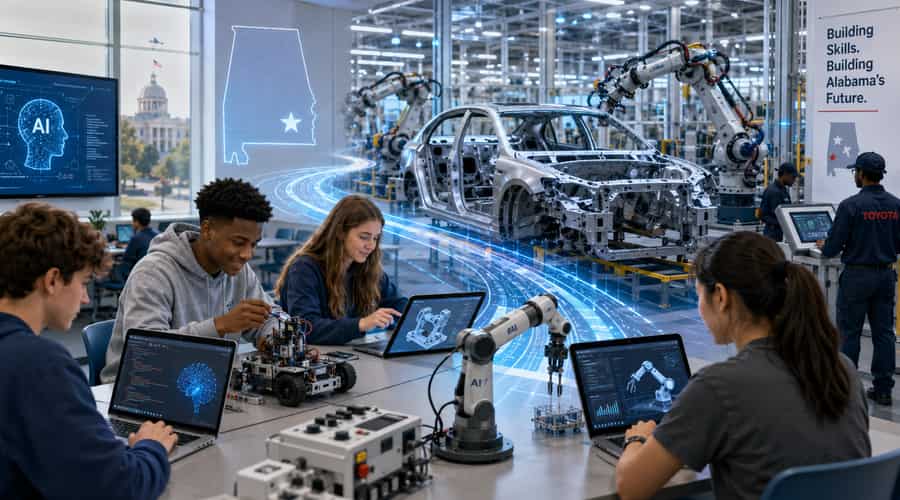
As AI puts pressure on white-collar work, Toyota and Huntsville educators are making a different bet: train teenagers for technical jobs that still need human hands, judgment and real-world problem solving.
The most interesting AI workforce story this week is not coming from a software company. It is coming from a career tech center in Huntsville, Alabama, where high school students are learning industrial maintenance skills tied directly to Toyota's local labor needs.
As Fortune reported, the Huntsville Center for Technology is a new $40 million facility where roughly 700 students leave their regular high schools for part of the day to get industry-standard training. Its Inditech program was developed with Toyota Alabama and backed by Toyota USA Foundation support, part of a broader company commitment to STEM and career pathways in Huntsville City Schools.
The pitch is simple and unusually concrete. Students can train toward industrial maintenance roles where, with a two-year degree and a few years of experience, pay can rise above $40 an hour. That is not a theoretical promise about future employability. It is a practical route into work that keeps modern plants running, from robotics and sensors to mechanical systems that still need trained people nearby.
Manufacturing has a problem that AI will not solve on its own. Deloitte and the Manufacturing Institute have warned that the U.S. could need 3.8 million manufacturing workers by 2033, with about 1.9 million roles at risk of going unfilled if current workforce gaps continue. That is why programs like Huntsville's matter beyond one school district.
Toyota Alabama is not a small local employer testing a nice community project. The Huntsville plant assembles nearly half of Toyota's engines in North America, employs more than 2,400 people and has drawn more than $1.7 billion in current investment. In October 2025, Toyota said new differential production lines were tied to a $282 million investment and 350 additional jobs.
That makes the school partnership less like charity and more like supply chain planning. A factory can buy new equipment, automate inspection and add smarter software, but it still needs people who can diagnose a machine that stops at 2 a.m. The more advanced the plant becomes, the more expensive it is when those people are missing.
This is the part of the AI debate that often gets lost. Automation does not remove labor from the economy in a clean line. It changes which labor has leverage. Entry-level office work, coding tasks, research support and customer service can be compressed by software. Skilled technical work, especially work tied to physical systems, becomes harder to replace and more valuable when the surrounding operation gets more automated.
Local pipelines are moving faster than national policy
California is taking the policy route. On May 21, 2026, Gov. Gavin Newsom signed an executive order directing state agencies to prepare for potential AI-driven labor disruption, including recommendations on job training, worker supports and possible updates to California's WARN Act. Lawmakers have also been looking at proposals such as SB 951, which would require notice when AI or automation causes technological displacement.
That approach matters because AI job losses will not be limited to one region or one industry. But legislation tends to move at the speed of studies, hearings and agency recommendations. Huntsville is moving at the speed of local hiring needs. Toyota needs industrial maintenance talent, the school district needs stronger career pathways, and students need a reason to believe training will lead somewhere real.
There is a lesson here for founders and executives. If AI is part of your productivity strategy, workforce planning cannot be an afterthought. It is not enough to say displaced workers will be retrained later. The institutions that produce replacement skills are often local, fragmented and underfunded. Companies that wait for a federal system to appear may find themselves competing for the same thin pool of technicians, electricians and automation specialists.
The Huntsville model will not copy perfectly everywhere. It depends on a large employer, an aligned school district and enough student interest to keep the pipeline alive. It also does not answer the harder question of what happens to white-collar workers already in the labor market, especially those whose jobs are being automated faster than they can retrain.
Still, it points to where the economy is heading. The safest careers in an AI-heavy world may not be the ones furthest from technology. They may be the ones closest to machines, infrastructure and production systems that software can assist but cannot fully own. For businesses, the next advantage may come from treating human capital with the same seriousness as automation. For students, the old college-or-bust story is starting to look less complete.
Also read: CEOs expect AI to trigger layoffs within two years • Disney's facial recognition lawsuit puts biometric AI startups on notice • Nvidia is watching Huawei turn China into an AI chip market