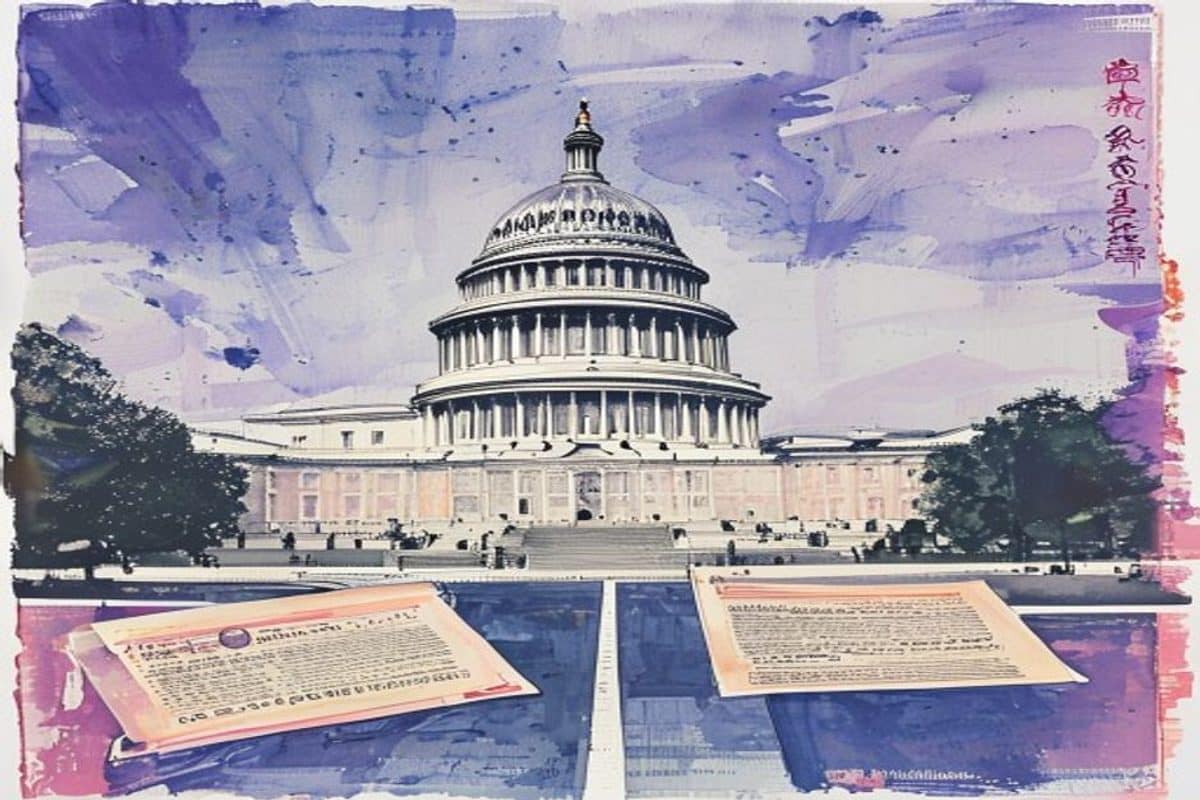
The CLARITY Act passed the House in July 2025 but stalls in the Senate as $TRUMP memecoin ethics scandals give Democrats political cover to block legislation that the industry urgently needs.
The Digital Asset Market Clarity Act is the most consequential crypto legislation ever drafted in the United States. It passed the House Financial Services Committee with bipartisan support in July 2025, classifying digital assets into three distinct categories, handing spot market authority over digital commodities to the CFTC, and giving the SEC a narrower but clearer role in primary market fundraising. It is the kind of structural legislation that crypto companies, institutional investors, and exchange operators have spent years lobbying for. And it is now in serious trouble, not because of policy disagreements, but because Donald Trump decided to host a private dinner for top holders of his personal memecoin at Mar-a-Lago.
The April 25 event, reportedly attended by Trump himself after initial scheduling uncertainty, brought together the largest wallets holding $TRUMP tokens for what organizers billed as exclusive access to the President. Democrats immediately framed it as pay-to-play: purchase enough of a token that generates transaction fees for Trump's family, and you earn face time with the most powerful man in Washington. Three Democratic senators wrote to the White House warning that organizers were promoting presidential access as an incentive for purchasing a speculative token, and that this crossed a clear ethical line.
Charles Hoskinson, co-founder of Cardano and one of crypto's most prominent voices, put the stakes bluntly on Reddit: the CLARITY Act will kill American crypto if the Trump memecoin scandal derails it. His position is not that the bill is bad. It is that Trump's personal financial entanglements are handing opponents a weapon to block legislation that would otherwise likely pass.
The bill's framework is straightforward and long overdue. Bitcoin and Ethereum, defined as assets intrinsically linked to a blockchain whose value derives from use of that network, become digital commodities under CFTC jurisdiction. The CFTC gains comprehensive oversight of spot and cash markets, including registration requirements for exchanges, brokers, and dealers. The SEC retains authority over initial token sales and investment contract assets, which is where most of the securities law risk in crypto actually sits. Stablecoins are handled as a separate category under shared oversight.
For developers and startups, this matters enormously. Right now, any token could theoretically be reclassified as a security by an SEC enforcement action regardless of how it functions. The CLARITY Act removes that ambiguity for the broadest category of assets and creates a regulatory path that does not require hiring a team of securities lawyers to navigate. Coinbase's Brian Armstrong publicly endorsed the bill. Treasury Secretary Scott Bessent called for a Senate Banking Committee markup. David Sacks, former White House crypto and AI advisor, urged the Senate to act before the window closes.
The political trap
Galaxy Research confirmed in an April 23 update that comprehensive market structure legislation is entering its endgame phase, with a markup potentially scheduled before May. But the legislative calendar is the smaller problem. The larger one is that Trump's crypto empire, which now includes $TRUMP memecoin, DeFi protocol World Liberty Financial, and American Bitcoin co-founded by his sons, gives Democrats a principled reason to demand ethics provisions that the administration is unwilling to accept.
House Democrats introduced the Stop TRUMP in Crypto Act in 2025, which would bar the president, vice president, and members of Congress from owning or trading digital assets while in office. That bill has no chance of passing, but it does not need to. Its purpose is to frame any vote against ethics provisions as a vote for presidential self-dealing. Representative Maxine Waters formally requested additional hearings on Trump's crypto dealings before any CLARITY Act markup. That request alone can pause progress indefinitely.
Senator Tim Scott acknowledged in November 2025 that Democratic stalling had already pushed the bill into 2026, warning that delays past May risk pushing the timeline past the midterm elections entirely. If that happens, the bill dies with the 119th Congress and the process starts over in a new political environment where crypto may have lost its momentum.
What this means for startups
Regulatory clarity is not an abstract governance question for early-stage crypto companies. It determines whether they can raise institutional capital, list tokens without SEC risk, hire compliance teams, and access banking services. Every month the CLARITY Act stalls is a month that US-based projects operate under rules that competitors in Europe, Singapore, and the UAE do not face. The $TRUMP dinner did not create the political opposition to crypto regulation. It just gave that opposition a sharper weapon. Watch the Senate Banking Committee calendar, the ethics negotiation, and whether the White House is willing to accept constraints on presidential crypto holdings in exchange for getting the broader bill done.
Also read: Talkie 13B speaks only in pre-1931 English, testing AI's ability to invent the modern world • Xiaomi's MiMo V2.5 Pro open-source release brings hardware giant into AI model race • Accenture deploys Microsoft Copilot to 743,000 staff in the largest enterprise AI rollout yet