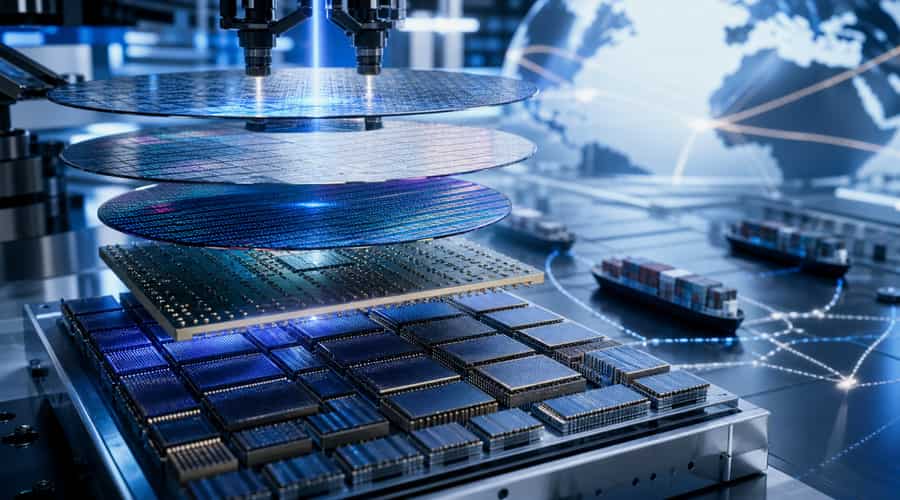
TSMC has raised its view of the global chip market because AI is no longer just a software story. The next fight is over wafers, packaging capacity and who controls the factories behind the boom.
TSMC has put a much bigger number on the AI buildout. The Taiwanese company now expects the global semiconductor market to exceed $1.5 trillion by 2030, a sharp step up from its previous $1 trillion outlook and a clear sign that the industry's center of gravity has moved from consumer devices to high-performance computing.
That matters because TSMC is not just another chip company making a bullish forecast. It is the world's largest contract chipmaker and the manufacturing partner behind many of the most important processors used by Nvidia, Apple, AMD, Qualcomm and other technology companies. When TSMC changes its long-term view, it is effectively telling the rest of the market what kind of demand its most powerful customers are asking it to prepare for.
According to Reuters, the company laid out the new forecast in materials for its May 14 technology symposium in Hsinchu, where it said AI and high-performance computing should account for 55% of the 2030 semiconductor market. Smartphones are expected to represent 20%, while automotive applications are expected to make up 10%.
That split says plenty about where the money is going. Smartphones remain enormous, but they are no longer the main growth engine. Cars are becoming more semiconductor-heavy, especially as electric vehicles, driver-assistance systems and in-car software expand. Yet the biggest prize is now the infrastructure behind AI models: accelerators, networking chips, high-bandwidth memory interfaces, advanced logic and the packaging technologies that allow these parts to work as one system.
For the last two years, much of the AI conversation has focused on models, users and applications. That was useful, but incomplete. The physical constraint is becoming more visible. You can have demand for every AI assistant, search tool, coding product and enterprise automation system imaginable, but none of it scales without enough advanced chips.
TSMC's expansion plan makes that point clearly. The company said it plans nine phases of wafer fabs and advanced packaging facilities in 2026. It also expects capacity for 2-nanometer and A16 technologies to grow at a 70% compound annual growth rate from 2026 to 2028. These are not casual upgrades. They are the manufacturing base for the next generation of AI and high-performance computing products.
The packaging side may be just as important as the transistor side. TSMC's CoWoS advanced packaging capacity is forecast to grow at more than an 80% compound annual growth rate from 2022 to 2027. CoWoS has become a critical part of the AI supply chain because powerful processors need to sit close to high-bandwidth memory. The bottleneck is not only whether a chip can be made. It is whether a whole AI system can be assembled in volume.
This is why the forecast is useful beyond the headline number. A $1.5 trillion semiconductor market by 2030 would not simply mean the world is buying more chips. It would mean the industry has successfully shifted capital, talent, tooling and geopolitical attention toward the hardest parts of advanced manufacturing.
The bubble question is still real
There is a reasonable concern here. AI infrastructure spending has climbed quickly, and fast investment cycles can get ahead of real usage. Cloud companies are spending heavily, chipmakers are expanding capacity, and investors are rewarding every company that can credibly say it sits in the AI supply chain. That kind of momentum can create excess.
But TSMC's forecast also points to a more durable case. AI chips are not like a single consumer electronics cycle where demand rises and then fades after a product refresh. The largest buyers are building data centers that need repeated generations of processors, memory, networking and power-efficient designs. If model training, inference, robotics, enterprise automation and sovereign AI programs continue to grow, the need for advanced manufacturing will not disappear after one spending wave.
The risk is timing. Capacity can arrive just as demand pauses. Customers can double-order when supply is tight. Governments can subsidize factories that make political sense but not economic sense. Export controls can shift where chips are sold and which customers can access the most advanced nodes. In semiconductors, even strong long-term demand can still produce painful short-term corrections.
TSMC is also operating in a world where manufacturing itself has become strategic. Taiwan's role in global chip production gives the company unmatched importance, but it also puts the industry's biggest growth story close to one of the world's most sensitive geopolitical fault lines. New capacity in places such as the United States, Japan and Europe can reduce some concentration risk, but leading-edge production is difficult to duplicate quickly.
For startups and technology companies, the practical takeaway is simple. AI capability will increasingly depend on access to compute, and access to compute will depend on a supply chain that is expensive, concentrated and technically demanding. The winners will not only be the companies with the best models. They will be the companies that can secure reliable hardware economics as everyone else fights for the same capacity.
TSMC's $1.5 trillion call is therefore less a victory lap than a warning. The AI market may still produce bubbles in valuation and spending, but the manufacturing race underneath it looks very real. Watch the next few years of fab construction, CoWoS expansion and 2-nanometer ramp schedules closely. That is where the confidence behind the AI boom will either be proven or tested.
Also read: Huang Foundation turns AI compute into a new kind of influence • OpenAI shows why coding agents need real Windows sandboxes • Americans now prefer nearby nuclear plants to AI data centers