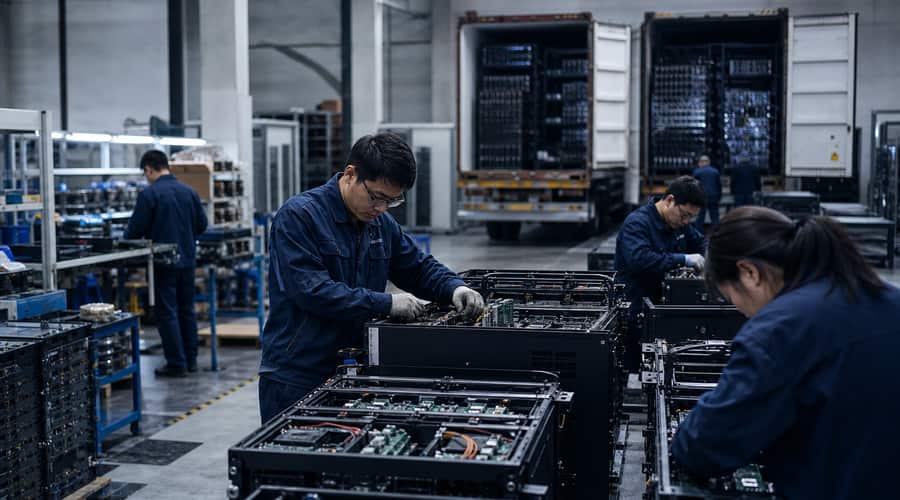
A student project from the University of Toronto claiming 50,000 tokens per second from a small language model running on FPGA hardware is worth reading less as a benchmark curiosity and more as a signal about where the inference cost and latency conversation is heading for startups building AI-dependent products.
The number is striking enough to generate attention, but the context around it determines whether it represents a genuinely transferable architectural lesson or a controlled demonstration on a toy-scale model that does not survive contact with real deployment requirements. A team of students at the University of Toronto built a MicroGPT-style implementation on FPGA hardware and reported throughput in the range of 50,000 tokens per second. The FPGA in question, the model size, and the precise conditions under which that throughput was measured are the details that separate an impressive academic project from a result that should influence how founders and infrastructure engineers think about inference hardware choices. FPGAs can be configured to execute specific computational patterns with very high efficiency, which means throughput figures from FPGA implementations often reflect the performance of a narrow, well-optimized pipeline rather than the general-purpose inference capability that a production deployment requires. That is not a criticism of the project. It is the context without which the number is not interpretable.
What makes the project worth taking seriously regardless of those caveats is its timing. Inference economics have moved from a background consideration for AI infrastructure teams into a primary constraint on product viability for a growing number of startups. The cost of running a capable language model at scale, measured in tokens per dollar and latency per query, now shapes product decisions about feature scope, pricing, and margin in ways that were not relevant when only a handful of well-capitalized companies could deploy AI at all. As those economics have tightened, the field of inference hardware alternatives has expanded beyond the GPU-centric model that dominated the first generation of AI deployment. Custom silicon from companies like Groq, Cerebras, and Tenstorrent has demonstrated that purpose-built inference chips can deliver throughput and latency profiles that general-purpose GPUs cannot match on specific workloads. FPGAs occupy a different position in that landscape: more flexible than ASICs, more programmable than custom silicon, and significantly cheaper at low volume than either, which makes them a natural tool for students, researchers, and engineers trying to demonstrate architectural ideas without access to large hardware budgets.
The practical case for FPGAs in AI inference has existed for several years and has found traction in specific niches: ultra-low-latency financial trading systems, real-time signal processing, and edge deployments where power consumption constraints rule out GPUs and the application is narrow enough that the FPGA's programmability can be fully exploited for the target workload. Microsoft's Project Brainwave, which used FPGAs in Azure data centers for accelerated inference, demonstrated that the approach can work at cloud scale with the right engineering investment. The challenge has always been programmability: optimizing an FPGA for a specific model architecture requires specialized hardware description language skills that are scarce relative to the pool of engineers who can optimize GPU-based inference using CUDA or ROCm. That scarcity is a real deployment barrier that a compelling throughput figure does not dissolve.
The model size question is equally important for assessing transferability. A MicroGPT-style model at the scale likely used in a student project, probably in the range of tens of millions to low hundreds of millions of parameters, is several orders of magnitude smaller than the models that matter for most production AI applications. Inference throughput scales differently across hardware architectures as model size increases, and a throughput advantage that is dramatic at small model scales can narrow or reverse at the sizes required for genuinely capable output. The 50,000 tokens per second figure is meaningful if it reflects architecture and pipeline choices that remain advantageous as model scale increases. It is primarily a demonstration of what is possible at one specific operating point if the advantage is specific to toy-model scale.
Why inference economics are the right lens for startup founders
The reason this project matters for founders is not that FPGAs are about to replace GPUs in AI infrastructure. They are not. The reason it matters is that it is one more data point in a converging set of signals about the value available to teams that treat inference as an engineering problem worth solving rather than a cost to be managed through vendor selection. The companies with the largest inference efficiency advantages in 2026, Groq's LPU architecture, Cerebras's wafer-scale approach, and the various quantization and batching optimizations that the open-source inference community has developed around llama.cpp and vLLM, all emerged from deliberate engineering effort rather than from accepting the default compute architecture. The University of Toronto project is in the same tradition of that inquiry, and the students doing it are developing skills and intuitions about inference hardware that are genuinely scarce and commercially valuable.
For founders evaluating inference infrastructure, the practical implication is to treat hardware selection as a product decision rather than a procurement category. The right inference stack for a real-time voice application is different from the right stack for a batch document processing pipeline, which is different again from the right stack for an edge deployment on a device with a five-watt power budget. The FPGA result is a useful reminder that the design space is broader than the GPU-cloud-API default suggests, and that teams willing to explore it can find efficiency advantages that competitors optimizing within the default assumption set will not find. Whether the specific architecture in the Toronto project scales to production-relevant model sizes is a question that more detailed technical analysis of the project would help answer, and it is the question that anyone genuinely interested in the result should be asking the team directly.
Also read: The market for AI generation tools is maturing and the next wave of value is being built in provenance detection and reputation systems • California giving police the power to ticket Waymo is less about fines and more about who owns the liability when software breaks a traffic law • Australia's data center backlash is the social license problem that AI infrastructure spending cannot buy its way out of