A confrontation in a nursery parking lot has turned Utah's AI data center debate into something bigger than a zoning fight. The real issue is whether the next wave of compute can be built without losing public trust first.
Utah state Sen. Jerry Stevenson is now part of the story in a way no infrastructure backer wants to be. As ABC4 reported, reporter Bayan Wang was covering harassment claims involving Stevenson's J&J Nursery and Garden Center in Layton when Stevenson approached the crew, objected to the reporting and swiped at Wang's hand, knocking his phone to the pavement.
Layton police were called by a witness, a police report was filed, and officers later told the ABC4 crew that Stevenson apologized for the parking lot incident. The crew was also issued a trespassing notice barring it from the business property. That sequence, physical confrontation followed by an apology and a ban, is why a local fight over power, land and water has become a national warning for the AI industry.
The project behind the uproar is the proposed Stratos data center in Box Elder County, a massive facility backed by Kevin O'Leary and advanced through Utah's Military Installation Development Authority. County commissioners approved resolutions this week to enter an agreement with MIDA for a large data center in a rural area south of US-84. Stevenson sits on MIDA's board, which is one reason public frustration moved quickly from the project itself to the officials helping move it forward.
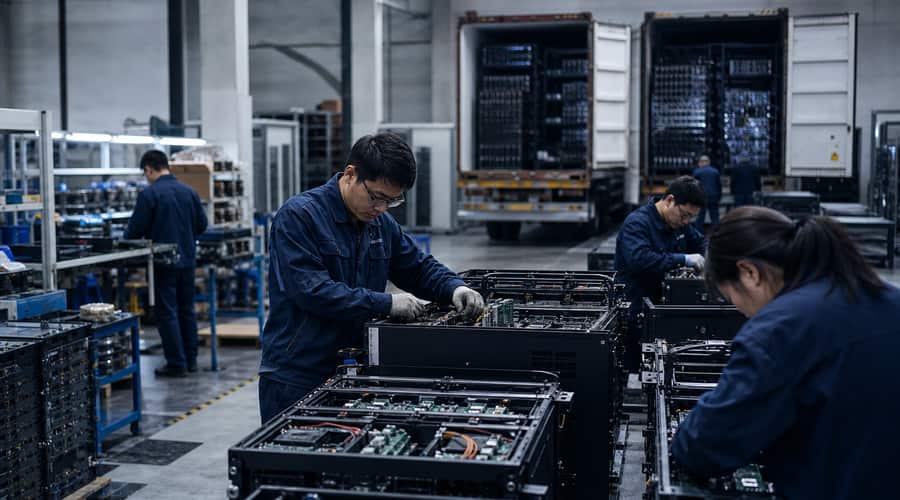
Data centers are usually sold as clean, modern infrastructure. They look like technology, not heavy industry. But AI has changed the scale. Stratos has been discussed as a project that could ultimately require up to 9 gigawatts of power, more than twice Utah's current average electricity use. Supporters have pointed to jobs, investment and national competitiveness in artificial intelligence. Critics see a rural county being asked to absorb industrial energy demand before residents have enough answers.
The Box Elder fight is not only about whether people like AI. It is about who pays for the physical systems AI needs. Compute expansion requires land, transmission, generation, cooling, backup power and permitting. When those costs arrive in a county meeting rather than a venture pitch deck, the conversation changes. Residents ask about air quality, water use, noise, traffic, tax treatment and what happens if projections are wrong.
That is where the Utah project became politically combustible. MIDA approved a sharply reduced energy tax rate for Stratos, moving from an authorized 6% rate to 0.5%, while state officials argued Utah was competing with other states for the project. To a developer, that may look like a necessary incentive. To residents who feel rushed, it can look like public leverage being spent before the public has been heard.
Power is the biggest flashpoint. Officials have said the project would generate its own electricity, with natural gas playing a central role. That may reduce one concern, direct competition with households on the existing grid, but it raises another one. A 9-gigawatt gas-backed buildout would put emissions, pipelines and long-term energy planning squarely into a county land-use decision. AI companies may think in model releases and GPU clusters, but local governments think in roads, aquifers and air permits.
Water adds another layer. Utah recently moved to require new data facilities to publicly disclose annual water use, a sign that lawmakers know the industry cannot grow on trust alone. Conservation groups still argue the state has not gone far enough, especially in rural areas where water scarcity is already part of daily planning. Even when developers promise closed-loop cooling or minimal withdrawals, residents now want public records, enforceable commitments and independent review.
Transparency is now part of the infrastructure
The Stevenson incident matters because it shows how quickly a transparency problem can become a reputational problem. The reporter was not there to attack nursery employees. The story, by ABC4's account, was about harassment the business was receiving after the data center vote. That should have been an opportunity to separate legitimate public anger from mistreatment of workers who had no direct role in the project.
Instead, the confrontation became a symbol of the very distrust surrounding the approval process. For AI infrastructure developers, this is the lesson. A project can have financing, political backing and a plausible technical plan, yet still run into trouble if the public process feels closed, accelerated or personally entangled with powerful officials. Once that perception takes hold, every permit, tax agreement and police response gets interpreted through it.
For startups, this is not distant local drama. Cheap and abundant compute is now a strategic input, and the AI companies that need it are depending on a physical buildout that must pass through county commissions, water boards, utility regulators and state authorities. If communities begin treating data centers as extractive industrial projects with weak public accountability, timelines stretch and costs rise. The capital markets can fund chips, but they cannot easily buy legitimacy.
There is still a path for projects like Stratos, but it runs through disclosure rather than speed. Developers need to publish credible power plans, explain water assumptions, show why tax incentives are justified and give residents a real forum before decisions are effectively locked in. Public officials need to keep their business interests, board roles and constituent responsibilities visibly separate.
The next phase of AI will not be decided only in labs or cloud contracts. It will be decided in places like Box Elder County, where people are being asked to host the physical machinery of artificial intelligence. The companies that understand that local politics is now part of compute strategy will have an advantage. The ones that treat community scrutiny as an obstacle may find that the hardest bottleneck is not silicon at all.
Also read: Anthropic's compute crunch shows AI demand has reached the physical world • Qwen makes local AI inference practical on consumer GPUs • ICE wants smart glasses to make facial recognition harder to ignore