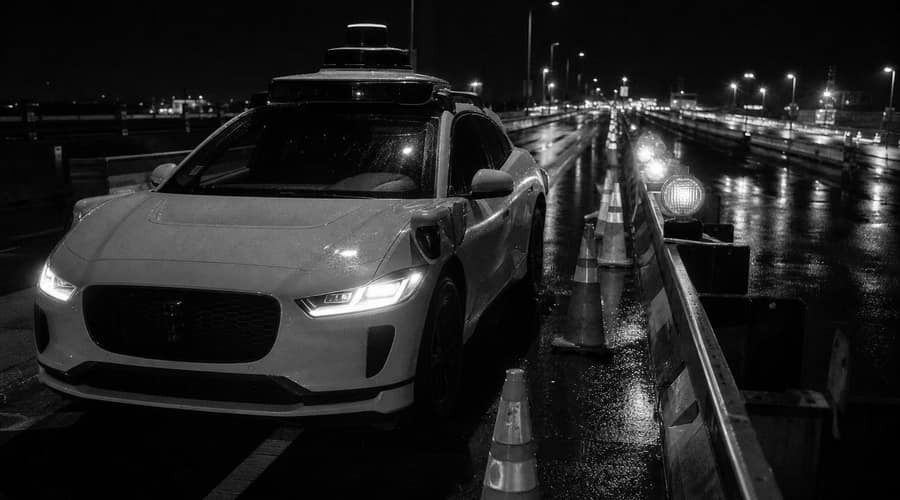
Waymo's latest recall is current, specific, and serious: 3,871 robotaxis are being kept off freeways after cars entered closed construction zones at speed.
Thirteen incidents. Six in Phoenix in April. Seven in the San Francisco Bay Area on May 18. Waymo's June recall is not a small software footnote, because the failure happened in the one place a robotaxi has to be boringly reliable: a live freeway, with cones, closure signs and workers somewhere nearby.
As CNBC and NHTSA reported, the defect affected 3,871 vehicles using Waymo's fifth-generation automated driving system. The cars could enter active freeway construction zones and keep moving at freeway speeds because the software either failed to recognize the closure or gave too much weight to other freeway hazards around it. No crashes or injuries were reported. That matters, but it doesn't make the filing harmless. A car doesn't need to hit anyone for regulators to see the risk.
Waymo has restricted freeway use while it works on a software fix and new operating protocols. Its robotaxis can still run on surface streets, so this is not a full shutdown. But if you've used a ride-hailing service in a spread-out city, you know what losing freeway access does. It turns a useful trip into a slower one, and it makes the service feel less like a transportation network and more like a neighborhood experiment.
Just over a month earlier, Waymo recalled 3,791 vehicles after one of its driverless cars drove into flooded road conditions on a high-speed roadway instead of stopping. That recall covered fifth and sixth-generation Waymo Driver systems, and NHTSA listed the defect rate across the affected population at 100%. A flood and a construction closure are different scenes. The common thread is the same: the road changed faster than the system handled.
That's the uncomfortable part for the robotaxi business. Construction zones move. Water collects under an overpass after a storm. A school bus stops where the map expected normal traffic. These are not rare science-fiction puzzles. They're ordinary driving messes, and the whole promise of autonomous vehicles is that the software can deal with them without needing a human to lean forward and take over.
Waymo's earlier safety actions make the pattern harder to wave away. In 2025, it recalled about 1,200 vehicles after collisions with stationary objects such as gates and chains. Before that, it recalled vehicles over improper behavior around stopped school buses, after incidents in places including Austin and Atlanta drew federal attention. Each case had its own technical cause. Still, you don't have to be hostile to autonomous driving to see the broader problem: real streets keep producing situations the system should have recognized sooner.
You can call one recall a bug. Four safety recalls since early 2024, as Wired counted it, start to look like a process problem. Waymo will say, fairly, that software-defined vehicles can be patched faster than conventional cars can be repaired. That's true. Over-the-air fixes are useful. But fast repairs are not the same as proving the hazards were caught early enough.
Regulators are building the record now
NHTSA is treating autonomous driving software defects like safety defects in any other vehicle. Good. A robotaxi company doesn't get a softer standard because the steering wheel is empty. The voluntary recall system also creates a public paper trail: what failed, how many vehicles were affected, what the company knew, and when it decided to act. Those filings are going to matter more as robotaxi services spread from test zones into everyday city traffic.
Competitors should be reading the same filings closely. Zoox, Amazon's autonomous vehicle unit, issued a voluntary recall in 2025 for 258 vehicles over unexpected hard braking. Cruise, after its 2023 San Francisco incident, lost the shape it once had as a public robotaxi challenger and was folded back into General Motors' broader driver-assistance work. The field is narrowing, but the standard is rising. Every recall teaches regulators what to ask the next company.
Waymo's size cuts both ways. It has more real-world miles than any U.S. robotaxi rival, and that gives it more data than a smaller operator can gather from a handful of cars. It also means more chances for the strange, ugly edge cases to show up in public. If you're the leader, your mistakes become the industry's case law.
Investors still appear willing to give Alphabet patience on Waymo. Barron's noted that Alphabet shares were not punished heavily after the latest filing, which tells you the market still sees Waymo as a long-term asset rather than a near-term profit engine. That patience has limits. A company can talk about future scale, but freeway restrictions remind riders and regulators that scale is not just adding cities, vehicles and app downloads. It is proving the cars can handle the dull hazards human drivers curse at every week.
Frankly, Waymo's strongest argument is also its biggest burden. The company is operating enough vehicles to find problems faster than anyone else. Now it has to show that it can find more of them before they reach the road. The software fix will come. The harder question is whether the next recall will look like a surprise, or like a lesson the company should already have learned.
Also read: Hyundai takes full control of Boston Dynamics as SoftBank exits for $325 million • Texas just rewrote the rules for connecting AI data centers to its power grid • Elastic's $85 million bet on DeductiveAI is a signal that AI-native ops tooling is now acquisition currency