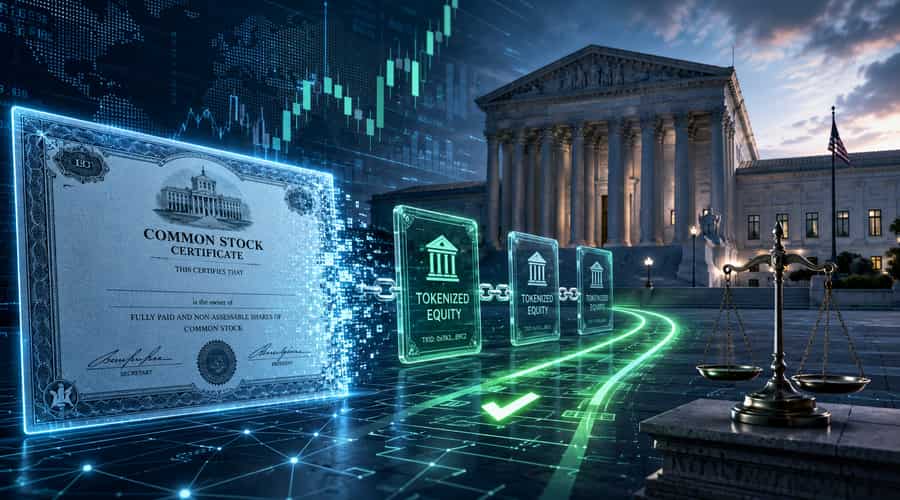
The SEC is moving toward a short-term exemption for tokenized stocks, and the most important fight is not about blockchain speed. It is about who gets to create a market tied to Apple, Nvidia or JPMorgan without the company giving permission.
The next big test for tokenized securities may arrive through a temporary SEC framework rather than a sweeping new law. Bloomberg reported this week that the agency is preparing an innovation exemption that could let regulated platforms offer tokenized versions of public stocks, including versions created by third parties without issuer consent. That is a meaningful shift because it would move tokenized equities from the edge of crypto speculation toward a supervised experiment in US market structure.
SEC Chair Paul Atkins set the stage on April 21, when he said the agency was on the cusp of releasing an innovation exemption that would give market participants a cabined way to facilitate on-chain trading in tokenized securities while longer-term rules are developed. The timing matters. Tokenization has been discussed for years, but the policy conversation has now moved from whether the SEC should allow it at all to what guardrails should apply first.
The issuer consent fight
The central question is simple: can a platform create a token tied to a public company stock without the company agreeing to it? In March, SEC Commissioner Hester Peirce asked directly whether a third party should have to obtain issuer consent before issuing tokenized versions of an existing company's equity securities. The reported answer inside the emerging framework appears to be no, though the final text has not yet been released.
That answer is what makes the exemption controversial. A tokenized Nvidia or Amazon product may track the price of the underlying stock, but it may not give investors the same voting rights, dividend treatment or legal relationship they would have through ordinary share ownership. Some models could be fully backed by shares held in custody. Others could use derivatives or synthetic exposure. To a sophisticated trader, those distinctions are manageable. To a retail investor, they can become confusing quickly.
The SEC's January statement on tokenized securities made that distinction important by separating issuer-sponsored tokens from third-party sponsored products. An issuer-sponsored model looks more like a company or its agent putting shares on-chain within the existing securities framework. A third-party model is different because the platform, not the company, creates the tokenized exposure. That is where questions about disclosures, custody, settlement, shareholder rights and investor expectations become unavoidable.
Brett Redfearn, president of Securitize and a former director of the SEC's Division of Trading and Markets, warned Bloomberg that if third parties can tokenize major stocks without issuers involved, there is no obvious limit to how many wrappers of the same company could exist. That is not a technical complaint. It is a market quality complaint. If multiple venues trade different versions of a stock-linked token, investors may struggle to know which price reflects the real market and which product carries the rights they assume they are buying.
The Blockchain Association has argued the other side in comments filed with the SEC. Its position is that requiring issuer consent would give public companies and incumbent market players too much control over secondary-market infrastructure. In that view, tokenization does not need to create a new security every time it creates a new way to represent an existing one. The more practical argument is that innovation often starts outside the institutions most comfortable with the current system.
What startups and exchanges are watching
For crypto infrastructure companies, the exemption could be a rare opening into regulated public equities. Firms such as Securitize, Backed, Ondo Finance and Superstate have spent years trying to make tokenized assets fit inside existing rules. A defined sandbox would not remove the compliance burden, but it could replace uncertainty with a clearer path for limited products, reporting obligations and investor protections.
Traditional finance is also positioning itself. The NYSE is working on blockchain-based trading for tokenized stocks and ETFs, while Nasdaq has been exploring structures that preserve more issuer control. Large institutions including BlackRock, JPMorgan and Franklin Templeton have already shown that tokenization is no longer just a crypto-native ambition. The real question is whether public equities can move on-chain without weakening the protections that make US stock markets unusually trusted.
That trust is why SIFMA and large trading firms have urged caution. The concern is not that blockchain settlement is inherently dangerous. It is that tokenized markets could develop without consistent standards for know-your-customer checks, anti-money-laundering controls, price transparency and market interconnection. If the SEC builds the exemption too loosely, it could create parallel markets that look innovative in a bull cycle and fragile in stress.
The exemption would also put offshore platforms on notice. Tokenized US equities already trade outside the United States, often in forms that give users price exposure without full securities-market protections. A US framework would create a legal route for domestic platforms, but it would also sharpen the line between compliant experimentation and unauthorized access to American investors.
For founders and investors, the next document from the SEC will matter more than the headlines around it. A 12 to 36-month sandbox could accelerate tokenized stock products, but only within the limits the agency chooses to set. Watch issuer consent, custody requirements, retail access and the treatment of synthetic products. Those details will decide whether tokenized stocks become a useful market upgrade or just another layer of complexity wrapped around companies investors already know.
Also read: Zafe Protocol is bringing private SOL transfers to Solana • Bankless co-founder David Hoffman sells all his ETH as the show enters a new era • SpaceX's S‑1 Reveals 18,712 Bitcoin, Quietly Turning the IPO Into a Crypto Moment