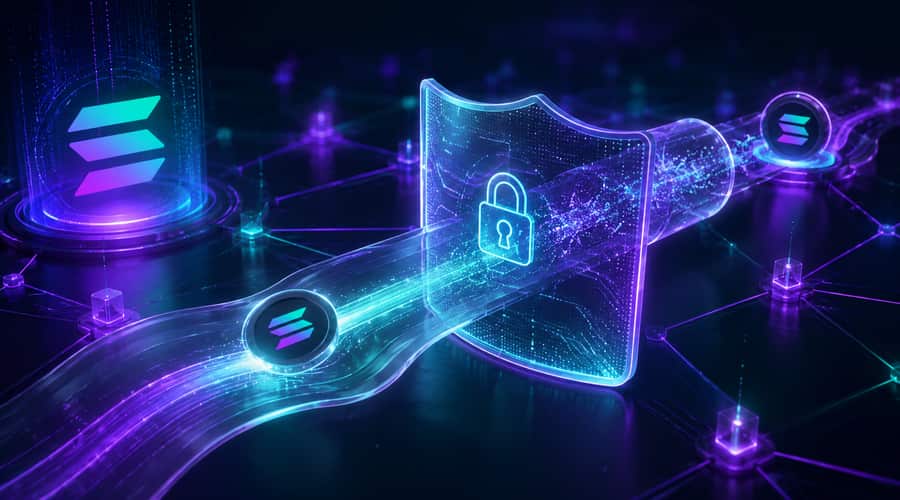
Zafe Protocol is pushing a simple argument into Solana's privacy debate: fast public chains still need private money movement.
Solana has spent years proving that blockchains can be quick, cheap and useful at consumer scale. The tradeoff is just as obvious. Standard wallet activity is public by default, which means payments, balances and transaction histories can be followed by anyone with a block explorer and a little patience.
URL of Zafe Protocol's official website https://zafe.network
Zafe Protocol is entering that gap with a privacy layer for SOL transfers. The project says users can deposit SOL into a vault and later withdraw to another wallet without leaving a visible on-chain link between the two addresses. That is the important part. It is not trying to make Solana faster. It is trying to make ordinary transfers less exposed.
The timing matters because privacy on Solana is no longer a side conversation. Solana's own documentation describes the network's current privacy limits clearly: confidential transfers can hide token amounts and balances, but account addresses remain public. That may be tolerable for some retail use. It becomes harder to defend when the use case is payroll, treasury management, trading strategy, donations or any payment where the sender does not want the whole market watching.
Transparency is useful when you want auditability. It is uncomfortable when every payment becomes a permanent public breadcrumb. A founder paying contractors from a known wallet can reveal cash flow. A trader moving funds before a position can show intent. A DAO contributor can accidentally expose personal holdings just by receiving compensation from a treasury address.
This is the weakness privacy projects keep returning to. Pseudonymity is not the same as privacy. A wallet may not carry a legal name at creation, but once it touches an exchange account, a public social profile, a payroll stream or a known business wallet, the surrounding history becomes much easier to map.
Zafe's proposed answer is based on zero-knowledge proofs. According to the project's description, it uses Groth16 zk-SNARKs to let a user prove they control a valid deposit without revealing which deposit is being withdrawn. In plain English, the chain can verify that the withdrawal is legitimate without being shown the path from sender to recipient.
That is a different model from routing through a centralized exchange or custodian. A CEX can break the public link between two wallets, but it also introduces identity checks, account logs, withdrawal limits and platform risk. Zafe is pitching a more crypto-native idea: use cryptographic verification to reduce wallet traceability without asking a platform to sit in the middle of every transfer.
Solana's privacy stack is still taking shape
Solana already has privacy work happening at several layers. Confidential Token Extensions are designed to hide token amounts and balances while leaving account addresses visible, although Solana's documentation currently notes that the ZK ElGamal program is temporarily disabled on mainnet and devnet while it undergoes a security audit. That distinction is important. Amount privacy and address unlinkability solve different problems.
Zafe appears to be aimed at the second problem. If the deposit and withdrawal cannot be connected on-chain, the user gets a kind of transactional privacy that simple confidential amounts do not provide. The amount may matter, but in many cases the relationship between wallets matters more.
Ethereum users already understand this category because Tornado Cash made the model famous, and controversial. Monero took a different route by building privacy into the currency itself. Solana has had privacy projects around encrypted computation, anonymous state and confidential transfers, but the network's mainstream identity remains speed and low fees, not privacy.
That may be changing as on-chain finance becomes more professional. Institutions do not want to reveal treasury movements before they are finished. Market makers do not want competitors reverse-engineering flows. Normal users do not want every salary payment, gift or transfer building a public financial profile.
There is also a regulatory reality that cannot be ignored. Privacy tools attract scrutiny because they can be abused, even when their ordinary use cases are legitimate. The stronger projects in this space will need to be clear about what they do, what they do not do, and whether users or developers can support selective disclosure, compliance workflows or audit trails when required.
For now, Zafe's market test is simple. Can it make private SOL transfers feel native to Solana users without asking them to rely on a conventional intermediary? If it can, privacy will look less like a specialist feature and more like basic financial hygiene.
The next thing to watch is whether Zafe publishes enough technical detail, code visibility and security review to earn trust beyond the launch announcement. In crypto privacy, the claim is never enough. The math matters, but so does implementation, and users will need both before moving serious funds through a new vault.
Zafe on X.com: https://x.com/ZafeNetwork
Also read: Bankless co-founder David Hoffman sells all his ETH as the show enters a new era • SpaceX's S‑1 Reveals 18,712 Bitcoin, Quietly Turning the IPO Into a Crypto Moment • Pocatello's data center rejection shows local AI backlash turning into law