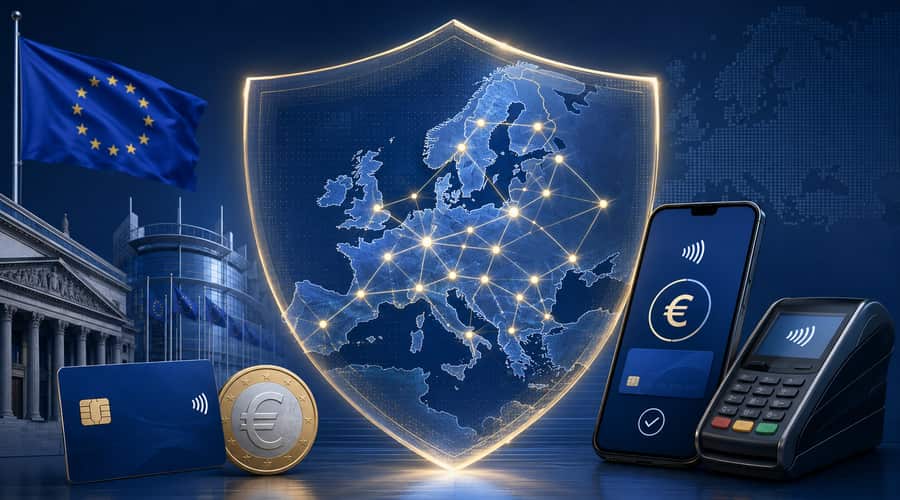
Europe is not about to abandon Visa and Mastercard overnight. But a new interoperability push has turned its scattered domestic payment apps into something much closer to a real continental alternative.
The European Payments Initiative and the EuroPA Alliance have moved the payments sovereignty debate from policy language into implementation. Their February 2, 2026 Memorandum of Understanding links national and regional players including Wero, Bizum, Bancomat, MB WAY and Vipps MobilePay, bringing together payment services that reach about 130 million users across a 13-country roadmap.
That matters because Europe has tried this before and failed. The old model was to build one pan-European wallet and persuade everyone to move into it. Consumers rarely change payment habits because institutions ask them to. Merchants do not rush to integrate another checkout button unless there is a clear reason. This time the pitch is simpler: keep the apps people already use, then make them work across borders through a central interoperability hub.
As the EPI and EuroPA announcement makes clear, the plan is not to replace national brands with one European super-app. It is to let a French Wero user, a Spanish Bizum user and a Portuguese MB WAY user transact across borders without thinking about the plumbing underneath. That is the right architecture for a market where local payment habits are strong and trust is built bank by bank, not continent by continent.
Wero gives the plan a stronger base
Wero is the most visible part of the European Payments Initiative, and its progress now looks less experimental than it did a year ago. Launched in 2024 for peer-to-peer payments in Germany, France and Belgium, it has grown past 50 million registered users, with more than €7.5 billion in transfers processed. Those figures do not put it anywhere near the global card networks, but they do prove that Wero is no longer just a policy project with a logo.
The commercial rollout is the bigger test. Wero has started moving beyond payments between friends into e-commerce, with German merchants such as Lidl, Rossmann and CTS Eventim already involved, while France and Belgium are adding large names including Air France, E.Leclerc, Orange and Veepee. The planned migration of iDEAL in the Netherlands and Payconiq in Luxembourg adds another advantage: Wero can inherit existing user behavior rather than buy it from scratch.
The April proof of concept keeps the story current
The February MoU would be easier to dismiss if it were only a signing ceremony. The more important development came in April 2026, when Bancomat, SIBS-MB WAY and EPI completed a proof of concept for QR-code-based person-to-merchant payments across their networks. In practical terms, that means an app from one country can be used at a merchant in another, with the transaction routed through interoperable European infrastructure.
The roadmap remains phased. Cross-border peer-to-peer payments are expected in 2026, followed by broader e-commerce and point-of-sale use cases in 2027. That timeline is important for founders, banks and merchants because it separates near-term testing from full commercial scale. Europe has a credible direction, but credibility still has to become uptime, merchant coverage and daily user habit.
Visa and Mastercard still have the stronger hand
The easy headline is that Europe is building an answer to Visa and Mastercard. The more useful reading is that Europe is building leverage. Consumers do not stop using cards because another payment option appears. They accumulate payment methods. Merchants, meanwhile, choose based on conversion, cost, reliability and reach. A European account-to-account rail only wins where it makes the transaction cheaper, faster or strategically safer.
That strategic case has become much sharper. European policymakers increasingly view payment dependence through the same lens as cloud infrastructure, energy and defense procurement. If everyday payments rely heavily on non-European networks, data, fees and operational control sit outside the continent's direct authority. The argument is no longer only about merchant costs. It is about financial infrastructure in a more fragmented geopolitical environment.
The incumbents are not standing still. Mastercard's March 2026 agreement to acquire stablecoin infrastructure provider BVNK for up to $1.8 billion shows how aggressively card networks are buying into new rails. Visa is also expanding settlement and bank integrations around digital assets and account-based payments. The competitive question is not whether cards disappear. It is whether the next layer of payments is controlled by the same global networks or partly by European schemes.
Fintech startups should build for optionality
For fintech founders, the opportunity is obvious but not automatic. A startup building checkout, wallet routing, merchant acquiring or cross-border payment tools could benefit from a single European interoperability layer that reaches users through familiar domestic apps. That is a better distribution story than negotiating country by country, especially for companies selling into merchants with customers across the euro area and neighboring markets.
The risk is speed. Bank-led initiatives can be deliberate, and the most valuable use cases are still rolling out. A company that bets exclusively on Wero or the new hub may find itself waiting for coverage that arrives later than planned. The stronger position is infrastructure-agnostic: support cards, local wallets, instant account-to-account payments and, where relevant, stablecoin settlement, then route users toward the best option without making the payment feel complicated.
The next milestone is cross-border peer-to-peer payments later in 2026. If that launch feels natural to users and reliable to banks, the 2027 merchant expansion becomes much more believable. If it stumbles, Europe will have another ambitious payments plan looking for momentum. For now, the shift is real enough to watch closely. Europe has stopped merely talking about payment sovereignty and started testing the rails that could make it usable.
Also read: St. Charles bans data centers in AI infrastructure warning • Tencent Hy-MT2 proves specialized AI models have edge • VinFast debt transfer sparks governance concerns