Pump.fun has added USDC liquidity pools for new token launches, giving creators a stablecoin option alongside SOL. The change raises launch costs, reduces exposure to Solana price swings, and could reshape one of the biggest demand loops in the Solana memecoin market.
Pump.fun is no longer a SOL-only launch machine. The Solana memecoin platform has started letting creators launch tokens with USDC-paired bonding curves, a small technical change that carries a bigger market signal: the platform wants launches to depend less on Solana's price and more on the token's own demand.
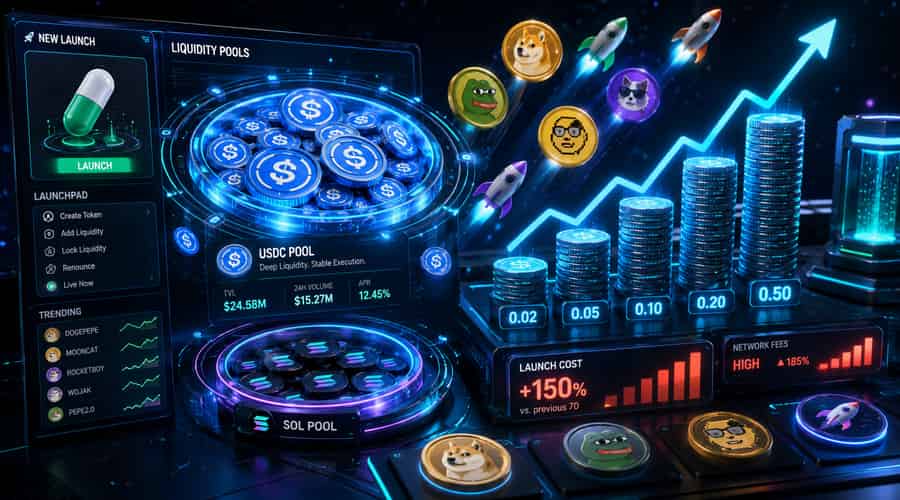
According to SolanaFloor, the USDC option went live on May 21 after being previewed earlier in the month, while existing SOL-based pairs remain unchanged. Under the new structure, a USDC-paired token starts with an initial market cap of about $4,000 and reaches its bonding completion threshold at roughly $58,783. That compares with about $2,000 and $30,000 for SOL pairs. Buying the first 30 percent of supply now costs around $1,682, up from about $998 under the SOL model.
That matters because Pump.fun's old design tied every launch to SOL volatility. When SOL fell, the dollar value of the bonding curve fell with it, making it cheaper for early buyers to capture a large share of supply. The platform has described this as a low ceiling problem, where aggressive early accumulation can damage distribution before a token has a real chance to form a market. USDC pools remove that variable. A creator may still launch a bad coin, and traders may still chase terrible charts, but the launch math is no longer shifting every time SOL moves.
Why USDC changes the Solana loop
Pump.fun has been one of Solana's most important activity engines. Since launching in January 2024, an estimated 5.07 million SOL, worth about $430 million at the time of the cited data, has been locked in liquidity pools when tokens graduate. That helped create a reflexive relationship: more launches meant more SOL demand, and rising SOL could make the whole ecosystem feel stronger.
USDC weakens that direct connection. If a meaningful share of new creators choose stablecoin pools, Pump.fun's revenue and trading activity can keep growing while its role as a SOL demand engine becomes less concentrated. That is not automatically bad for Solana, but it does change the market structure. The platform becomes less dependent on the native asset's price action, while SOL holders lose some of the mechanical benefit that came from every successful launch feeding into SOL liquidity.
For Pump.fun itself, the move is practical. Stablecoin pools make the product easier to understand for creators and traders who think in dollars. They also make the platform more resilient during sharp SOL corrections, when launch economics can suddenly look distorted. That is the point. Pump.fun is trying to keep the launch factory running even when the base asset becomes noisy.
Higher costs create a sharper filter
The new USDC route is also more expensive. It costs about $12,161 to bond a USDC-paired token, compared with roughly $7,276 for a SOL pair. That 67 percent increase will not stop serious teams, but it may discourage the lowest-effort launches that depend on cheap creation, quick attention, and fast exits.
This does not turn Pump.fun into a curated marketplace. The platform is still built for speed, speculation, and a very low barrier to entry compared with traditional token launches. But price still changes behavior. A creator willing to put up more capital has a different risk profile from someone launching dozens of disposable coins and hoping one catches a bid. For retail traders, that could mean fewer tokens to sift through, and possibly a slightly better signal among the ones that survive the first hour.
The benefit for traders is simpler too. Dollar-based pricing makes valuation easier to read. There is no need to convert SOL in your head while a token chart is moving. A $4,000 starting market cap is a $4,000 starting market cap. That clarity matters in a market where decisions are often made in seconds.
What founders and traders should watch
For founders building on Solana, the signal is mixed. USDC pools offer cleaner price discovery and reduce exposure to SOL volatility, which can help projects that want a steadier launch environment. At the same time, if USDC launches become popular, the broader memecoin flywheel that helped support SOL demand may become less direct. That is a market-level concern rather than a launch-day problem, but it is worth watching.
The next test is adoption. If creators mostly stick with SOL because it is cheaper and familiar, USDC pools will remain a useful option for teams that value stability over cost. If creators move heavily into USDC, Pump.fun becomes less of a SOL-centered memecoin casino and more of a neutral token launch venue with stablecoin-denominated liquidity. Either way, the platform just gave creators a choice they did not have before, and the market will quickly show whether that choice changes behavior or simply adds another lane to the same speculative highway.
Also read: Uniswap’s UNI token now trades natively on Solana • US bill seeks 1M Bitcoin reserve with 20-year hold • Zillow loses Chicago listings in data access war