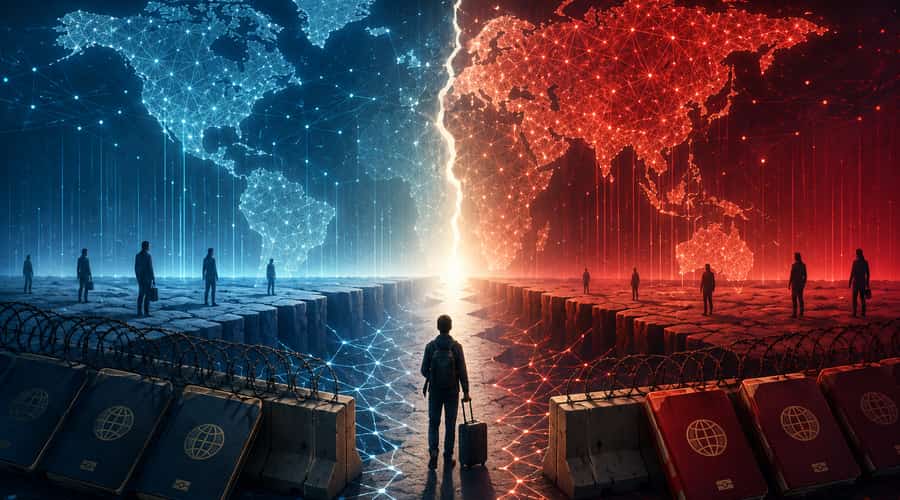
The AI threat that matters most right now is not a Hollywood machine uprising. It is the slow closing of borders around the people, capital and knowledge that make the technology work.
The global AI race has moved from chips and models to passports. China has expanded travel restrictions on top artificial intelligence researchers and engineers at private technology firms, according to Bloomberg, adding a sharper edge to a contest that already reaches across export controls, startup funding, acquisitions and national security reviews.
That may sound less dramatic than the familiar doomsday script. No red-eyed robot. No rogue supercomputer. But for founders and investors, this is the more immediate threat. AI companies are built on scarce talent, fast collaboration and the ability to move people across borders when a problem demands it. Once governments start treating engineers as strategic assets that must be contained, the operating model changes.
China has been moving in this direction for some time. The Wall Street Journal reported in March 2025 that Chinese authorities had advised leading AI entrepreneurs and researchers to avoid traveling to the United States because of security concerns. The concern was not only that sensitive information could leak abroad, but also that senior executives could be detained and used as bargaining chips in a broader geopolitical dispute.
The new restrictions suggest Beijing is no longer satisfied with informal caution. It is drawing a tighter line around the human layer of AI. That matters because talent mobility has been one of the quiet foundations of the industry. A researcher trained in China might work at a U.S. lab, return to launch a startup in Shanghai, collaborate with a team in Singapore and raise money from global investors. That path is becoming harder to rely on.
For years, the AI debate has focused on hardware. Washington restricted sales of advanced chips to China beginning in 2022, and that policy still shapes the market. Taiwan moved last week to detain three people accused of using false declarations to ship Nvidia AI chips to China, Hong Kong and Macau through servers made by Super Micro Computer, a reminder that chip controls are no longer just paperwork.
But AI capability is not stored only in GPUs. It is also stored in the engineers who know how to train models efficiently, tune them for commercial products and work around bottlenecks. That is why travel controls matter. They turn people into protected infrastructure.
This is the part Hollywood misses. The real risk is not that AI suddenly becomes uncontrollable in a single cinematic moment. The risk is that countries build rival AI systems inside increasingly sealed environments, each with different data, censorship rules, security assumptions and commercial incentives. Once that happens, collaboration becomes politically expensive and technical trust becomes harder to rebuild.
The Manus case shows how quickly this can affect dealmaking. Bloomberg reported in April that China blocked Meta's $2 billion acquisition of agentic AI startup Manus, after earlier reports that two Manus co-founders had been barred from leaving China while regulators reviewed the deal. That was not just a dispute over one startup. It was a warning that Beijing may treat Chinese-linked AI talent and intellectual property as assets that cannot simply be sold into a U.S. platform.
For venture capital, that changes the diligence process. A Chinese AI founder with strong technical credentials may also carry regulatory risk that is difficult to price. A Singapore structure may not be enough. A cross-border acquisition may not close. A key engineer may not be able to attend a U.S. product sprint, investor meeting or customer deployment. These are practical problems, not abstract foreign policy concerns.
Startups face a smaller map
Western companies are also being forced to think differently about Chinese AI. Airbnb Chief Executive Brian Chesky defended the company's use of Alibaba's Qwen model last week, saying U.S. lawmakers were misunderstanding open-source AI and that Airbnb was not sending user data to Chinese companies. That argument may be technically sound, but the politics are moving in the other direction.
At the same time, OpenAI, Anthropic and Google have been working through the Frontier Model Forum to detect attempts by Chinese competitors to copy model behavior through adversarial distillation, according to Bloomberg. So one side worries about leakage through people and deals, while the other worries about leakage through model outputs and open software. Both are symptoms of the same problem: AI is becoming too strategic to remain comfortably global.
Entrepreneurs should not read this as a reason to avoid China entirely. That would be too simple. China remains one of the deepest AI markets in the world, with major companies such as Alibaba, Tencent, DeepSeek and MiniMax pushing hard across models, agents and enterprise tools. It also has a large engineering base and a state-backed urgency that Western firms should not underestimate.
But founders do need to plan for a world where AI teams, suppliers and investors are sorted by jurisdiction more often than by capability alone. Hiring a brilliant researcher is no longer just a compensation question. It may involve travel permission, export rules, data controls and national security reviews. Joint ventures that looked efficient on paper may become slow and politically fragile.
The practical takeaway is clear. Companies building serious AI products need more redundancy in talent, compute and legal structure than they did two years ago. Investors need to ask where the critical people are located, who can approve their travel and whether the company's most important knowledge can cross a border without creating trouble.
The next phase of AI competition will not be decided only by who has the biggest model or the fastest chip. It will also be decided by who can keep teams moving, keep trust alive and keep commercial relationships from being swallowed by politics. That is the real threat to watch now.
Also read: India and the U.S. are turning rare earths into an AI supply chain bet • SpaceX is asking public investors to accept Musk's rule • China's public AI optimism is becoming a strategic advantage