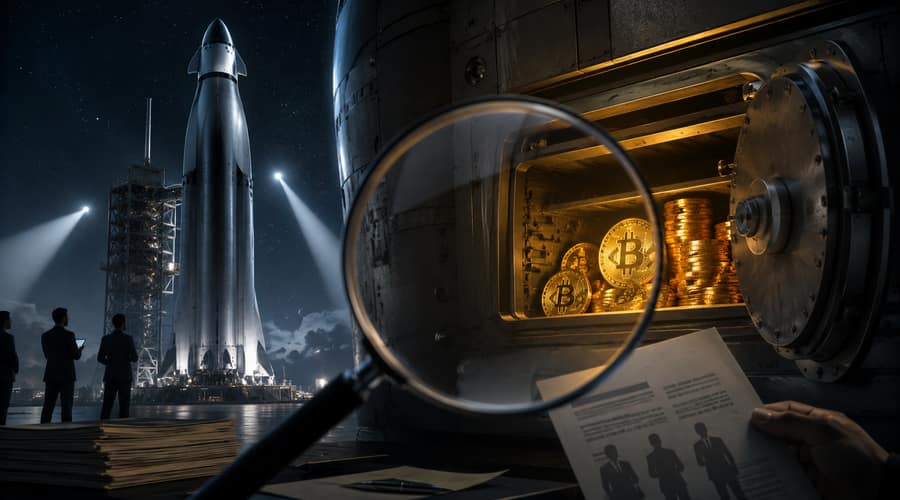
SpaceX's IPO filing has exposed a much larger Bitcoin position than markets expected, turning a quiet treasury bet into a new variable for investors.
The disclosure matters because it arrives just as Elon Musk's aerospace company pushes toward public markets and investors start asking what, exactly, belongs on the balance sheet and what belongs in the valuation discussion. Bloomberg reported that SpaceX's SEC filing shows a Bitcoin holding larger than previous estimates, while Reuters has separately reported that the company is being watched closely as it moves through the IPO process and heads toward a possible $1.75 trillion valuation.
What makes this more interesting is the way the information surfaced. SpaceX did not choose to pitch itself as a Bitcoin story in the way Strategy has done for years. Instead, the position emerged through regulatory disclosure, which is often how the market learns what companies would rather keep quiet until they absolutely have to say it.
The immediate question is not whether SpaceX owns Bitcoin, because that is now public, but whether investors will treat that exposure as a meaningful part of the IPO conversation. A large Bitcoin position can help during rising markets and complicate matters when volatility picks up, and that tension matters more for a company like SpaceX than it would for a pure crypto treasury play. The filing gives bankers, analysts and prospective buyers a cleaner view of the company's financial profile, which means fewer assumptions and more room for argument over what the stock should be worth.
According to the reporting cited by Bloomberg and other outlets following the filing, SpaceX held 18,712 Bitcoin as of March 31, with an acquisition cost of about $661 million, implying an average price near $35,300 per coin. At recent prices, that position is worth far more than the original purchase cost, which helps explain why the disclosure landed with such force. It is one thing to know a company has exposure to digital assets. It is another to see that exposure measured in billions rather than a token side bet.
This also adds another layer to the SpaceX IPO itself. Reuters has reported that the company is expected to maintain controlled company status after the listing, keeping Elon Musk firmly in charge. That means public investors may get a more transparent look at the balance sheet, but not necessarily much more influence over how the company uses it.
The quiet balance sheet question
The bigger story may be what this says about other companies. SpaceX is now part of a widening group of major firms with Bitcoin on the books, but unlike the companies that advertise their crypto strategy, it revealed the position only because it was required to do so. That raises a straightforward question for investors and regulators alike: how many other corporate Bitcoin holdings are still sitting in plain sight, just not yet exposed by a filing that forces the issue.
For investors, that matters because corporate Bitcoin positions are no longer a novelty. They can alter liquidity analysis, shift perceptions of management discipline and complicate the clean story companies like to tell before going public. For regulators, the disclosure is a reminder that transparency often arrives late and indirectly, especially when a company is trying to control the narrative around a major listing.
There is also a symbolic angle here. SpaceX is not a crypto-native company. It is a rocket maker, a satellite operator and one of the most closely watched private companies in the world. Yet its filing shows how deeply Bitcoin has moved into corporate finance, to the point where even a business built on launchpads and spacecraft can carry a digital asset position large enough to become part of the market's valuation debate.
That is why this filing resonates beyond the headline number. It suggests that Bitcoin is increasingly less of a side story and more of a quiet line item that can surface at the worst possible time, or the most revealing one, depending on your view. As more companies approach the public markets, investors may find that the real surprise is not who owns Bitcoin, but who has not said so yet.
Also read: DuckDuckGo installs surge as users reject Google AI Search • Huawei rewrites chip physics to bypass US sanctions • Claude Code and OpenClaw turned AI agents into tech's new force