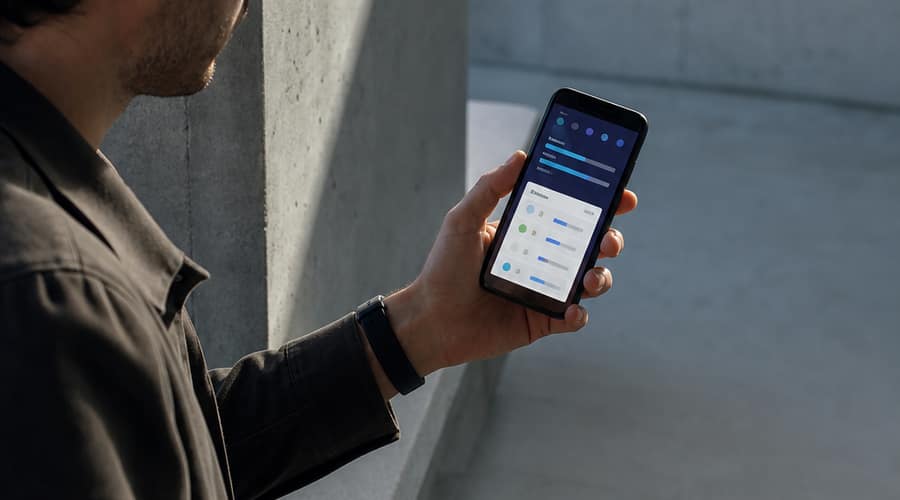
Cursor launched an iOS app and Progressive Web App for Android today, letting developers prompt and monitor AI coding agents from their phones, a move that reframes what it means to build software in 2026.
The announcement is not really about mobile. It's about what coding has become. Cursor, the AI-native development environment that crossed $3 billion in annualized recurring revenue earlier this year and is now the subject of a $60 billion all-stock acquisition by SpaceX, shipped a mobile interface today that lets users spin up new agents or pick up sessions started on desktop, review diffs, merge pull requests, annotate screenshots, and unblock stuck tasks. All from a phone. The iOS version is a native TestFlight beta; Android users get a Progressive Web App installable from Chrome. Neither is a code editor in any traditional sense. That's the point.
Cursor's own blog post framing the release was direct about it: this is a control panel for agents, not a keyboard for humans. The "background agents" the app surfaces, now officially called cloud agents in Cursor's documentation, keep running whether or not you're at your machine. You check in, redirect them, approve what's ready, and move on. Voice dictation lets you describe a problem and trigger a fix while you're doing something else entirely. It's a fundamentally different posture than writing code, and the shift to mobile is the most concrete symbol yet that Cursor is betting developers will spend more time supervising than typing.
The mobile launch didn't arrive in isolation. It was part of a trio of announcements Cursor made at Compile, its developer conference at Fort Mason in San Francisco on June 16. Alongside the mobile app, Cursor unveiled Origin, a Git platform built for workflows where multiple AI agents commit to a single repository simultaneously, GitHub's architecture having been designed for human-paced development rather than agents running in parallel. Origin is scheduled for general availability in fall 2026. Cursor also confirmed it's training its first frontier model from scratch, a 1.5-trillion-parameter system running on xAI's Colossus supercomputer in Memphis, on par in scale with Opus and GPT-class models, using ten to twenty times the compute of Cursor's previous models. The SpaceX acquisition, which closed simultaneously with the Compile announcements, handed Cursor access to that Colossus infrastructure.
Together, the three announcements describe a company repositioning around a single idea: the developer is an architect now, and agents are the builders. Mobile is where that repositioning gets tested in practice.
What this means if you're building something
For founders and solo builders, the implications are more concrete than they might look at first. Cursor's /multitask feature already lets users spin up to eight agents simultaneously, each working on an isolated branch. Combine that with mobile check-ins and Slack-triggered agents, and you get something that used to require a team: a codebase that moves while you're meeting investors, handling customer calls, or traveling. The productivity case for one-person product companies just got meaningfully stronger.
Don't overstate it, though. The Cursor mobile experience, as TechCrunch noted in its coverage today, is mostly used to kick off and monitor agents, with detailed work still finishing back on desktop. Voice dictation is useful; editing a complex function on a phone screen is not. This is asynchronous oversight, not a replacement for focused work. The value is in the handoff: describe what you need, let it run, review the output later. That loop is genuinely new, and it compresses the feedback cycle for builders who can't afford to be desk-bound all day.
Anthropic and OpenAI have both been pushing coding tools to mobile contexts, but Cursor's move is sharper because it's paired with the agent infrastructure that makes mobile oversight actually meaningful. Without persistent cloud agents, a mobile coding app is just a worse version of the desktop. With them, the phone becomes a real management layer. That's the competitive frontier that matters now in AI dev tools, and it isn't raw model capability or feature count. It's workflow continuity across every device and context a developer actually uses. Cursor is currently ahead on that dimension, though Origin, once it ships, will be the harder test: whether an agent-native Git platform can actually displace habits and integrations built around GitHub over a decade.
For now, the mobile app is a bet on what kind of worker the AI era is creating: someone who sets direction, checks progress, and trusts agents to fill in the rest. If that bet is right, the desk isn't where the work happens anymore. It's just where you finish it.
Also read: Copper has broken records this year and AI data centers are the reason the rally isn't done • The semiconductor layer is where the real AI money is being made in 2026 • Ardian is betting over a billion dollars that the Nordics will power Europe's AI infrastructure buildout