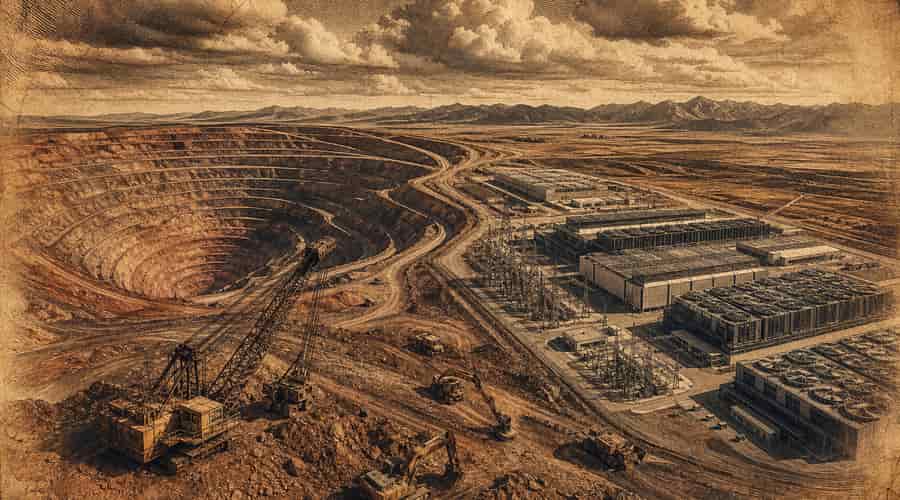
Copper has already broken records in 2026, and the AI data center buildout gives the rally a harder floor than a normal commodity spike.
Copper is no longer just riding the old electrification story. The metal hit an intraday high above $14,500 a metric ton on the London Metal Exchange in January 2026, according to MarketWatch, and it was still close to that record in May after rising nearly 8% for the month. If you're building data centers, grids, transformers, EV chargers or renewable power projects, that price is not an abstract chart problem. It's the cost of wiring the next phase of the economy.
The easy explanation is speculation. There has been plenty of that. The Guardian reported in January that intense trading in China helped push benchmark copper above $14,000 a metric ton, as investors bet on stronger US growth and more spending on data centers, robotics and power infrastructure. But don't confuse a hot tape with an empty story. Copper is rising because the physical market is tight, and AI is adding another claim on a metal that was already spoken for.
The numbers are blunt. A Tom's Hardware report citing Wood Mackenzie said the refined copper market was expected to face a 304,000-tonne deficit in 2025, with a wider gap in 2026. The same report said large AI campuses are now commonly designed around 50MW to 150MW blocks, with copper use estimated at roughly 27 to 33 tonnes per megawatt before all the upstream grid work is counted. A single 100MW site can absorb several thousand tonnes of copper before you even start talking about the power lines and substations feeding it.
That is why this rally feels different from a normal commodity squeeze. AI data centers don't only need Nvidia chips and cheap land. They need transformers, switchgear, cooling systems, backup power and a lot of copper sitting inside walls, racks and electrical rooms where nobody on a stock chart ever sees it. The metal is boring until it isn't available.
Supply is the uglier side of the story. The Wall Street Journal reported last year that the Grasberg disruption in Indonesia, one of the world's largest copper mines, forced Freeport-McMoRan to cut output expectations, with J.P. Morgan forecasting a deficit of 180,000 tons in 2026 after the incident. Barron's later reported that Freeport cut its 2026 sales forecast to 3.1 billion pounds of copper, down from earlier expectations, as the company dealt with delays tied to the September mud rush at Grasberg that killed seven workers.
You can't fix that kind of shortage with a spreadsheet. New copper mines take years to permit, finance and build, and older mines are fighting lower ore grades and higher operating costs. The International Energy Agency's critical minerals outlook, cited in the same Tom's Hardware report, said existing and planned mines would meet only about 70% of projected 2035 copper demand. That is a long way of saying the market needs supply that does not yet exist.
The AI trade now runs through copper
Investors noticed. The United States Copper Index Fund, better known by its CPER ticker, has become one of the simpler ways to get exposure to copper futures without buying the metal directly. Miners have also been dragged back into growth conversations that, only a few years ago, were dominated by cloud software and chip designers. Frankly, that makes sense. If AI campuses need power at a scale utilities are still scrambling to deliver, the companies that control copper deposits are no longer just cyclical miners. They are infrastructure gatekeepers.
There is a catch. Commodity markets can punish anyone who treats a strong thesis as a straight line. China still matters enormously to copper demand. A weaker industrial cycle can cool prices. High prices can also force substitution, delay projects or make buyers draw down inventories before they come back to the market. None of that breaks the copper case, but it does mean you shouldn't mistake a structural shortage for a guaranteed monthly price climb.
The harder question is whether governments, miners and hyperscalers are moving fast enough. Right now, they aren't. Data center developers can announce gigawatts of capacity much faster than mining companies can bring new copper supply online. That mismatch is the reason copper has broken records this year, and it is the reason the rally still has life even after the speculative heat cools.
If you want the simplest test for the AI infrastructure boom, don't only watch GPU shipments. Watch copper. It tells you where the physical world is pushing back.
Also read: Ardian is betting over a billion dollars that the Nordics will power Europe's AI infrastructure buildout • Strategy approves selling up to $1.25 billion in Bitcoin as Saylor's treasury model faces its hardest test yet • Indian households are selling gold as prices fall and the math could weigh on bullion through 2026