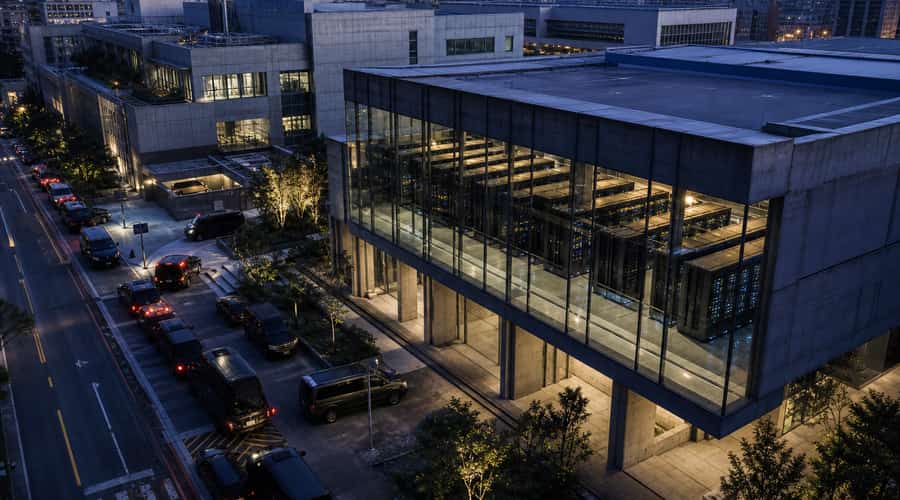
Taiwanese authorities raided Super Micro Computer's offices and six residences on June 29, expanding a probe that has already ensnared the company's co-founder and exposed a $2.5 billion scheme to funnel restricted Nvidia AI hardware into China.
The Keelung District Prosecutors Office sent investigators into Super Micro's Taiwan offices and the homes of six individuals on Monday, targeting three affiliated companies in what Bloomberg reported as an extension of raids carried out in May 2026. Those earlier operations, which swept 12 locations across the island, resulted in the seizure of roughly 50 high-end Super Micro servers packed with Nvidia chips bound, prosecutors allege, for mainland China, Hong Kong, and Macau through forged customs documents and fraudulent declarations. SMCI shares fell as much as 9% on the news before recovering some ground.
The case goes back further than Monday's headlines. In March 2026, US federal agents arrested Super Micro co-founder Yih-Shyan "Wally" Liaw, along with Ruei-Tsang "Steven" Chang and Ting-Wei "Willy" Sun, on charges of conspiring to violate US export control laws. The DOJ indictment, unsealed March 20, alleged the trio routed Nvidia A100 and H100-equipped servers through a transshipment network running from the US to Taiwan, Thailand, Hong Kong, and into China. Among the end users, according to prosecutors: Beihang University and Harbin Institute of Technology, both on the US Entity List, institutions the Pentagon has linked to China's military research programs.
Frankly, what makes this week's raid significant is not the servers themselves. It's the geography. Taiwan has, until very recently, lacked the legal architecture to treat unauthorized AI chip exports to China as a criminal offense. Taiwanese authorities could warn sellers they might be breaching US rules, but prosecuting the smuggling under local law required charging suspects with other existing violations, customs fraud among them. That is precisely what the Keelung prosecutors have done. The island is, in effect, becoming the enforcement front line for a US export control regime that was written in Washington but whose supply chain runs through Hsinchu.
The routing scheme alleged in the indictment is worth understanding, because it is not unique to Super Micro. Prosecutors say the group used shell companies and intermediaries in Malaysia, Singapore, Japan, and Hong Kong to obscure the final destination of the servers. In the Keelung seizure, the hardware appears to have transited Japan before reaching China. As Asia Times reported in May, China's demand for Nvidia H200-class hardware has driven smugglers to test new waypoints as older routes get shut down.
The economics are straightforward. A single fully configured 256-chip Nvidia rack runs to roughly $10 million. A restricted A100 GPU goes for well north of $20,000 on the open market. At that price, the margin on a successful delivery more than covers the cost of a network of front companies and falsified paperwork. What the Super Micro case adds to this picture is the specific allegation that insiders at a major server manufacturer, not just gray-market traders, were running the diversion. That is a different order of problem for the industry.
Taiwan's government has picked up on this. Bloomberg reported on June 9 that Taiwanese authorities are weighing formal controls on AI chip exports to China, measures that would for the first time give local prosecutors a statutory basis to charge smuggling directly rather than routing charges through customs fraud statutes. If that legislation moves, it will represent the most significant policy alignment between Taipei and Washington on technology controls in years, and it will tighten the window that companies like Super Micro, wittingly or not, have allowed to remain open.
Super Micro has said it is cooperating with Taiwanese authorities and has not been charged as a company in any phase of the investigation. Jensen Huang publicly rebuked the company's conduct at an industry event in May. Nvidia has not been charged with any wrongdoing; its chips were legal at the point of sale. The liability in this case sits with the people alleged to have engineered the diversions.
What changes now is the scrutiny. Hyperscalers building out AI infrastructure at scale, Microsoft, Google, Amazon, Oracle, are each doing due diligence on their server supply chains in a way that would have seemed excessive two years ago. A hardware partner with a co-founder under federal indictment and offices being raided in multiple countries is not a comfortable counterparty when you're contracting billions of dollars of AI server capacity. The broader server market won't freeze, but the calculus around which manufacturers clear procurement committees is shifting in real time.
Taiwan stepping up enforcement matters beyond this single case. The island manufactures or assembles a significant share of the world's advanced AI server hardware. If Taipei closes the legal gap that has let smugglers exploit Taiwanese intermediaries with limited criminal exposure, the effective reach of US export controls extends substantially without Washington needing to pass new law. That's the real enforcement story here, and Monday's raid is the clearest sign yet that Taiwan has decided to play it.
Also read: Arena hit $100M in annualized revenue by letting AI companies pay to be evaluated, and that is exactly the problem • Cursor's mobile app signals that coding has become a job you supervise, not a desk you sit at • Copper has broken records this year and AI data centers are the reason the rally isn't done