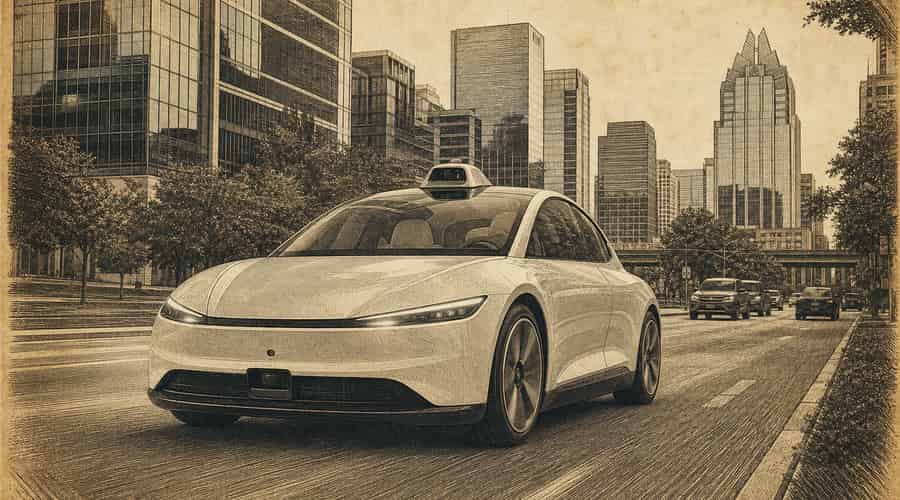
Tesla began engineering tests of its first production Cybercab on Austin public roads on June 30, 2026, putting a vehicle with no steering wheel and no pedals into city traffic roughly 20 months after the concept was first revealed.
The car that pulled onto the streets of downtown Austin today is not a prototype. It rolled off the Gigafactory Texas production line on February 17, was confirmed as a production vehicle during Tesla's Q1 earnings call in April, and is now navigating public roads with a passenger in the seat and no one where a driver would normally sit, because there is no driver's position to occupy. Texas DoT confirmed the operation, with one official describing the Cybercab as "a tangible example of how quickly our transportation system is evolving." Thirty-four vehicles are running downtown Austin. A staging lot in the Dallas medical district reportedly holds more than 70 additional units.
That speed matters. From the October 2024 concept reveal to a production unit on public roads is roughly 20 months, a pace that catches most automotive timelines off guard. For context, Waymo has been running fully driverless commercial rides for years and completed 14 million driverless trips in 2025 alone, generating over $286 million in revenue across six cities. By February 2026, Waymo had expanded to 10 cities, with a stated plan to launch in more than 20 additional cities this year. Tesla is not ahead. But Tesla is moving.
The regulatory dimension here deserves its own attention. Texas DoT signing off on a purpose-built controlless production vehicle operating on public city streets is not a formality. Federal rules still technically require steering wheels, and Tesla hasn't yet formally petitioned NHTSA for an exemption, though NHTSA can grant them for up to 2,500 vehicles per manufacturer annually. The agency has also proposed removing the federal requirement for brake pedals in vehicles designed exclusively for automated driving systems, a rule change expected to clear later this year. If it does, one of the last meaningful federal barriers to vehicles like the Cybercab disappears.
States set their own rules on top of federal ones, and Texas has now put its name on a controlless production vehicle running public roads. That's a precedent other states will watch. California, where Waymo holds commercial permits and Tesla does not, operates under a more cautious regulatory posture. But Texas moving first, and Texas being where Tesla manufactures, creates a natural proving ground that gives the Cybercab a real operational home while federal rules catch up.
Don't mistake today's milestone for a commercial launch. The vehicles in Austin are running engineering validation miles, not fare-paying passengers. A person rides in what would be the passenger seat, not because the car needs a minder by regulatory requirement in the usual sense, but because this is still a testing phase. The path from "production Cybercab on a public road" to "fully autonomous ride you can hail on an app" runs through software validation, regulatory sign-off at the federal level, and a full self-driving stack that Tesla has tied to the forthcoming FSD V15. Until that version is ready and validated at scale, the fleet size stays measured.
Tesla's current robotaxi service, running Model Y vehicles in Austin, Dallas, and Houston, sits at roughly 20 unsupervised cars as of May 2026. Waymo's comparable fleet numbers in the hundreds per city. On pure operational scale, Waymo is not just ahead, it's in a different phase of the business. The question isn't whether Tesla has caught up. It hasn't. The question is whether the Cybercab's hardware economics change the math once the software is ready.
Waymo's sixth-generation vehicle costs under $29,000 to manufacture, which is genuinely competitive. Tesla's camera-only approach, no lidar, no radar arrays, promises lower unit costs still, though the tradeoff is a software dependency that has to work flawlessly before the hardware advantage means anything. You can build a cheap autonomous car. You can't cut corners on the autonomy part.
What June 30 actually represents is a compressed development cycle meeting a regulatory moment. Tesla got a production vehicle onto public city streets without a steering wheel, in a state that said yes, faster than most analysts expected after the original robotaxi timeline slipped repeatedly. Waymo's head start is real and substantial. But the Cybercab is no longer a concept on a stage in Hollywood. It's a production car on a real road in Austin, and the next 12 months will tell us whether the software can close the gap the hardware just opened.
Also read: Etched bets $800 million that transformer silicon will outlast the GPU era • ForthWrite Founder Curtis Boortz on the Email AI That Gets Better at Sounding Like You Specifically • Bending Spoons prices its Nasdaq IPO above range as Wall Street bets on AI-powered software roll-ups