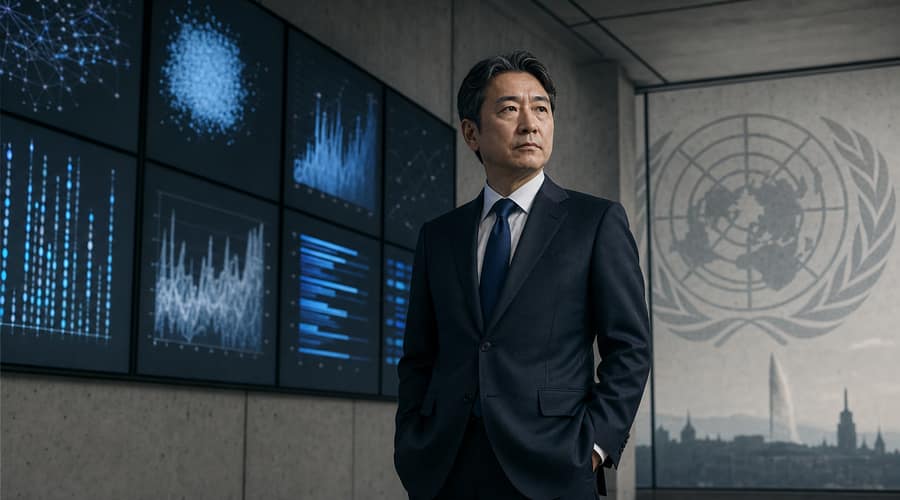
Ren Ito, the Tokyo entrepreneur who helped Sakana AI build a workaround for Anthropic's export ban, just picked up a seat at the UN's table on AI governance.
The United Nations and the International Telecommunication Union announced the AI for Good Global Commission on July 1, and Ren Ito made the founding roster. He's the co-founder and chairman of Sakana AI, the Tokyo lab that spent June building an alternative to two Anthropic models the US government had just cut off from most of the world.
You don't usually see a Japanese AI executive share a commission roster with Jensen Huang and a sitting head of state. But that's the room Ito is walking into. According to the commission's founding announcement, more than 40 members signed on, including Amazon's Andy Jassy, Nvidia's Jensen Huang, Microsoft president Brad Smith, Anthropic co-founder Jack Clark, and Cohere co-founder Aidan Gomez. Salesforce CEO Marc Benioff and Rwandan President Paul Kagame will co-chair the group, with ITU Secretary-General Doreen Bogdan-Martin serving as permanent vice-chair. The commission holds its first meeting on July 8 in Geneva.
Ito's presence on the commission isn't accidental. Sakana AI spent the past month at the center of exactly the access fight the commission says it wants to address. On June 12, the US Department of Commerce placed export controls on Anthropic's Mythos and Fable 5 models, cutting API access overnight for teams outside a narrow list of vetted American organizations. Sakana responded with Fugu, a system that orchestrates a pool of existing frontier models behind a single, OpenAI-compatible endpoint rather than training a new one from scratch.
The numbers Sakana published are specific, a rarity in a field that runs on vague performance claims. On SWE-Bench Pro, Fugu Ultra scored 73.7%, ahead of Claude Opus 4.8 at 69.2%, GPT-5.5 at 58.6%, and Gemini 3.1 Pro at 54.2%. Sakana says Fugu Ultra performs on par with Anthropic's own Fable 5 and Mythos Preview across coding, reasoning, science, and agent benchmarks, the same models the export ban put out of reach.
But frankly, the cost story is messier than Sakana's launch materials suggest. Anthropic charges $25 per million input tokens for Mythos Preview and $10 per million for Fable 5. Fugu's orchestration approach can multiply token usage well past what a single model call would need, and independent testers reported within 24 hours of launch that real-world coding results lagged the published benchmarks. Sakana hasn't said how much the added orchestration inflates the bill for a typical workload.
None of that erases the underlying achievement. Sakana built its reputation on squeezing more out of existing models instead of racing to train bigger ones. The company used evolutionary model merging, a gradient-free technique that combines the weights of existing models without retraining, to build Japanese-language and vision models years before Fugu existed. Fugu runs on the same instinct: don't build a new frontier model, recombine the ones already out there.
That approach has been good business. Sakana raised $135 million in a Series B round last November at a $2.65 billion valuation, with Mitsubishi UFJ Financial Group, Lux Capital, and In-Q-Tel among the investors. Ito co-founded the company in 2023 alongside David Ha, a former Google Brain researcher who serves as CEO, and Llion Jones, the Google engineer who co-authored the 2017 paper Attention Is All You Need. Ito himself came up through Mercari, where he ran European operations through the company's 2018 IPO, and later served as chief operating officer at Stability AI in London.
Ito has already staked out a position on the access question the commission is meant to tackle. Writing for Project Syndicate, he argued that Washington's first priority should be to preserve access for its closest allies, and that AI should not become a technology that is hoarded. That's the view of someone whose own company just spent a month building around an access restriction, and it will likely shape how he engages with a commission whose stated goal, per the founding announcement, is to expand access and strengthen trust in AI across borders.
Not everyone is convinced the commission is built to do that. Common Dreams described the new body as a panel full of Big Tech executives, noting that CEOs and chairmen of the companies building frontier AI now sit alongside the heads of state meant to regulate them. Ito's seat cuts both ways on that critique. He represents a company that just showed how quickly export controls can be routed around, which is either proof the commission needs voices like his, or proof that the companies setting the terms of access are the same ones sitting on the body meant to govern it.
The commission meets for the first time on July 8 in Geneva. Whether it produces anything beyond forty names attached to a press release will depend on what happens in that room, not on who's in it.
Also read: Kioxia Sells Out Its Entire 2026 NAND Flash Supply Just as AI Chips Ship • A Nuclear Reactor in Utah Just Powered an Nvidia Chip for the First Time • Anthropic Opens Talks With Samsung to Build Its First Custom AI Chip