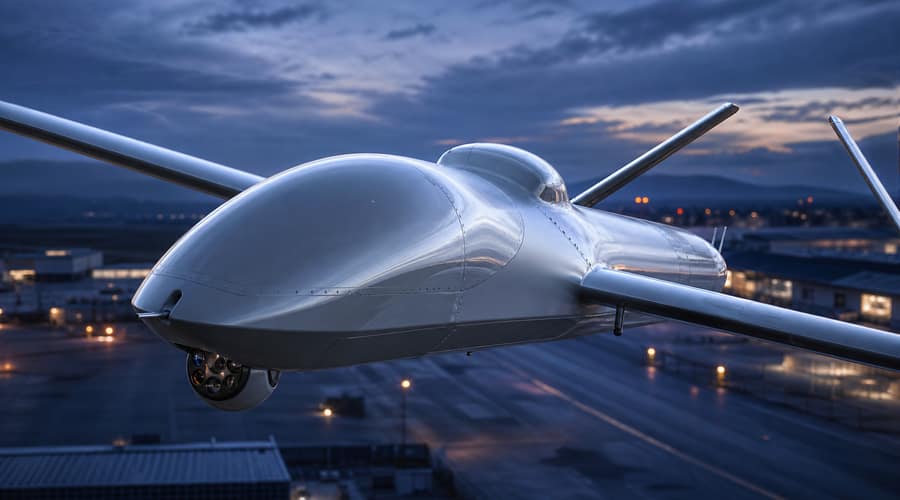
Quantum Systems just raised $1.2 billion at an $8 billion valuation, and one of the investors writing the check is Airbus, the same defense giant its founder says he wants to disrupt.
Munich-based Quantum Systems closed a $1.2 billion Series D on July 2, more than doubling its valuation to roughly $8 billion. The round was co-led by Blackstone, Noteus, Airbus and Advent, with Bond, Fidelity Management and Research Company, Balderton and HV Capital also participating, according to Bloomberg and CNBC.
Airbus's presence on the cap table is the strange part. Co-CEO and co-founder Florian Seibel told CNBC that with Quantum Systems, they are building a "next generation neo prime" that has the potential to "disrupt defense as we know it today." Airbus builds the exact kind of hardware Seibel wants to leapfrog, and it just helped fund the company trying to do it. Alongside the investment, Airbus Defence and Space agreed to deepen its partnership with Quantum, with the two sides combining what the companies described as architectural, software and AI capabilities across the sensor to shooter chain.
Quantum Systems didn't start out building weapons. Florian Seibel, Armin Busse and Tobias Kloss founded the company in 2015, initially selling drones for agricultural mapping and infrastructure inspection. Peter Thiel backed it early. The pivot toward AI-driven autonomous defense systems came later, and it's what turned a mapping startup into one of Europe's most closely watched military technology companies. Its systems have flown more than 19,000 missions in Ukraine in 2025 alone, giving the company a track record most defense startups can only claim on a pitch deck.
That track record shows up in the numbers too. Quantum Systems generated roughly 300 million euros in revenue last year, is on pace to double that this year, and says it's already profitable, with double digit EBITDA margins. A defense startup posting real profit while still raising at a rapidly climbing valuation is unusual. Most companies at this funding stage are burning cash on the promise of scale. Quantum is asking investors to bet on a company that already works.
The raise lands in the middle of the biggest defense tech funding year on record. Defense startups have pulled in $17.4 billion so far in 2026, according to Dealroom, already well past the $11.2 billion raised across all of 2025. Anduril took in $5 billion in May. Saronic Technologies raised $1.8 billion in March, the same month Shield AI closed $2 billion. Quantum Systems' round is the latest entry on a list of checks that would have seemed implausible in defense tech just three years ago.
Fortune has already asked whether this is a boom or a bubble, and it's a fair question when valuations are doubling in a single funding cycle. But Quantum's profitability is the detail that separates it from the pack. It's one thing to raise a huge round on projected demand. It's another to raise one while already generating real revenue and real margin, in a sector where most competitors are still years from break-even.
The new capital will go toward expanding manufacturing capacity, shoring up supply chains and funding further AI and software development, including the buildout of MOSAIC UXS, the company's software layer meant to connect drones and unmanned systems across air, land and sea into a single interoperable network. Quantum Systems also plans to use some of the money for acquisitions as it tries to become what Seibel calls a neo prime, a defense contractor built on software and autonomy rather than decades-old hardware programs.
Whether Quantum actually displaces the primes it just took money from is a question for the next few years, not this one. What's clear now is that Airbus decided the safer bet was to own a piece of its potential disruptor rather than watch from the sidelines.
Also read: Convertible Note vs SAFE: The Dilution Math Founders Skip Before They Sign • How to Read a Startup Term Sheet Before You Sign It • Bhavin Turakhia is spending $30 million of his own money to rebuild Office from scratch