Gemini Space Station has lost almost nine tenths of its value since its Nasdaq debut, and the Winklevoss twins are trying to answer that collapse by pushing the crypto exchange deeper into everyday investing.
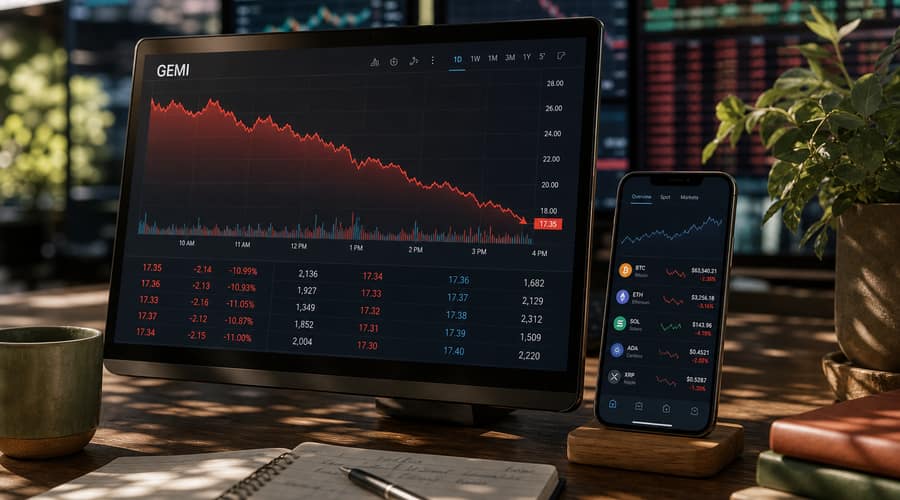
Ten months ago Gemini Space Station opened at $37.01 a share on its first day on the Nasdaq. This week it traded near $4.34. Do the math and that's an 88% collapse from the opening print, and the company is now asking investors to believe a crypto exchange can win a larger place inside their financial lives.
That is a hard sell.
Gemini switched on commission-free trading in thousands of U.S.-listed stocks inside its crypto app on July 7, with Nasdaq providing market data and Apex Clearing serving as custodian and clearing broker. Cameron Winklevoss framed the launch as a step toward putting a customer's whole financial life inside one app. Investors weren't impressed. GEMI shares fell 3.9% that morning, according to Yahoo Finance, even as Robinhood and Coinbase also slipped.
The launch is a pivot born of necessity.
The IPO Pop Vanished Fast
Gemini priced its IPO at $28 a share on September 11, 2025, raising about $425 million and valuing the company at roughly $3.3 billion. MarketWatch reported that the stock opened at $37.01 and closed its first session at $32, a 32.2% gain from the offering price. That first-day excitement didn't survive contact with the company's public numbers.
By November, Gemini had reported a $159.5 million net loss in its first earnings report as a public company. The damage kept coming. The Wall Street Journal reported in March that Gemini's fourth-quarter net loss widened to $140.8 million, or $1.22 a share, from a $27 million loss a year earlier, even as revenue rose 39% to $60.3 million.
That isn't a small miss. It's the public market telling you that a good crypto brand and a famous pair of founders are not enough.
The fallout has been ugly. The Wall Street Journal reported that Gemini cut about 25% of its workforce and withdrew from the U.K., Europe and Australia, markets executives had previously treated as part of the growth story. Investors who bought shares between September 12, 2025 and February 17, 2026 have also filed a federal class action in the Southern District of New York, alleging Gemini and its executives made materially misleading statements in IPO documents, according to TipRanks.
Stocks Are Not A Shortcut
Stock trading is not new ground. Robinhood already owns the consumer brokerage habit, Kraken has pushed into stocks and ETFs in certain U.S. states, and Coinbase has been talking up tokenized equities rather than pretending crypto alone is the whole retail investing market. Gemini is arriving late with a smaller user base and a weaker balance sheet.
Frankly, zero-commission brokerage is a commodity now. The button is not the business. What matters is whether stock trading gets people opening Gemini more often, leaving more cash on the platform, and using services that don't depend entirely on crypto trading volume. That part is worth watching because Gemini has already been trying to rely less on transaction fees and more on services and interest revenue.
But you can't talk your way around cash burn. A company that just cut staff and pulled back from major markets has to show that the new product changes customer behavior, not just the investor presentation. Robinhood can sell stocks, options, crypto, retirement accounts and prediction-style event contracts from a position of strength. Gemini is trying to build the same kind of everyday finance app while its own shares sit near $4.
The Nasdaq relationship gives Gemini one real institutional anchor. Reuters reported before the IPO that Nasdaq agreed to invest $50 million in Gemini through a private placement, while Gemini would provide Nasdaq clients with crypto custody and staking services. That is useful. It is not a rescue plan by itself.
The next real test comes with second-quarter results. That will be the first report investors can use to judge whether the stock-trading launch is doing anything more than adding another tab to the app. Until then, Gemini's share price is the market's plain answer to the super-app pitch.
Also read: UK Enlists Wall Street and Crypto Giants to Build a Live Tokenized Repo Market • A Hobbyist's $150 Bitcoin Miner Just Won a $200,000 Block Reward • Velocity Raises 38 Million Dollars to Turn Stablecoins Into Business Payment Rails