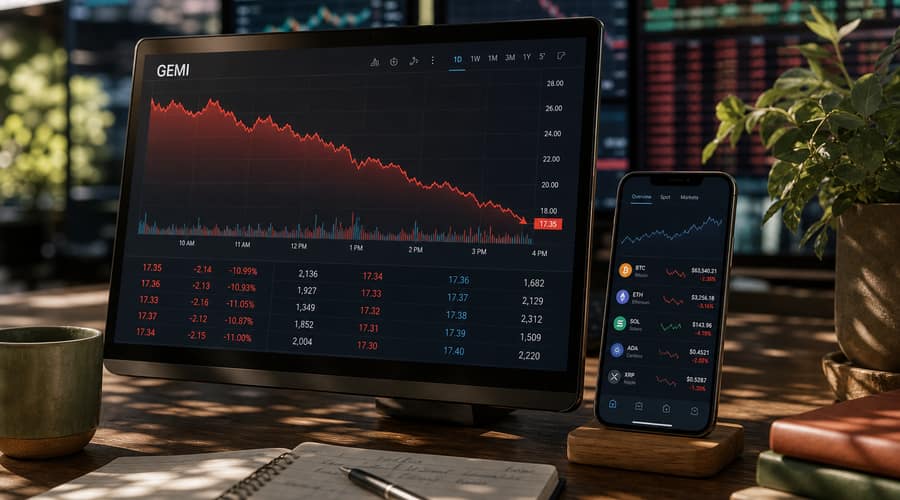

Bitcoin doesn't need a new crisis to fall hard from here. It only needs the Iran shock to last long enough for oil, borrowed money, and thin crypto liquidity to start feeding on each other.
Bitcoin is trading near $62,500 while the US and Iran are again fighting around the Strait of Hormuz, and that is a bad place for crypto to be. Not because Bitcoin is tied directly to Iranian ports or tanker routes. It isn't. The problem is simpler: when oil jumps, inflation fear returns, and traders start selling the assets they can unload fastest.
According to AP, the US has reimposed a naval blockade on Iranian ports after Tehran's attacks on ships in the Strait of Hormuz. The Guardian reported that the blockade followed renewed US strikes on Iranian military targets and Iranian retaliation against US-linked facilities and shipping in the Gulf. This is current. It is not a stale war scare being recycled for clicks.
The market noticed immediately. MarketWatch reported that Brent rose 1.7% to $84.73 a barrel and WTI gained 1.5% to $79.34 as the fighting deepened, with prices still tied closely to what happens next in Hormuz. Barron's put Bitcoin near $62,681 on Wednesday as traders watched inflation data, oil, and the US-Iran conflict at the same time. That's the right stack of worries if you own risk assets. It's also the wrong one.
The floor is already crowded
Here's the thing. Bitcoin has already done the easy part of the selloff. Barron's reported last week that it was more than 50% below its October peak after President Donald Trump said the US-Iran ceasefire was over. That matters because a market that has already fallen this far doesn't need panic to break lower. It needs forced selling.
The first pressure point is oil. If Hormuz stays disrupted, crude stays bid, and every inflation conversation in Washington gets uglier. You don't need to believe in a full global energy shock to see the trade: higher oil makes rate cuts harder, weakens risk appetite, and pushes investors toward cash, and crypto is one of the first things sold because it trades all day and settles fast. Liquidity is useful until everyone wants it at once.
The second pressure point is borrowed money. Crypto traders love a bounce, especially after a sharp drop, and that habit becomes dangerous when the headlines are moving faster than the charts. Economic Times reported Bitcoin near $62,521 on July 14 as US-Iran tensions and inflation fears kept investors cautious. A market pinned around $62,000 is close enough to key liquidation zones that a small move can become a mechanical one. Falling prices trigger margin calls. Margin calls trigger more selling. Then the news almost stops mattering.
That is how crypto crashes usually become ugly. Not slowly. Then all at once.
Hormuz is not just a headline
Skeptics are right about one thing: Bitcoin often shrugs off geopolitical shocks. It can fall on the first headline and recover before the week is over. But that pattern assumes the shock stays brief. A blockade on Iranian ports, attacks on commercial vessels, and a strait carrying a major share of global energy flows are not the same as a one-day missile scare.
There is another risk sitting under the market. The Wall Street Journal reported last month that Iran allegedly moved billions through Binance-linked channels despite US sanctions, while Binance denied knowingly serving sanctioned parties. You don't have to treat that as a Bitcoin price forecast to see the point. If Washington decides crypto rails are part of Iran's war-finance problem, exchanges, stablecoin issuers, and settlement banks will get more scrutiny fast.
Frankly, crypto investors should stop pretending every geopolitical shock is just noise. Some are. This one touches oil, inflation, sanctions, shipping, and dollar settlement at the same time. Those are the pipes behind the market, not background decoration.
None of this means Bitcoin must crash tomorrow. It does mean the downside case is cleaner than the bullish one. For Bitcoin to hold this level, the strait has to stay usable, oil has to stop climbing, and traders carrying borrowed money have to avoid turning a normal selloff into forced liquidation. For Bitcoin to break lower, only one of those things has to fail.
The market has already told you where it is nervous. Bitcoin is sitting around $62,000 while Brent is back above $84 and the US is blockading Iranian ports again. If the war widens, the ugliest part of the trade won't be the first red candle. It will be the moment traders realize the exits are narrower than they looked.
Also read: Gemini's Stock Has Collapsed 88 Percent and Now It Wants to Sell You Stocks • UK Enlists Wall Street and Crypto Giants to Build a Live Tokenized Repo Market • A Hobbyist's $150 Bitcoin Miner Just Won a $200,000 Block Reward