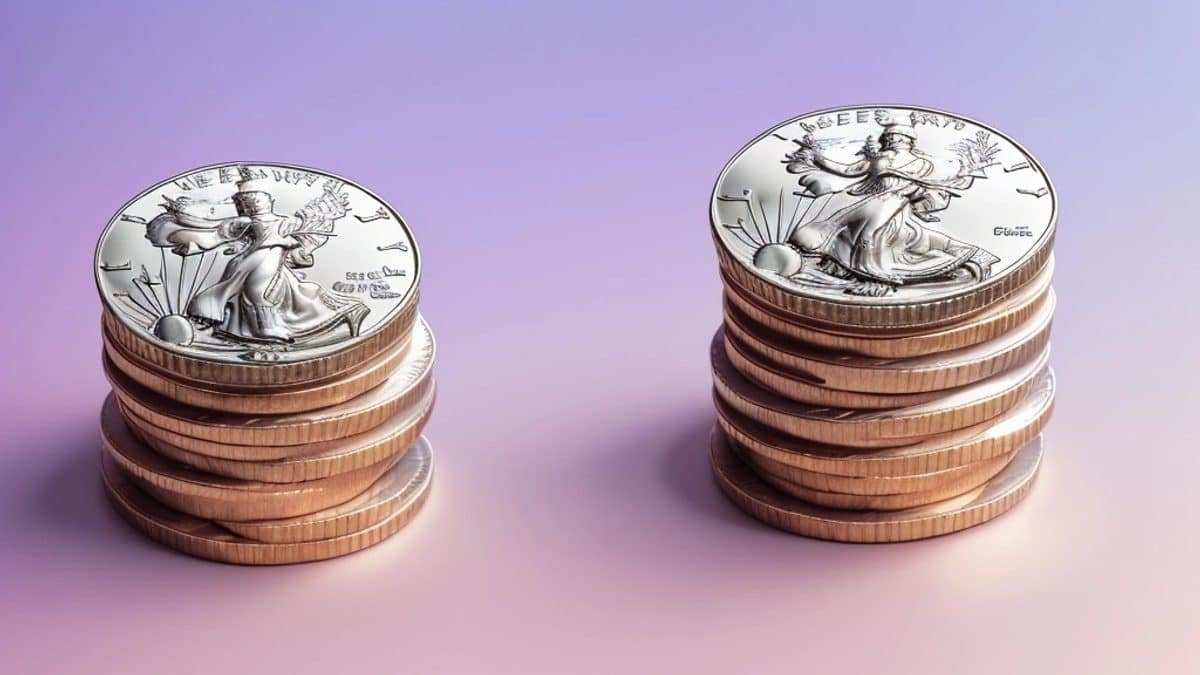
With silver spot prices cracking $38 an ounce for the first time in over a decade, retail premiums on physical coins are surging past 35 percent, reigniting one of the precious metals community's most divisive arguments: is paying up for physical silver rational, or just expensive sentiment?
Walk into any online bullion dealer today and you'll find American Silver Eagles priced closer to $48 to $51 an ounce, even as the spot ticker flashes $38. That $10-plus gap isn't a rounding error or a dealer margin quirk. It's the physical market telling you something the paper price isn't. And right now, the silver stacking community on Reddit's WallStreetSilver forum and across Silver Twitter is tearing itself apart trying to decide what, exactly, that something is.
The proximate cause of the current spike is straightforward enough. Silver spot has been on a tear, driven by a structural deficit in the physical market that the Silver Institute now projects will extend into a fourth consecutive year. Industrial consumption, particularly from photovoltaic solar panel manufacturers, has outpaced mine supply for long enough that the fundamental picture is genuinely tight. Add geopolitical instability, a softening U.S. dollar, and a renewed appetite for safe-haven assets, and you have the conditions for a sustained rally, not a speculative blip.
Here's where the community splits. One camp argues that paying 25 to 35 percent over spot for government-minted coins like the Eagle or the Canadian Maple Leaf is entirely justified. Their reasoning is partly practical: sovereign coins carry guaranteed weight and purity, are universally recognized, and in a genuine liquidity crisis, the premium you paid on the way in tends to compress your loss on the way out because buyers will still pay a premium for trusted metal. Privacy, portability, and the absence of counterparty risk are baked into that cost. From this perspective, the premium isn't overhead. It's insurance with a ticker.
The opposing camp, often called low-premium stackers, makes a harder-nosed case. If your goal is to accumulate the maximum number of ounces relative to dollars spent, a 100-ounce bar from a recognized private mint at 15 to 18 percent over spot is simply better arithmetic. You're buying the metal, not the mint mark. When spot eventually rises further, every ounce you didn't buy because you overpaid for aesthetics or a government stamp is a real opportunity cost.
What makes this debate more than a forum flame war is the structural signal embedded in the premium itself. When the gap between paper spot and physical delivery price widens this dramatically, it's a visible crack in the fiction that the two markets are measuring the same thing. Futures contracts settle in cash. Physical eagles do not. The premium is, in a real sense, the market charging you for actual metal rather than a derivative claim on metal, and right now that surcharge is substantial.
The 2021 Silver Squeeze didn't end, it evolved
Unlike the meme-driven squeeze attempt of early 2021, which fizzled within weeks once retail enthusiasm cooled, the current move has industrial demand doing the heavy lifting. Solar panel manufacturers are not sentiment traders. They buy silver because they need it to make cells, and that demand doesn't evaporate when Reddit loses interest. This gives the current premium environment a stickier foundation than anything the community has seen before.
That said, persistently high premiums do create a real friction problem for retail participation. A first-time buyer confronting a $51 price tag for a coin theoretically worth $38 in spot terms faces a steep psychological and financial hurdle. If premiums stay elevated for long enough, some portion of retail demand simply shifts to ETFs or mining equities, where entry costs are lower but the physical ownership argument disappears entirely.
The practical takeaway for anyone watching this market right now is to decide what you're actually trying to accomplish before placing an order. If you're building a crisis reserve of recognizable, liquid metal, the premium on sovereign coins has historically been recoverable at the point of sale. If you're trying to maximize your silver exposure per dollar in a structurally bullish market, generic bars and rounds let you do that more efficiently. What you probably shouldn't do is conflate the two strategies and then resent the price you paid for whichever one you chose. The premium debate is really a values debate dressed up as an arithmetic argument, and the market is finally forcing people to be explicit about which side they're on.
Also read: A high-grade silver vein found at a Canadian lithium project is rattling supply forecasts and drawing retail investors back to the precious metals trade • A high-grade silver vein found at a Canadian lithium project is rattling supply forecasts and drawing retail investors back to the precious metals trade • A viral post about 1.5 ounces of silver reveals how grassroots stacking culture is quietly reshaping retail precious metals demand