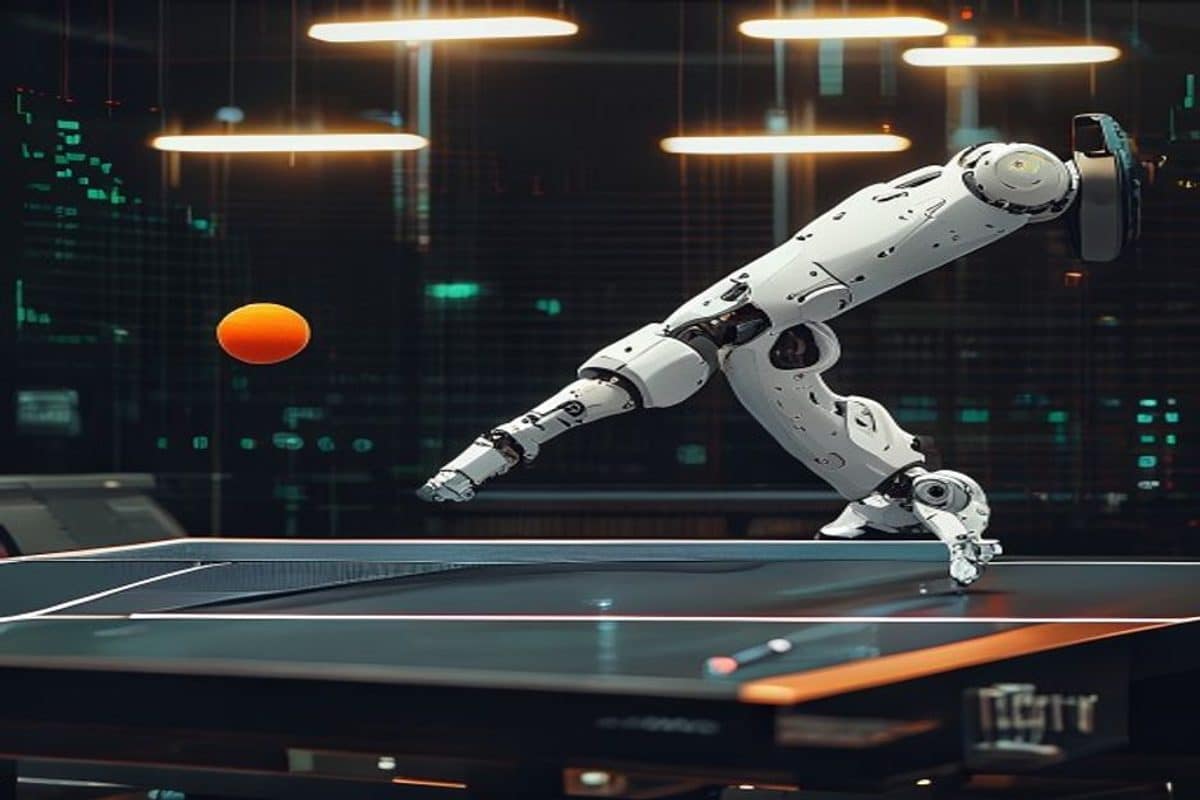
A robot called Ace has achieved something AI has never managed before in physical sport, defeating elite and professional table tennis players under official competition rules by combining event-based vision sensors with reinforcement learning at speeds that push the edge of human reaction time.
Beating a grandmaster at chess is old news. Mastering a video game in superhuman fashion stopped surprising anyone years ago. What researchers at Google DeepMind have now done is categorically different: they built a robot that can step up to a table tennis table against elite human opponents, read a spinning ball traveling at competition speed, and return it well enough to win. That is not a simulation. It happened in the physical world, under official rules, against players who train for this at the highest level.
The system is called Ace, and the research detailing its development was published this week. The headline result is that Ace achieved several victories against elite and professional players while consistently returning high-speed, high-spin shots throughout each match. For context, table tennis at this level involves balls moving faster than most people can consciously track, with spin variations that require instant mechanical adjustment on every stroke. Human players spend years developing the reflexes and pattern recognition to compete at that tier. Ace had to solve the same problem through hardware and learned behavior.
The researchers chose table tennis deliberately. It is one of the few physical sports that operates at the absolute boundary of human reaction time, demands adversarial reading of an opponent, and requires precise real-world movement around obstacles in a confined space. Chess and Go are strategic but static. Even robotic manipulation tasks tend to be pre-programmed or slow. Table tennis collapses all of that margin, which is exactly why it had remained an unsolved challenge for physical AI agents despite rapid progress in software-based systems.
The perception problem alone was formidable. Standard cameras introduce latency that is simply too long for competition table tennis. Ace uses event-based vision sensors, a technology borrowed from neuromorphic computing that detects changes in light intensity with microsecond precision rather than capturing full frames at fixed intervals. This allows the system to track ball trajectory and spin in real time without the processing lag that would make competitive play impossible. Pairing that sensor architecture with high-speed robot hardware capable of executing the resulting commands was the second piece of the puzzle.
How the Robot Learned to Play
The control system behind Ace is built on model-free reinforcement learning, meaning the robot was not handed a manual on how to play table tennis. It learned by doing, developing stroke strategies through interaction rather than explicit programming. Model-free approaches are computationally expensive and often brittle in physical environments, but they tend to generalize better than scripted systems when conditions change mid-match, which in competitive table tennis they constantly do. The fact that Ace could handle the variety of shots that elite players threw at it suggests the training produced something genuinely adaptable rather than a narrow set of rehearsed responses.
The distinction matters because consistency under adversarial conditions is exactly what separates this result from earlier robotic sports demonstrations that worked only against predictable, cooperative opponents. Elite table tennis players are actively trying to create situations the opponent cannot handle. Ace held up against that pressure well enough to win matches, which puts it in a different category from anything that has come before in physical AI sport.
What This Means Beyond the Table
The researchers are explicit that table tennis was a proving ground, not an end goal. The capabilities demonstrated by Ace, fast perception, real-time physical decision-making, and adaptive response to an unpredictable human opponent, are precisely the requirements for a wide range of human-robot interaction scenarios that remain commercially and industrially unsolved. Surgical assistance, warehouse automation in dynamic environments, and physical rehabilitation systems all share the same underlying demands. A robot that can keep a rally going with an elite player has demonstrated the foundational competencies those applications need.
The investment and development community has watched physical AI lag years behind its software counterpart, and this result shifts that picture meaningfully. Embodied AI has been a consistent theme in venture capital conversations for the past eighteen months, with humanoid robotics attracting substantial funding on the premise that physical intelligence is the next frontier. Ace does not settle that debate, but it does provide concrete evidence that the perception and control problems at the core of real-world robot performance are solvable at speed. That demonstration will carry weight well beyond the table tennis community.
Also read: Young men are choosing AI girlfriends over real relationships and the consequences are only beginning • Alibaba's Qwen3.6-27B beats a 397B model on coding benchmarks and runs on a single consumer GPU • How OpenAI's release timeline is shaping investor bets on GPT-5