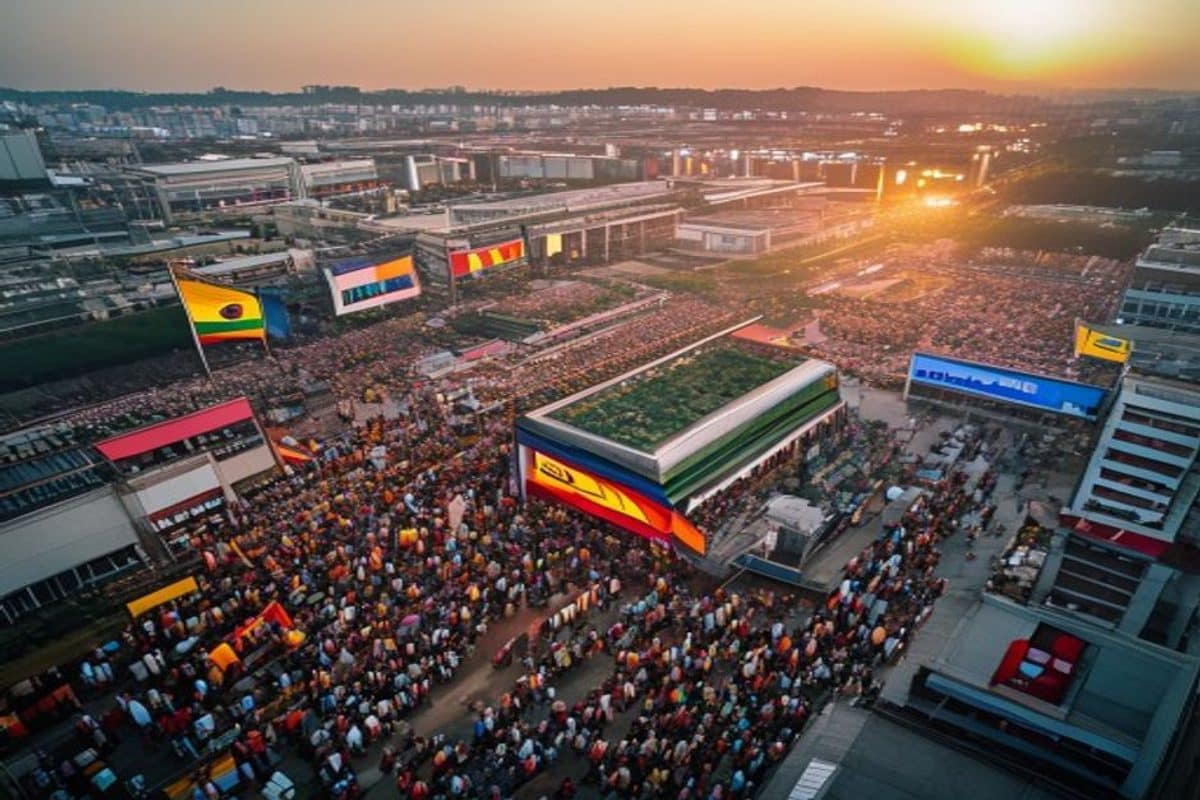
Up to 39,000 Samsung semiconductor workers rallied in Pyeongtaek on April 23, demanding 15% of the company's $38 billion quarterly operating profit and threatening an 18-day strike from May 21 that could disrupt global AI chip supply.
The scale of the rally makes it one of the largest organised labor actions in Samsung's history. Union leader Choi Seung-ho addressed the crowd from atop a crane-mounted structure, declaring they would not stop until their demands were met. Those demands are specific: remove the cap on performance bonuses and allocate 15% of operating profits to chip-division employees. At Samsung's reported Q1 2026 operating profit, that works out to more than $400,000 per worker on average across the roughly 74,000-strong workforce the union represents. The company has not publicly detailed its counter-offer, but has sought judicial intervention to prevent production line blockages, and Reuters reported overnight chip output dropped during the protest period.
The timing could not be more strategically sensitive. SK Hynix, Samsung's closest rival in high-bandwidth memory, just reported its best-ever quarterly results, driven by the same AI data centre demand powering Samsung's profits, and announced average bonuses of approximately $400,000 per employee. That comparison is not incidental. It is the central argument the union is making: a competitor in the same market, producing the same chips for the same customers, is sharing the windfall differently. Samsung's workforce is aware of the gap and organised enough to act on it.
For the AI industry, this is a preview of something that will intensify rather than pass. Samsung and SK Hynix together produce roughly two-thirds of global memory chips. HBM3E chips from both companies are essential to Nvidia's H100 and Blackwell GPU families, which sit at the centre of every major AI data centre buildout globally. A 25-day strike, as occurred in 2024, or an 18-day action beginning May 21, introduces a category of supply chain disruption that AI infrastructure buyers have not yet priced into procurement planning or risk models. The 2024 strike ended partly because workers could not sustain the loss of income. That calculus may look different when the company's quarterly profit runs to $38 billion.
The broader pattern is visible across the semiconductor sector. As Bloomberg Technology noted in covering the rally, AI systems depend on compute, data, and the human labor that designs, manufactures, and tests the chips that run those systems. Profits from AI are concentrating at the top of corporate structures. Workers building the physical infrastructure are beginning to organize around that asymmetry, and they have leverage: unlike a software engineer who can be replaced with relative speed, a skilled semiconductor technician takes years to train and operates within production environments where institutional knowledge directly affects yield rates.
What this means for startups and investors
For any startup or infrastructure team whose roadmap depends on GPU availability, the Samsung dispute is a risk event worth modeling. An extended strike does not just slow chip output. It gives SK Hynix further runway to consolidate its lead in HBM supply to Nvidia, a position it has built carefully and which Samsung has been trying to close. Supply tightening during a strike period pushes spot prices up and extends lead times, compounding the cost pressure already flowing from AI infrastructure build-outs.
At a strategic level, the episode signals that labor costs in the semiconductor supply chain are becoming a variable, not a fixed assumption. Compensation pressure at fabs and chip complexes will not resolve with a single negotiation. Every quarter that AI profits set a new record, the comparison baseline for worker demands resets upward. Companies building long-term AI infrastructure strategies, and the investors backing them, need to factor this in. The chip boom has been framed almost entirely as a supply-side technology story. The workers keeping the fabs running are making clear it is also a labor story, and one that is only getting started.
Also read: OpenAI's GPT Image 2 resets the bar for production-ready image generation • OpenAI's super PAC allegedly funded a fake news site staffed by AI reporters • OpenClaw makes DeepSeek V4 Flash its default model as the Huawei chip question hangs over the industry