The Nasdaq is not repeating 2000 in a simple way, but the market is again asking a familiar question: how much future growth can a narrow group of technology winners carry?
The latest warning sign is not that investors suddenly forgot how to read earnings statements. It is that the Nasdaq's biggest winners have started moving with the kind of force that usually appears late in a cycle, when confidence hardens into assumption and every new piece of good news gets priced as if the next one is already guaranteed.
MarketWatch reported this week that BTIG strategist Jonathan Krinsky found the top 10 performers in the Nasdaq 100 were up an average of 784 percent over the past year, above the 622 percent gain for the biggest winners in the year before the index peaked in March 2000. That is the metric behind the current comparison. It does not mean today's market is a carbon copy of the dot-com bubble. It does mean the temperature in the hottest corner of the market is no longer easy to dismiss.
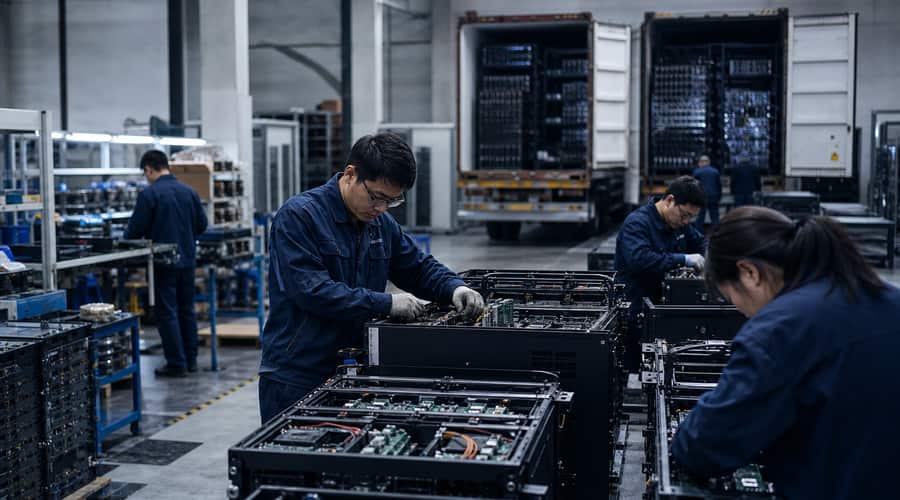
The names powering that one-year performance are not only the familiar mega-cap platforms. The most explosive gains have come from the hardware chain around AI, especially semiconductors, memory, storage, and data center infrastructure names such as Micron, AMD, Seagate, Western Digital, Sandisk, and Intel. The broader index concentration story, however, still comes back to Nvidia, Microsoft, Meta, Amazon, Alphabet, Broadcom, and Apple because they are the companies large enough to bend the index and define investor appetite for everything below them.
The strongest argument against a simple bubble call is earnings. In 1999 and 2000, many internet companies were priced on traffic, brand promise, and imagined business models. Some of the era's leaders were real companies, including Cisco, Microsoft, Intel, and Oracle, but valuations often assumed years of flawless growth. Cisco traded at extreme earnings multiples near the peak, while plenty of smaller dot-com names had little revenue and no credible path to profit.
Today's leaders look different. Nvidia has become one of the most profitable companies in the world, with annual revenue above $100 billion and gross margins that would have been hard to imagine for a hardware supplier in an earlier cycle. Microsoft, Alphabet, Amazon, and Meta are not concept stocks. They generate hundreds of billions in revenue, produce large operating profits, and have balance sheets that can fund infrastructure spending without needing public markets to stay open every quarter.
That makes the current setup more durable, but not automatically safer. The risk has moved from whether these businesses exist to whether their growth can keep justifying the capital now being committed. Alphabet, Amazon, Microsoft, and Meta are expected to spend roughly $700 billion or more on capital expenditures this year, largely for data centers, chips, power, networking equipment, and cloud infrastructure. That is not marketing spend. It is heavy industry wearing a software multiple.
This is where the comparison with 2000 becomes more useful. Back then, telecom carriers and internet companies built capacity on the belief that demand would catch up. Some of it eventually did, but not fast enough to protect shareholders from brutal losses. In 2026, the AI buildout has real customers and real revenue, yet it also depends on a small set of companies deciding that spending more is safer than falling behind. When every leader is building because the others are building, discipline becomes harder to see from the outside.
Why founders should care
For startup founders, this is not an abstract stock market debate. AI startup valuations, acquisition prices, IPO windows, and secondary sales are now tied closely to the public-market confidence around the largest AI platforms. If Nvidia keeps growing into its multiple and Microsoft, Amazon, Alphabet, and Meta show clear returns on AI infrastructure, private-market investors will keep underwriting ambitious revenue multiples for infrastructure, developer tools, vertical AI software, and model-adjacent services.
If the Nasdaq narrows further, the opposite pressure arrives quickly. Late-stage investors will ask whether startup revenue is truly independent or just recycled through the same hyperscaler and model-provider ecosystem. Public-market investors will become less forgiving of losses. Strategic buyers may still acquire, but they will push harder on price, especially if their own shareholders are questioning capex intensity and free cash flow. A market that looks generous on the way up can become very literal when the benchmark leaders stop rising.
The practical lesson is not to avoid fundraising or wait for perfect conditions. It is to understand what kind of market is funding you. Founders with real gross margins, clear customer retention, and revenue that does not depend on subsidized AI usage will have more room to move. Founders selling into the AI infrastructure boom need to show that demand survives when GPU supply improves, inference prices fall, or hyperscalers slow the pace of new commitments.
The Nasdaq can stay concentrated longer than skeptics expect, especially when the companies at the center are profitable and strategically important. But concentration always reduces the margin for error. For founders planning a raise, IPO, or secondary sale, the signal to watch is not only whether AI stocks are up. It is whether the earnings behind the rise are becoming more diversified, or whether the market is asking the same few companies to carry an ever larger story.
Also read: Qwen3.6 makes budget GPUs a serious local AI option • BeeLlama.cpp shows how local AI costs are starting to bend. • ChatGPT Images shows why visual AI demos need harder math tests