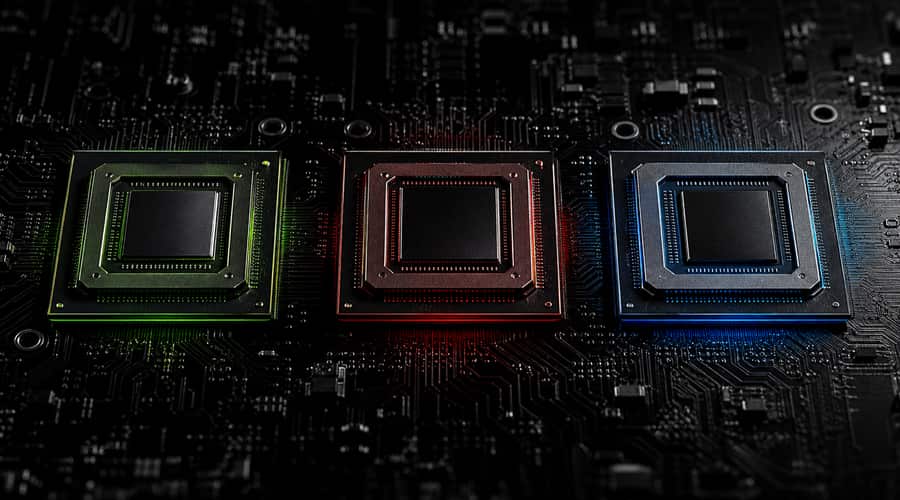
Nvidia still dominates AI data center revenue, but AMD gave investors the better first half of 2026. The market is not scoring the chip war the same way buyers are.
The AI chip war has a winner on paper. It is Nvidia. If you owned AMD stock heading into 2026, though, you had the better first half. That tension, between market control and investor returns, is the story behind the three-way scorecard that played out between January and June.
Nvidia's numbers are still staggering. The company reported $81.6 billion in revenue for its fiscal Q1 2027, with data center revenue of $75.2 billion, up 92% year over year, according to Nvidia's May 20 earnings release. Axis Intelligence calculated that Nvidia's data center revenue represented 87.4% of the combined data center revenue reported by Nvidia, AMD and Intel in Q1 2026. That is not a pure GPU market-share figure, because AMD and Intel include server CPUs in their data center segments. But the direction is clear enough. Nvidia is not scrambling for relevance. It is printing the market.
The stock story is different. Barchart calculated in early July that AMD shares had gained 142% year to date through the first half of 2026, while Nvidia was up just over 4%. Same sector. Opposite return profile. Nvidia's dominance was already in the price. AMD was still being treated as a harder, messier bet on a credible alternative, and that left more room for the stock to move once customers kept showing up.
AMD's data center revenue hit $5.775 billion in Q1 2026, up 57% year over year, according to the company's May filing. Its Instinct GPUs still hold only a small share of AI accelerator spending compared with Nvidia, but small is not the same as irrelevant. Microsoft Azure has offered MI300X virtual machines. Meta has talked publicly about using MI300X for Llama inference. Oracle and OpenAI are in AMD's customer orbit, and Dell is selling AMD-based AI systems to enterprise buyers rather than running a cloud GPU fleet of its own. That distinction matters. Don't blur customers, clouds and server vendors into one tidy list.
Then came the deal AMD could not have bought with a press release alone. In October 2025, AMD and OpenAI announced a 6 gigawatt agreement across multiple Instinct generations, starting with MI450 deployments in the second half of 2026. AMD also issued OpenAI a warrant for up to 160 million shares tied to deployment, technical and stock-price milestones. In July 2026, AMD added another large validation point when Anthropic agreed to deploy up to 2 gigawatts of MI450 GPUs and AMD committed up to $5 billion of investment, according to reports from The Wall Street Journal and others.
AMD does not need Nvidia's crown
Frankly, AMD's moat problem is real and shouldn't be papered over. Nvidia's CUDA software ecosystem has a decade of lock-in behind it. AMD's ROCm has improved, but moving model training infrastructure from CUDA to ROCm is not painless. Most hyperscalers use AMD as a complement to Nvidia, not a clean replacement. That is the gap.
But AMD does not need to beat Nvidia to justify the first-half rally. It needs to hold No. 2 while AI infrastructure spending keeps expanding. Even a 10% slice of a much larger compute market would be a major business, especially if AMD can sell GPUs alongside CPUs and the rack-scale systems around them. That is still real money.
Intel is the warning
Intel's Gaudi 3 AI accelerator never gained meaningful cloud traction. The company said in 2024 that it would miss its $500 million Gaudi 3 revenue target, with software readiness a central problem. Intel then cancelled Falcon Shores for commercial release and said it would use the chip internally instead, a decision The Register described in February 2025 as Intel having missed the boat for AI in the data center.
The next chip in line is Crescent Island, an inference-focused data center GPU based on Intel's Xe3P architecture. Intel showed the design at Computex 2026, with customer sampling expected in the second half of 2026. The odds are poor. FutureSearch put only a 13% probability on AWS, Azure, Google Cloud or Oracle announcing a Crescent Island deployment by December 31, 2027. That forecast is not gospel, but it is grounded in the fact that no top-four cloud has announced a Crescent Island commitment yet.
This is bigger than Intel's shareholders. A genuine three-way competition for AI compute would help every cloud buyer and every startup paying per-GPU-hour - not to mention every company trying to build models without handing Nvidia all the pricing power. Custom silicon from Google, AWS, Microsoft and Meta will keep growing. Merchant alternatives are narrowing to two names. Buyers lose bargaining power. That is a real problem.
So yes, Nvidia still owns the market that matters most. AMD owned the first-half stock chart. Intel, for now, owns the cautionary tale. If you score by revenue share, Nvidia wins. If you score by investor returns, AMD wins. If you were waiting for Intel to break the duopoly, you are still waiting.
Also read: Chinese investors are using crypto derivatives to route around Beijing's AI stock controls • Anthropic's silence on Nvidia's open-weights letter is the most revealing thing about it • Moonshot AI's Kimi K3 model sends its valuation toward $50 billion and a Hong Kong IPO