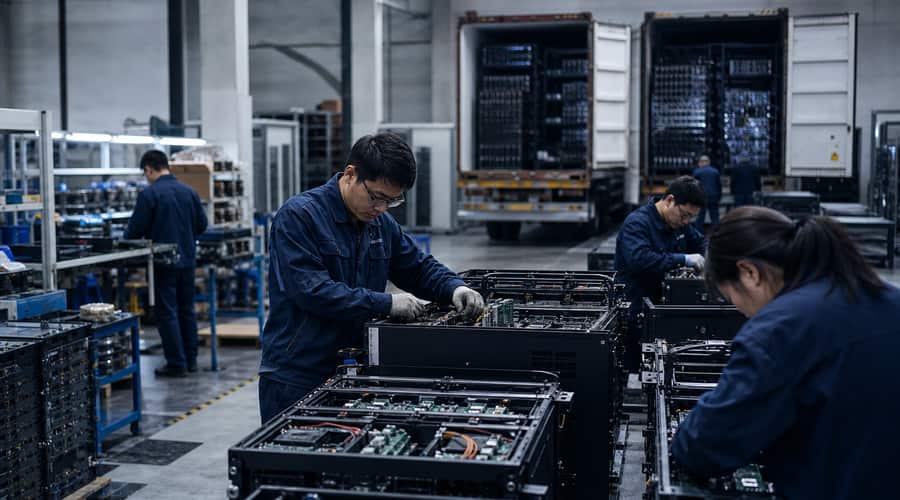
Drone and missile strikes attributed to Iran have damaged Amazon Web Services facilities in the Middle East, knocking out availability for an extended period and forcing a reckoning with just how physical the cloud actually is.
Cloud infrastructure has spent the better part of a decade being sold as elastic, borderless, and essentially frictionless. Spin up a region, deploy across availability zones, and trust that the hyperscaler has engineered away the hard problems. The damage to Amazon's Middle East data centers, caused by Iranian drone and missile strikes, is a direct challenge to that assumption. Repairs are expected to take months. The services and customers depending on those facilities do not get to wait months. What looked like a solved problem, reliable compute in a strategically important region, has turned out to be a building in a conflict zone.
AWS has data center infrastructure across the Middle East spanning its Bahrain region, which launched in 2019 as its first in the Middle East, and the UAE region that followed. The company has not released a granular breakdown of exactly which availability zones or services are most affected by the damage, which is consistent with how hyperscalers typically handle disclosures involving physical security incidents. What is clear from reports is that the disruption is not the kind that resolves in hours through failover or rerouting. Physical damage to the facility layer, power systems, cooling infrastructure, and the hardware itself requires replacement supply chains and on-site repair work that cannot be parallelized indefinitely. Several months is not a conservative estimate , it reflects the reality of rebuilding dense compute infrastructure in a region where logistics are already complicated.
The customers most exposed are not the ones who over-engineered for resilience. They are the ones who made a reasonable bet on a stable region and did not hedge it because the cost of multi-region redundancy looked higher than the risk of a prolonged outage. For many startups, that calculus made sense until last week. Government contracts and regulated enterprise workloads in the Gulf Cooperation Council states often carry data residency requirements that prevent simple failover to European or Asian regions, which means some customers face a genuine compliance bind alongside the operational one. They cannot legally move their data to a functioning region, and their designated region is not functioning.
AI workloads add a specific layer of pain here. Training runs and inference serving at scale are not stateless web applications. A training job interrupted by a regional outage does not cleanly resume from a checkpoint in another region without careful prior engineering. Model inference behind latency-sensitive applications in the Gulf, whether for Arabic-language models, regional fintech deployments, or government-facing AI tools, faces either significant latency increases from rerouting through distant regions or a complete service interruption. The AI layer is only as available as the GPU cluster underneath it, and GPU clusters are physical things that can be hit by a drone.
Rethinking the infrastructure assumption
The deeper issue this surfaces is one the cloud industry has been slow to address directly. Hyperscaler reliability statistics are almost always calculated against software failures, hardware component failures, and network events. They are not calculated against kinetic attacks on physical facilities. AWS, Azure, and Google Cloud publish detailed availability SLAs and architectural guidance for multi-region resilience, but that guidance implicitly assumes that at least some regions remain intact. A scenario where a geopolitical event takes a region offline for months sits outside the normal failure model, and most startup architectures were not designed with it in mind.
This is not an argument for building everything on-premises or abandoning cloud infrastructure. The economics and operational leverage of hyperscalers remain compelling, and most workloads will never face a risk like this. But it is an argument for treating region selection as a geopolitical decision, not just a latency and cost optimization. The Middle East is not the only region where that framing applies. Undersea cable routes, power grid dependencies, and the concentration of physical data center capacity in a small number of geographic clusters are all vectors through which physical reality asserts itself over cloud abstractions.
For founders building on AWS or any hyperscaler in regions with elevated geopolitical exposure, the practical responses available right now are fairly clear. Multi-region active-active architecture is expensive but it is the only configuration that actually survives a regional loss without service interruption. For workloads that cannot be distributed across regions due to compliance requirements, the honest answer is that local or sovereign cloud infrastructure, despite its higher cost and lower capability, may be the only option that meets both the regulatory and resilience requirement simultaneously. Edge inference, running model weights closer to users on smaller hardware rather than routing everything to a central region, also looks more attractive when the central region becomes a liability.
What the Middle East outage ultimately does is make infrastructure risk legible in a way that years of SLA documents and architecture whitepapers have not managed to do. Data centers have coordinates. They appear on satellite imagery. They draw power from grids that are themselves physical infrastructure. The companies that build their roadmaps around that reality, rather than the marketing abstraction of infinite elastic cloud, will be better positioned for a world where geopolitical risk is no longer a tail event but a recurring planning input.
Also read: Samsung is turning your refrigerator and washing machine into AI endpoints and the smart home startup world should pay attention • Autonomous Long-Running Coding Agents Are Becoming a Developer Tool Default and Startups Are Not Operationally Ready for What That Means • The Defense AI Land Grab by Nvidia Microsoft and AWS Is Moving Faster Than Most Startups Realize and the Window to Compete Is Narrowing