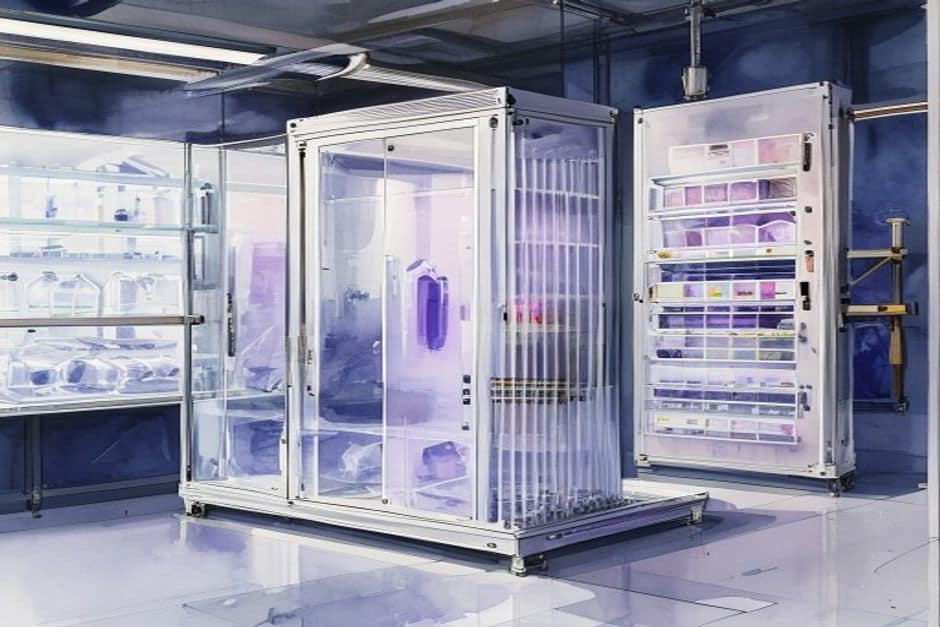
Barocal is betting that plastic crystals can replace refrigerant gases in one of the most stubborn parts of modern infrastructure.
A Cambridge startup has raised $10 million to commercialise a cooling system that does not depend on the gases still sitting inside most refrigerators, air conditioners, supermarket cases and data center equipment. Barocal wants to move cooling away from vapor compression, the architecture that has dominated the market for more than a century, and toward solid materials that heat and cool when pressure is applied and released.
That sounds like a lab story, because in many ways it still is. But it is also arriving at a moment when cooling has become a much larger business problem. AI data centers are demanding more power and thermal management. Heat waves are making air conditioning less optional in more parts of the world. Regulators are pushing industry away from high-impact refrigerant gases. A technology that can cool efficiently without leaking climate-warming gases has an obvious audience, if it can survive the hard part between prototype and mass deployment.
Barocal was founded in 2019 as a University of Cambridge spin-out by materials physicist Professor Xavier Moya and business developer William Averdieck. Its technology is built around barocaloric materials, a class of solids that change temperature under pressure. In simple terms, the material releases heat when squeezed, then absorbs heat when the pressure is removed. Put that cycle into an engineered system, move heat to the right place, and it begins to look like refrigeration without the refrigerant gas.
According to a recent TechCrunch report, Barocal has raised the seed round from World Fund, Breakthrough Energy Discovery, Cambridge Enterprise Ventures and IP Group. The company says it will use the funding to build its engineering team and accelerate development ahead of commercial deployment. That investor list matters, because this is not a quick software bet. It is materials science, hardware engineering and industrial adoption rolled into one, which means the capital has to be patient enough to wait for reliability data and manufacturing discipline.
The timing is not accidental. Heating and cooling account for a large share of global emissions, and the sector has long suffered from a strange visibility problem. Everyone notices aircraft, oil rigs and electric cars. Fewer people think about the compressor behind a grocery freezer or the cooling loop inside a data center, even though those systems quietly shape electricity demand and climate impact every day.
Traditional vapor-compression systems are effective because they are cheap, durable and well understood. That is exactly why they are so difficult to replace. The installed base is enormous, technicians know how to service it, and manufacturers have spent decades removing cost from the system. Any alternative has to do more than sound cleaner. It has to compete on performance, price, maintenance and supply chain reality.
Barocal is making the case that its solid-state platform can eventually hit those marks. The company says its approach avoids gas leaks entirely while offering efficiency gains, and it is targeting a global heating and cooling market estimated at roughly $450 billion. Early commercial targets include data center cooling and commercial refrigeration, two areas where energy use, uptime and emissions pressure are already board-level concerns rather than nice-to-have sustainability metrics.
Data centers are the cleanest example of why investors are paying attention now. AI workloads are pushing more dense computing into facilities that already run hot, and cooling is one of the core constraints on where and how those facilities can grow. If a new thermal management system can reduce electricity draw or simplify refrigerant compliance, it has a direct path into a market that is spending aggressively.
The Scaling Risk Is The Real Story
The strongest version of Barocal is a platform technology. If the same underlying material cycle can be adapted across commercial refrigeration, building cooling, industrial heat management and possibly heating applications, the company is not merely building a better fridge component. It is trying to create a new category of thermal hardware.
The cautious version is that this remains an early lab-to-market bet. Pressure-driven materials need to work through huge numbers of cycles without degrading. Systems have to be quiet, compact and serviceable. The materials need to be available at cost and in volume. Engineers have to design around pressure, heat exchange and control electronics in a way that beats the boring reliability of existing compressors.
That is why the $10 million round should be read as a serious vote of confidence, not proof of victory. The money gives Barocal room to hire, test and move closer to deployment, but it does not erase the basic challenge facing every deep-tech climate startup: the incumbent is flawed, but it works. Customers will care about emissions and regulation, but they will care even more about whether food stays cold, servers stay online and maintenance crews can fix the system without drama.
Still, the upside is large enough to justify the attempt. Refrigeration is one of those markets where small efficiency gains become meaningful at global scale, and the leak problem is not going away by itself. If Barocal can prove that plastic crystals can deliver dependable cooling outside the lab, the company could turn a materials breakthrough into infrastructure that touches homes, stores, factories and data centers. The next thing to watch is not the science alone. It is whether Barocal can make the science behave like a product.
Also read: Europe is racing to make cheap autonomous weapons at home • AI's giant spending spree is making investors ask harder questions • Tech managers are losing ground as AI rewards leaner teams