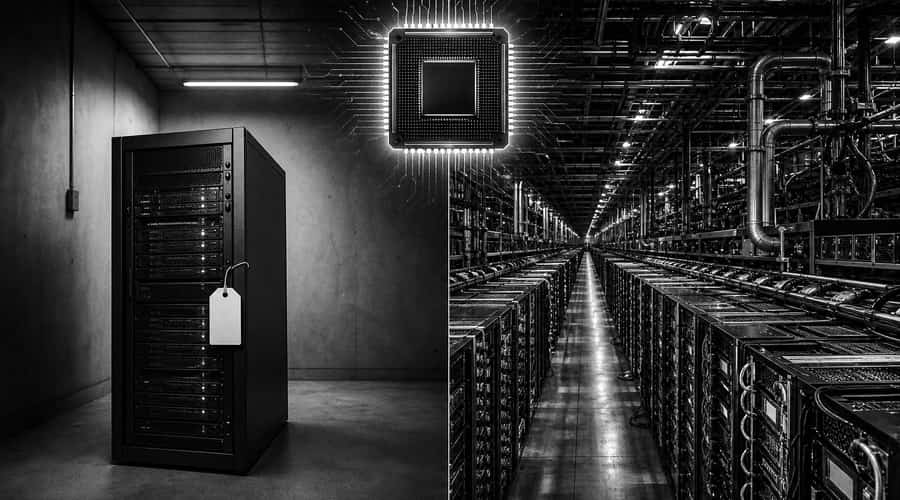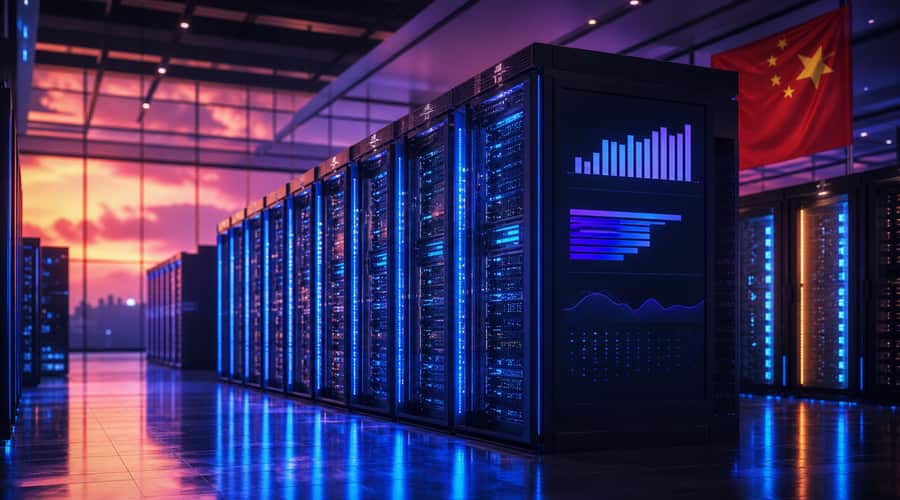
China's LineShine has taken the top spot on the TOP500 list without using GPU accelerators, which is exactly the kind of result Washington's chip controls were not built to stop.
LineShine did not creep into the supercomputing rankings. It arrived at number one. According to the 67th TOP500 list announced at ISC 2026 in Hamburg on June 23, the Shenzhen system posted a High Performance Linpack score of 2,198.40 petaflops per second, putting it more than 20 percent ahead of El Capitan, the Lawrence Livermore National Laboratory machine that had led the field.
You should be careful about reading too much into one benchmark. But you should not read too little into this one either. LineShine is installed at the National Supercomputing Centre in Shenzhen, was built by the Shenzhen Cloud Computing Center, and had never appeared on a TOP500 list before. It went straight to the top.
The machine runs on a custom LingKun platform built around 304-core LX2 processors clocked at 1.55 GHz. TOP500's published system details put it at more than 13.7 million cores, linked through a proprietary LingQi interconnect and running Kylin OS. It draws 42,220 kilowatts of power. That is not a small-footprint triumph. It is brute-force national computing, and China has just shown it can still do brute force very well.
Here is the part Washington cannot ignore: LineShine has no GPU accelerators at all. El Capitan pairs AMD EPYC CPUs with AMD Instinct MI300A accelerators. Frontier uses AMD MI250X GPUs. Aurora at Argonne National Laboratory runs Intel Xeon CPUs alongside Intel Data Center GPU Max chips. JUPITER, the new European system at Jülich and Europe's first exascale machine, uses NVIDIA Grace Hopper Superchips. LineShine did it with CPUs.
The gap is not cosmetic. El Capitan scored 1,809 petaflops. Frontier managed 1,353. Aurora came in at 1,012. LineShine also ranked first on the HPCG benchmark at 22 petaflops, a test meant to reflect application performance more closely than raw floating-point speed. On HPL-MxP, the mixed-precision benchmark more relevant to AI-style workloads, it placed fourth at 7.92 exaflops. That weaker showing fits the design. A CPU-only machine is not built like an AI training cluster packed with accelerators.
The June 2026 list is also the first TOP500 ranking in which all five leading systems crossed the exascale threshold, meaning each can perform more than a quintillion calculations per second. For China, the symbolism is plain. The country had not held the number one position since Sunway TaihuLight led the rankings in 2017. Now it is back, and it is back with a machine that does not look like the American systems it displaced.
Frankly, that is the most interesting part of the story. Washington's export controls on advanced chips were aimed mainly at the hardware that powers AI training, especially high-end GPUs from NVIDIA and AMD. Those controls have had real effects. Chinese companies have stockpiled older accelerators, worked on domestic alternatives such as Huawei's Ascend chips, and looked for supply routes through third countries. The restrictions have made China's AI buildout harder.
LineShine is a different problem. It is not an NVIDIA H100 substitute, and it is not being presented as the machine that will train the next frontier model. It is a scientific supercomputer, the kind used for climate modeling, molecular dynamics, materials simulation and other high-performance computing workloads governments have cared about for decades. If you judge it by AI accelerator logic, you miss what it actually proved.
What it proved is narrower, and more uncomfortable. Export controls can choke access to a specific class of foreign chips, but they cannot by themselves stop a country from designing general-purpose processors, building its own interconnect, and scaling the result into a machine that tops a public benchmark. The LingKun LX2 is not beating NVIDIA at NVIDIA's own game. It is playing a different one and winning there.
That distinction should shape how you read the US-China technology fight. The United States may still have the stronger hand in frontier AI chips. NVIDIA's GPU ecosystem, CUDA software, cloud access and developer base are not erased by one TOP500 result in Shenzhen. But the idea that chip controls can broadly freeze China's progress in advanced computing looks weaker after LineShine.
There is also a warning here for anyone who treats supercomputing rankings as a clean proxy for technology leadership. TOP500 measures HPL performance, not AI usefulness, software maturity or manufacturing yield. LineShine's mixed-precision result shows the limit clearly. If you want to train large language models at scale, GPU-heavy systems still have the advantage. If you want to show that China can assemble a CPU-only exascale system outside the usual US accelerator stack, LineShine has already done that.
So the conclusion is not that Washington's controls failed. That is too neat. The better conclusion is that they worked on the thing they were aimed at, while China kept building around the edges. Those edges now include the fastest publicly ranked supercomputer on the planet.
Also read: A single bad block just froze Base twice in 48 hours and the sequencer problem is not going away • Ford spent billions learning that AI cannot replace engineers who know where the bodies are buried • Cloudflare cut 20% of its workforce while growing its engineering team, and Matthew Prince says every company will do the same