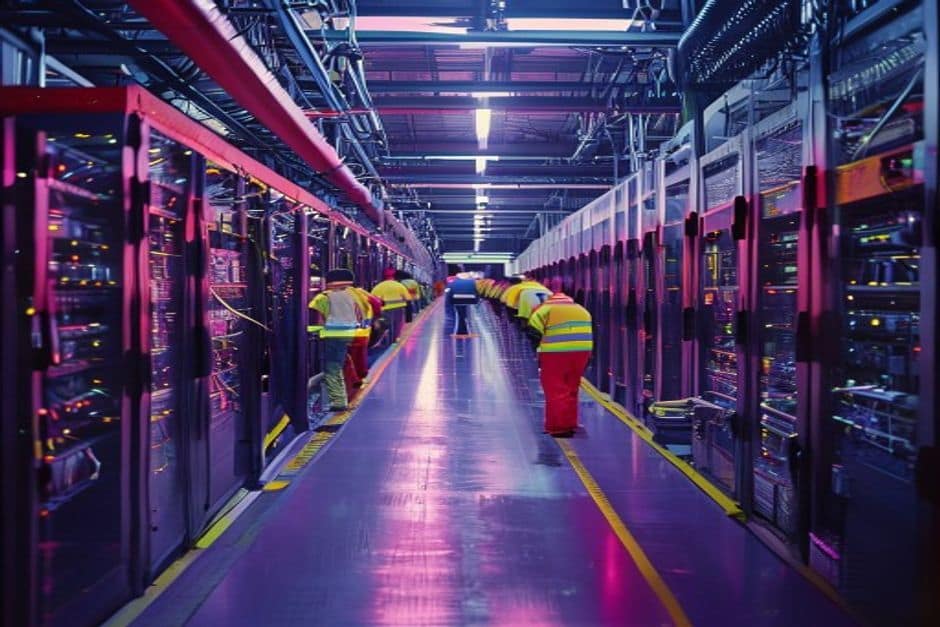
Flex, the global electronics manufacturing services company, plans to spin off its AI data center infrastructure unit into a separately listed company, according to Reuters, in a structural decision that reveals how far the AI infrastructure premium has penetrated beyond chipmakers and cloud providers into the industrial and manufacturing suppliers whose power systems, cooling equipment, server assembly, and rack integration services form the physical layer underneath the compute that frontier models and enterprise AI workloads consume.
Flex's data center infrastructure operations have been growing rapidly as hyperscaler capital expenditure programs have driven demand for the manufacturing and integration services that turn component supply chains into deployable data center capacity. The unit provides server and rack manufacturing, power conversion equipment, thermal management systems, and the supply chain integration services that allow hyperscalers to deploy GPU clusters faster than they could through direct component procurement and assembly. As a division within Flex's broader electronics manufacturing services business, which also includes consumer electronics, automotive components, medical devices, and industrial equipment, the data center infrastructure work has been growing at a faster rate and commanding better margin profiles than the other segments, creating the classic conglomerate discount problem: investors pricing the slower-growing diversified business are unable to apply the data center infrastructure multiple to the unit that deserves it because it is bundled with operations whose growth trajectory does not justify AI infrastructure valuations.
The spinout logic is straightforward once you understand how public market investors are currently pricing AI infrastructure exposure. Pure-play data center infrastructure companies, including the power equipment, cooling, and server integration suppliers that have direct hyperscaler customer exposure, have been trading at revenue multiples that would have been considered extraordinary for industrial manufacturers before the AI buildout began. Vertiv, which provides power and thermal management for data centers, trades at a premium that reflects concentrated data center customer exposure. Eaton's power management division has outperformed the parent company's diversification. nVent Electric's data center segment has carried its overall valuation. The pattern is consistent: when AI infrastructure exposure is identifiable within a diversified industrial company, the market applies a separate and higher multiple to that exposure, and the way to realise that multiple fully is to separate the unit into a company where 100 percent of the earnings story is data center infrastructure. Flex is doing exactly that calculation and concluding that its data center unit is worth more as a standalone than it contributes to the parent's blended valuation.
The comparison with recent data center debt and asset transactions is instructive for calibrating what the Flex spinout might eventually be worth in public markets. Blue Owl-backed Stack Infrastructure's Asia operations were recently reported by Bloomberg to be exploring a sale at a valuation near $30 billion, reflecting the premium that committed hyperscaler capacity commands in private infrastructure transactions. Stack and Flex operate in adjacent but distinct segments: Stack owns and operates data center facilities under long-term leases, while Flex provides the manufacturing and integration services that fill those facilities with functional compute infrastructure. The business model differences mean the revenue multiples will differ, with asset-light manufacturing services businesses trading at lower multiples than real-estate-backed infrastructure operators with contracted occupancy. But both sit in the same infrastructure supply chain that AI demand is repricing, and the public market comparables for a Flex data center spinout will include not just manufacturing peers but the power, cooling, and rack integration businesses whose valuations have been pulled upward by hyperscaler capex concentration.
The timing of the Flex announcement is itself a signal about market conditions. Spinouts are typically executed when the market multiple gap between the separated businesses is large enough to justify the transaction costs, management distraction, and operational complexity of separation. Flex's management has concluded that the multiple gap is currently large enough to make the spinout value-accretive for shareholders, which means they believe the public market will value an AI data center infrastructure pure-play at a meaningfully higher multiple than the current conglomerate discount allows. That conclusion is consistent with the broader trend of AI infrastructure assets being valued ahead of software AI economics, a pattern that has been characteristic of previous technology platform buildouts. During the cloud computing buildout of the 2010s, data center REITs and fiber infrastructure companies commanded significant premiums before cloud software economics were fully proven out, because investors were willing to price the infrastructure on the demand trajectory even before the revenue was fully visible. The same dynamic appears to be operating in AI infrastructure now, with power, cooling, server assembly, and rack integration businesses trading at multiples that reflect anticipated compute demand rather than only current contracted revenue.
For AI startups and the founders watching the infrastructure investment landscape, the Flex spinout represents a data point in the broader story of AI infrastructure becoming a standalone asset class. When a diversified industrial manufacturer concludes that its data center infrastructure unit deserves a separate public listing rather than remaining a segment within a larger business, it demonstrates that the investment and analyst community has developed sufficient framework for valuing AI infrastructure as a distinct category that pure-play exposure is commercially worth pursuing. That development matters for founders because it affects the financing environment for the entire compute supply chain. Companies that previously funded data center infrastructure through diversified industrial balance sheets or private credit are now considering public equity as a financing mechanism, which expands the capital available for infrastructure buildout and potentially accelerates the pace of compute capacity expansion. More capital flowing into the infrastructure layer means more competition for power, land, and skilled installation capacity, which are the constraints that currently determine how fast hyperscalers can expand their AI compute footprint and therefore how quickly the cloud capacity that AI startups depend on will grow. The public market validation of AI infrastructure as an investable category, visible in Flex's spinout decision and comparable transactions across the sector, is one of the financial mechanisms through which the AI buildout sustains itself beyond the balance sheets of the handful of companies whose capex programs originally drove it.
Also read: Anthropic Just Launched 10 Financial Services Agents and FactSet Fell 8% on the Same Day for Good Reason • Stack Infrastructure's Asia Operations May Be Worth $30 Billion and That Number Tells You Everything About How AI Has Repriced Physical Compute • Podcast Index Says 39% of New Podcasts May Be AI-Generated and the Real Problem Is What Synthetic Audio Does to Discovery, Ads, and Platform Economics