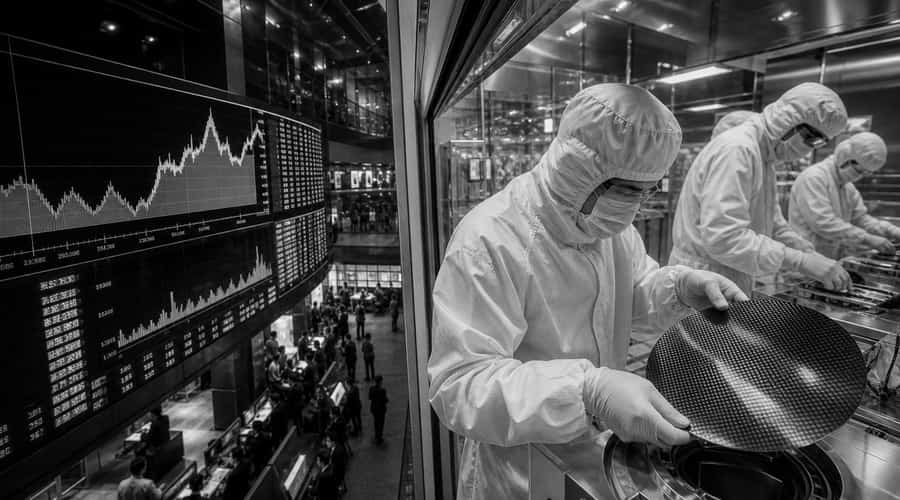
Nexchip Semiconductor raised $890 million in a Hong Kong debut priced at the top of its range, and Beijing's bet on legacy chipmaking just got a real market test.
Nexchip Semiconductor Corp began trading in Hong Kong on Friday after selling 216.2 million shares at HK$32.30 apiece, the maximum price in its offering range, raising roughly $890 million. The Hefei based wafer foundry priced its Hong Kong shares at a 57% discount to the 65.21 yuan close of its existing Shanghai listed stock on Thursday, according to Bloomberg, a gap wide enough that the debut needed little extra sweetener to draw buyers.
That's the story in one line. A state backed Chinese chipmaker just proved investors will still show up for legacy semiconductor manufacturing, even with Nvidia's most advanced silicon locked out of the country.
Nexchip isn't chasing the AI accelerator race. It makes display driver chips, the silicon that controls what shows up on a phone or television screen, along with power management chips, microcontrollers and CMOS image sensors. Its historic sweet spot sits at 55 to 150 nanometer process nodes, the mature end of the chipmaking spectrum that rarely makes headlines but keeps cars, appliances and consumer electronics running. Founded in 2015 as a joint venture between Hefei's government owned investment arm and Taiwan's Powerchip Technology, Nexchip has grown into China's third largest pure play foundry, trailing only SMIC and Hua Hong Semiconductor.
The IPO proceeds have a specific destination. About 53.6% is earmarked for research and development on a 22 nanometer chipmaking platform, a real step up in sophistication from Nexchip's current capabilities. The rest is tied to production capacity linked to AI related demand, mostly the power management and display chips that go into AI hardware rather than the AI processors themselves. Nexchip is also pouring 35.5 billion yuan, about $5.1 billion, into a Phase IV facility in Hefei's Xinzhan High Tech Zone that will eventually produce 55,000 wafers a month at the 28 and 40 nanometer nodes. Equipment installation starts in the fourth quarter of this year, with full production targeted for the second quarter of 2028.
Timing matters here. Nexchip's debut lands in the middle of the busiest stretch for Hong Kong listings in five years. New offerings on the exchange totaled about $22.45 billion in the first half of 2026, up nearly 57% from a year earlier, and Deloitte is forecasting roughly 160 new Hong Kong listings this year raising at least HK$300 billion. Chinese chipmakers are a big part of that wave, though not all on the same exchange. ChangXin Memory Technologies, China's largest DRAM maker, is preparing a $4.3 billion listing on Shanghai's STAR Market, with subscriptions opening July 16 and trading expected around July 24, after Bloomberg reported the company's revenue grew sevenfold in the first half of the year. SK Hynix, meanwhile, priced a roughly $24.5 billion Nasdaq offering that was more than seven times oversubscribed just days before CXMT's Shanghai deal.
Three different exchanges, three different chipmakers, one shared signal. Investors are willing to pay up for exposure to the physical infrastructure of the AI buildout, whether that's DRAM from CXMT, advanced memory from SK Hynix, or the unglamorous mature node chips Nexchip has spent a decade perfecting.
US export controls target the advanced end of the chip stack, the sub 10 nanometer logic and the high bandwidth memory that go into Nvidia's data center GPUs. They bite far less at 28, 40 or 55 nanometers, which is exactly where Nexchip lives. That's not an accident. China's Big Fund, the state investment vehicle launched in 2014, and the Made in China 2025 initiative that followed a year later both aimed at building a domestic supply chain resilient to exactly this kind of American pressure, with a target of 70% chip self-sufficiency. Nexchip's Hong Kong listing gives that strategy a public market price tag for the first time, and investors just signaled they will pay it.
Nexchip isn't catching up to TSMC or Samsung on cutting edge logic, and it isn't trying to. The bet is that the chips nobody talks about, the ones that make screens light up and batteries behave, are exactly the ones Washington can't easily choke off. An $890 million raise priced at the top of its range says the market thinks that bet still has room to run.
Also read: Anthropic Resets Claude Code Usage Limits Again After a Rough Week of Outages • AI Data Centers Are Quietly Pumping Pollution Into the Cities Built to Host Them • Singapore's AGONG Durian Uses Blockchain to Prove Every Fruit Is Genuine