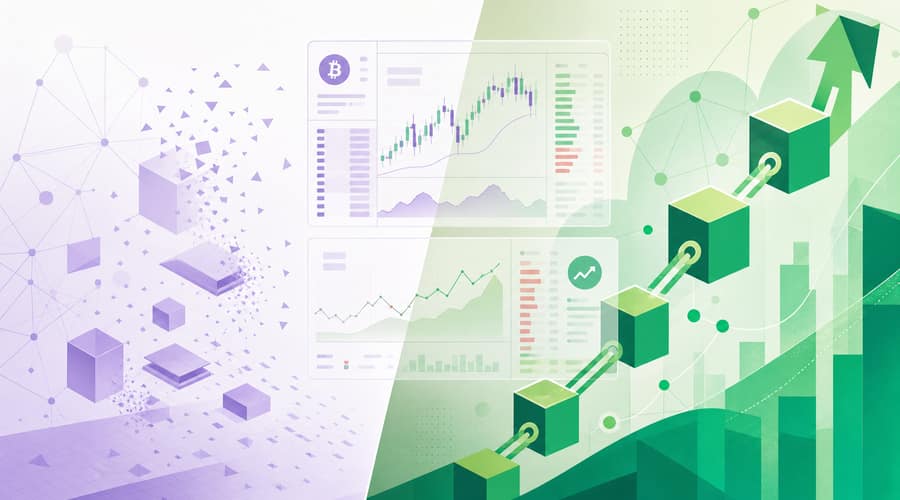

A bonding curve is the math that prices a token before any exchange touches it, and it's why a pump.fun coin can go from nothing to a million-dollar market cap in an afternoon.
If you've ever watched a token on pump.fun rocket from a fraction of a cent to several cents in minutes, with no order book, no market maker, and no listing announcement anywhere, you've watched a bonding curve at work. It's the single most important mechanic in the current wave of retail token launches, and most of the people trading it couldn't explain how it sets a price if you asked them.
Here's the short version. A bonding curve is a formula, coded directly into a smart contract, that determines a token's price based purely on how many tokens have already been sold. Buy tokens, and the price for the next buyer goes up. Sell, and it goes down. There's no buyer matched to a seller, no bid and ask. You're always trading directly against the contract itself.
Most bonding curves are exponential or some variant of it. Early buyers pay almost nothing because the curve starts flat near zero. As supply sold climbs, the curve steepens, and each additional token costs more than the last one. This isn't a policy choice by a founder. It's a mathematical guarantee written into the contract, and it can't be changed after deployment without redeploying the whole thing.
Pump.fun, the Solana launchpad that turned this into a mainstream retail habit in 2024, uses a fixed bonding curve for every token it mints. A creator deploys a coin for free, the curve sells tokens directly against a pool of SOL, and once that pool hits roughly 85 SOL raised, the remaining liquidity, together with the accumulated SOL, gets deposited into a Raydium liquidity pool and the token graduates to a normal automated market maker. Dune Analytics data cited widely across crypto media put the platform's cumulative token launches past four million by late 2024, with only a small single-digit percentage ever reaching that graduation threshold. Most bonding curves never finish the climb. They just die with the chart flat near zero.
That graduation mechanic is the whole point, and it's where founders and investors need to pay attention. A bonding curve isn't a permanent pricing model. It's a bootstrapping phase, a way to establish price discovery and seed liquidity for an asset that has neither, before handing the token off to a conventional market structure.
Bonding Curve Crypto Explained: Why It Beats an Empty Order Book
Launch a token the old way, on Uniswap with a manually seeded liquidity pool, and you need capital up front. Someone has to deposit both sides of the pair. Skip that step and you get an order book with nobody on it, which means no price and no way to buy or sell without slippage so severe it's meaningless.
A bonding curve solves that by making the contract itself the counterparty. There's always a price, because the formula always returns one, no matter how thin activity is. The first buyer at 3am with no other traders online still gets a quote. That's the actual innovation, not the hype cycle attached to it. Continuous token models, the academic term for this design, trace back to work by economist Simon de la Rouviere around 2017 and were later formalized in projects like Bancor, which used bonding curves to guarantee liquidity for its network tokens without relying on external market makers.
Compare that to a standard automated market maker vs bonding curve setup, and the distinction gets clearer. An AMM like Uniswap prices assets based on the ratio of two tokens sitting in a pool, and that ratio only moves because traders swap against it. A bonding curve prices a single token against a single formula, no pool ratio required, no counterparty needed beyond the contract. AMMs are built for trading two assets against each other at scale. Bonding curves are built for minting one asset out of nothing and giving it a price from the very first unit sold.
The Part Retail Traders Miss
Here's the thing most people trading these tokens don't grasp: the curve guarantees a price, not a profit. Because the formula is deterministic, an early buyer can, in principle, always sell back into the curve at a lower price than the next buyer would pay, which is what creates the appearance of guaranteed liquidity. But that liquidity is entirely a function of new buyers continuing to arrive. Stop the inflow and the exit price for existing holders collapses toward whatever the curve says the current supply level is worth, which, for a token that never graduates, is close to zero.
This is why pump.fun's own data, and the broader graduation statistics tracked across Dune dashboards, show such a brutal drop-off rate. The bonding curve isn't rigged. It's honest math. It just doesn't care whether the humans buying into it understand that they're the liquidity, not the market.
Founders building on continuous token models should treat the curve as a distribution tool, not a valuation. The price a bonding curve produces at any given moment reflects cumulative demand up to that point, full stop. It says nothing about whether the underlying project has revenue, users, or a reason to exist past the launch window. Confusing curve price with fundamental value is the single most common mistake retail investors make on these platforms, and it's an easy one to make when the chart is going straight up.
What This Means for the Next Launch You See
If you're evaluating a token launch that uses a bonding curve, the questions worth asking aren't about the curve's shape. They're about what happens after graduation. Does the project have a plan beyond the liquidity migration? Who controls the treasury once tokens move to an AMM? Pump.fun itself has iterated on this: in 2024 it introduced a livestreaming feature and later faced its own scrutiny after a high-profile incident involving a leaked developer key that let an attacker mint and dump tokens through the platform's infrastructure, a reminder that the smart contract math is only as trustworthy as the team that deployed it.
Bonding curves solved a real problem: how do you price an asset that has zero history and zero liquidity the moment it's created. They didn't solve the problem of whether that asset deserves a price at all. That distinction is the whole difference between understanding this mechanic and just watching a chart move.
Also read: What Is a Zero-Knowledge Proof and Why Crypto Runs On It Now • What Is MCP, the Model Context Protocol Powering AI Agents Now • How Your Onchain Credit Score Could Replace a Bank Loan Officer