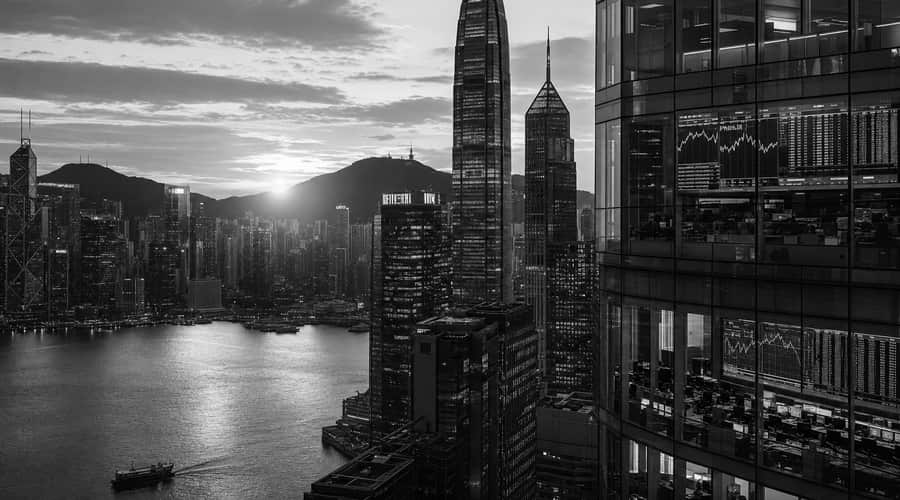
Hong Kong is becoming the practical listing venue for Chinese AI companies that need public money and can't count on New York. The rush is real, but you shouldn't confuse a hot debut market with permanent investor conviction.
Hong Kong's IPO market has come back with a very specific engine: Chinese AI and semiconductor companies that need capital, want international investors and no longer see New York as the obvious route. According to the Financial Times, Hong Kong raised more than $13 billion from equity sales in the first quarter of 2026, its strongest start in five years and ahead of Nasdaq and Bombay during that stretch. That's not a normal rebound. That's a capital route being rebuilt in public.
The names tell you what changed. Zhipu, now listed as Knowledge Atlas Technology and known internationally as Z.ai, began trading in Hong Kong on January 8, 2026. The Wall Street Journal reported that it raised HK$4.35 billion in the offering and ended its first day up about 13%, a modest debut by the standards of this market but still a first for one of China's major large language model developers. The company was founded in 2019 by researchers from Tsinghua University, and its losses were already heavy enough to remind you that public investors are not buying clean software margins here. They're buying a place in China's AI buildout.
MiniMax arrived one day later and gave the market the cleaner spectacle. Barron's reported that the Shanghai AI startup raised HK$4.8 billion and jumped 109% on its first day, from an offer price of HK$165 to HK$345. MiniMax had the story investors like: Alibaba backing, consumer AI products including Talkie and Hailuo AI, and a position inside the group of Chinese model companies often called the AI tigers. You don't get a move like that from sober spreadsheet work alone. Retail money was chasing the theme.
DeepSeek gave that theme its spark. When the Hangzhou lab released R1 in early 2025 and showed that a Chinese model could compete without copying the spending pattern of the biggest US labs, investors had to revisit a lazy assumption: that US chip restrictions would simply freeze China's AI sector in place. They haven't. They have made domestic chips, model efficiency and Hong Kong fundraising more important.
Look at the hardware side and the picture gets sharper. Biren Technology, a Shanghai GPU developer under US trade restrictions, began trading in Hong Kong on January 2, 2026 after an offering that Tom's Hardware reported could raise up to HK$4.85 billion. Lightelligence, which builds photonics chips, listed on April 28 and was reported by South China Morning Post to have surged around 400% in its debut. These aren't vague AI wrappers. They sit close to the question that now defines Chinese technology: how much of the stack can China finance and build for itself?
CATL helped show why Hong Kong works for companies that already have scale. The world's largest EV battery maker raised about $4.5 billion in its Hong Kong listing in 2025, and South China Morning Post later noted that its H-shares traded at a premium to its mainland A-shares. That gap is useful. It tells you international access still has a price, and companies with serious capital needs are watching it.
New York, meanwhile, is no longer the easy answer. The Holding Foreign Companies Accountable Act still hangs over Chinese companies trading in the US, and Washington's technology restrictions have made the listing question part of a wider political fight. Frankly, any Chinese AI company that can raise billions in Hong Kong while avoiding that mess would be odd not to try.
The part worth watching carefully
Don't mistake a hot tape for a permanent repricing. First-day jumps make headlines, but they also tell you that allocations were tight and buyers were willing to pay up after the book closed. That can be a sign of confidence. It can also be a sign that the price was set low enough to manufacture a clean debut.
The more durable shift is in market structure. The Financial Times reported that more than 400 companies were in Hong Kong's listing pipeline in early 2026, and KPMG's quarterly review said A+H dual listings, where a company trades on a mainland exchange and in Hong Kong, accounted for a large share of first-quarter fundraising. That structure gives Chinese companies domestic investors at home and international capital offshore. For founders and venture funds, that's a real answer to a problem that has been building since the 2021 regulatory crackdown.
You still need to be careful. Western institutions remain cautious on Hong Kong assets for reasons that go beyond valuation: geopolitics, liquidity, corporate governance and the risk that a brilliant debut becomes a thinly traded stock six months later. If global long-only funds stay hesitant, the market leans more heavily on mainland flows, regional funds and retail enthusiasm. That money can be powerful. It isn't always patient.
What H1 2026 has shown is not that Hong Kong has replaced New York for every Chinese tech company. It has shown something narrower and more important: for AI, chips and other strategically sensitive Chinese sectors, Hong Kong now offers a working public market when the US route looks politically expensive. That's enough to change where the next wave of Chinese tech capital goes.
Also read: AI's power hunger is turning energy infrastructure into the hottest new IPO category • Steve Eisman says investors betting on hyperscalers in the AI race are funding the wrong side of the trade • Solana now processes 95% of the world's tokenized stock trades but its token price tells a different story