
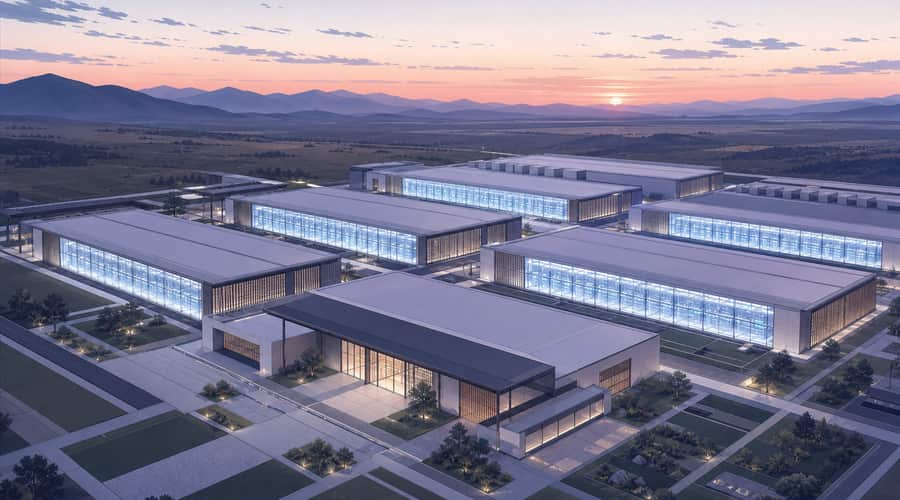
NTT Global Data Centers is working with Citigroup to raise at least $1 billion for US data center expansion, a deal that shows how the AI buildout is moving beyond Silicon Valley and deeper into institutional capital markets.
The pitch is straightforward: buy into a new development vehicle that will fund data center capacity across the United States, collect returns as hyperscale tenants fill that capacity, and lean on NTT's operating record in one of the world's fastest-growing infrastructure markets. The company is targeting pension funds and infrastructure investors, and reports on the planned raise suggest the final amount could move higher if demand is strong. A credit facility may also be added on top of the equity.
This is not a startup round. NTT Global Data Centers sits inside NTT DATA, part of Japan's broader NTT group, and already operates at a scale that few newer AI infrastructure companies can match. Its parent has been pushing more capital into AI-ready data center capacity, while NTT's US footprint includes major campuses in Virginia, Illinois, California, Texas, Arizona, Oregon, and other key markets. For investors, the appeal is not speculative software growth. It is contracted physical infrastructure tied to the demand for compute.
What makes this deal worth watching is not only the size of the raise, but the source of the money. NTT is not primarily turning to venture capital or strategic technology investors. It is looking for long-duration capital that understands real estate, power, leasing, and construction risk. That investor profile is becoming a central part of AI infrastructure finance, because the capital needs are too large and too physical to be funded like a normal technology cycle.
As MarketWatch recently reported, Amazon has lined up a $17.5 billion delayed-draw term loan facility to support its AI expansion plans, with pricing tied to SOFR plus 0.625 to 0.875 percent depending on credit ratings. The company has until September 30, 2026, to draw the funds, and the proceeds are formally earmarked for general corporate purposes. In practice, Amazon's capital spending plans are being driven heavily by AWS data centers, chips, and other infrastructure needed to keep pace with AI demand.
That matters because Amazon is not an outlier. The largest technology companies are using their balance sheets, bank loans, private credit structures, leases, and infrastructure partnerships to turn AI demand into physical capacity. CoreWeave and its landlords have leaned on debt markets to finance leased data center projects. Meta, Oracle, Microsoft, Google, and Amazon are all pushing capital into the same bottleneck: power-connected sites that can host dense compute at scale.
NTT's equity raise fits neatly alongside those structures. While Amazon can borrow at corporate scale and newer AI infrastructure companies often rely on more expensive credit, NTT is going directly to the infrastructure equity market. The mechanism differs, but the destination is the same. The AI economy needs buildings, substations, cooling systems, fiber, GPUs, and tenants with the ability to sign long leases. That is why pension funds are suddenly part of the same conversation as cloud providers and chipmakers.
Japan Inside the Wire
There is also a sovereignty angle here, although it should be stated carefully. NTT is not majority-owned by the Japanese government. Japan retains roughly a one-third stake in Nippon Telegraph and Telephone, the parent company at the top of the group, which gives NTT a state-linked profile without making it a government-controlled operator in the simple sense. That distinction matters, because US scrutiny of foreign ownership in sensitive infrastructure is becoming more serious and more precise.
Under CFIUS rules, foreign investments can face review when they involve US businesses tied to critical technology, critical infrastructure, or sensitive personal data. A mandatory filing is not automatic for every critical infrastructure investment, but it can be triggered in specific cases, including certain foreign government interests or export-controlled technology. Data centers become more sensitive when they host government, defense, or high-value AI workloads, and that sensitivity will only rise as compute capacity becomes a strategic asset.
NTT's advantage is that it arrived early. Its US campuses are already operating, its customer relationships are established, and Japan is a close US ally rather than a country at the center of Washington's national security concerns. Even so, the regulatory environment around who owns and finances the physical layer of American AI is tightening. A Japanese-linked operator with large US campuses may be well positioned, but it will still need to navigate policy risk as the sector becomes more strategic.
For institutional investors, the more immediate question is whether NTT's equity vehicle offers enough upside compared with the debt available elsewhere in the data center market. Equity exposure can capture more growth if leasing demand stays strong and valuations keep rising, but it also sits below debt in the capital structure. Pension funds will need to decide whether AI data centers look like stable infrastructure, a fast-growth real estate trade, or something riskier in between.
The practical takeaway is that AI infrastructure is no longer just a technology story. It is a financing story, a power story, and increasingly a national infrastructure story. NTT's raise will be worth watching because it shows whether conservative institutional money is ready to underwrite the next phase of the AI buildout, not through software valuations, but through the buildings that make the software possible.
Also read: DoorDash turns cookbook photos into grocery carts with a new AI chatbot that could reshape how the company makes money • Waymo Premier is Alphabet's bet that loyal riders will pay a monthly fee to skip the line • Visa embeds its payment network inside ChatGPT as the race to own agentic commerce breaks into a sprint