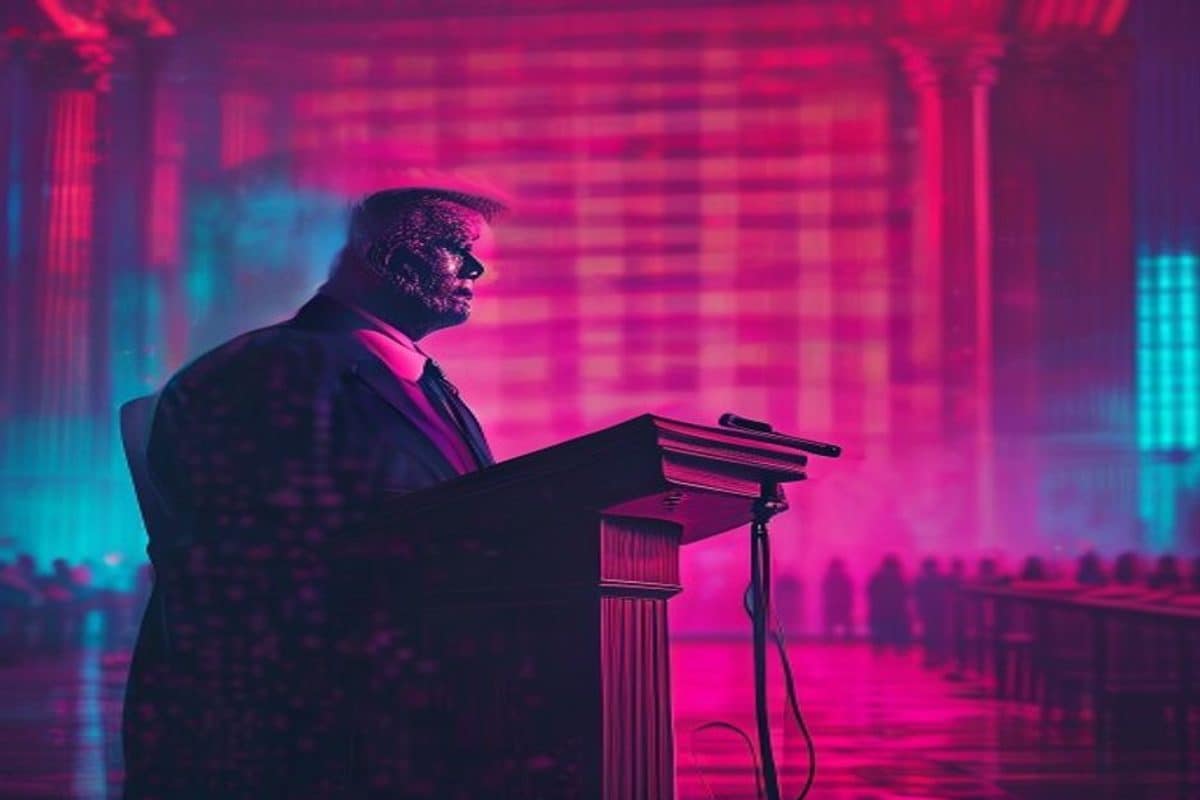
A social media trend challenging users to generate fictional U.S. presidents with GPT-Image-2 has racked up half a million mentions in 24 hours, exposing both the model's photorealistic capabilities and the soft edges of its content moderation.
Within a day of the President Test taking hold on X and Reddit, it had become something more than a meme. The prompt is deceptively simple: ask GPT-Image-2 to render the 47th President of the United States. No real person is named. No existing candidate is targeted. The AI has to hallucinate an entirely fictional political figure, which turns out to be precisely the kind of edge case that safety teams lose sleep over. The hashtag #PresidentTest crossed 500,000 mentions on X by Tuesday evening, while threads on r/ArtificialIntelligence pulled in upwards of 2 million collective views alongside cross-platform comparisons against Midjourney and Stable Diffusion.
OpenAI built GPT-Image-2 with enhanced filters specifically designed to block deepfakes and misleading portrayals of real political candidates. Those guardrails appear to be holding. What the President Test reveals, however, is that the guardrails are person-specific rather than concept-specific. Ask the model to render a real, named politician in a compromising context and it declines. Ask it to render a plausible, unnamed political figure standing at a podium in front of an American flag and it delivers something disturbingly credible. The distinction matters enormously as the 2026 midterm elections draw closer.
The technical challenge here is not trivial. Training a model to recognize and refuse requests involving specific public figures is relatively straightforward: it is essentially a classification problem with a known target list. Training a model to evaluate whether a fictional image could plausibly function as political propaganda is a much harder problem, one that requires the model to reason about intent and downstream use rather than identity. GPT-Image-2 has not solved that second problem, and to be fair, neither has anyone else in the generative AI field right now.
Regulatory pressure is building in response. Calls for mandatory watermarking of AI-generated political imagery have grown louder from advocacy groups and at least one congressional working group monitoring election integrity. The Content Authenticity Initiative, backed by Adobe and a consortium of media organizations, has been pushing for cryptographic provenance standards in image generation tools for over a year. The President Test is handing those advocates a very public proof of concept for why the urgency is real.
The competitive stakes behind the trend
For OpenAI, the timing is awkward but the visibility is not entirely unwelcome. Users flooding social media with GPT-Image-2 outputs, even in the context of a stress test, are demonstrating the model's photorealistic quality at scale. Side-by-side comparisons circulating on Reddit consistently position GPT-Image-2 ahead of the current public versions of Midjourney and Stable Diffusion on facial coherence and lighting fidelity, the two benchmarks casual users cite most often. In a market projected to reach $1.4 trillion by the end of the decade, that kind of organic benchmarking is worth more than most paid campaigns.
Investor attention is sharpening around user retention following high-profile releases like this one. A viral moment drives trial. What the metrics will show over the next 30 days is whether GPT-Image-2 converts that curiosity into sustained engagement, which is the number that actually moves valuations in the current funding environment.
The more consequential question for the sector is whether this episode accelerates regulatory timelines. The EU AI Act's provisions on synthetic media are already in force for high-risk applications. The United States has moved more slowly, but election-year pressure has a way of concentrating legislative minds. If the President Test ends up cited in a congressional hearing this summer, OpenAI will need more than a statement about its commitment to responsible deployment. It will need a technical answer to the propaganda problem that its current architecture does not yet have. Watch for whether Sam Altman's team updates GPT-Image-2's content policies before the primary season heats up.
Also read: Millions are asking ChatGPT to render New York and Los Angeles in 2126 and the results are reshaping how ordinary people picture the future • Meta is harvesting mouse movements and keystrokes from 25,000 engineers to train AI that could replace them • OpenAI's Images 2 Model cracks the two problems that have haunted AI image generation for years