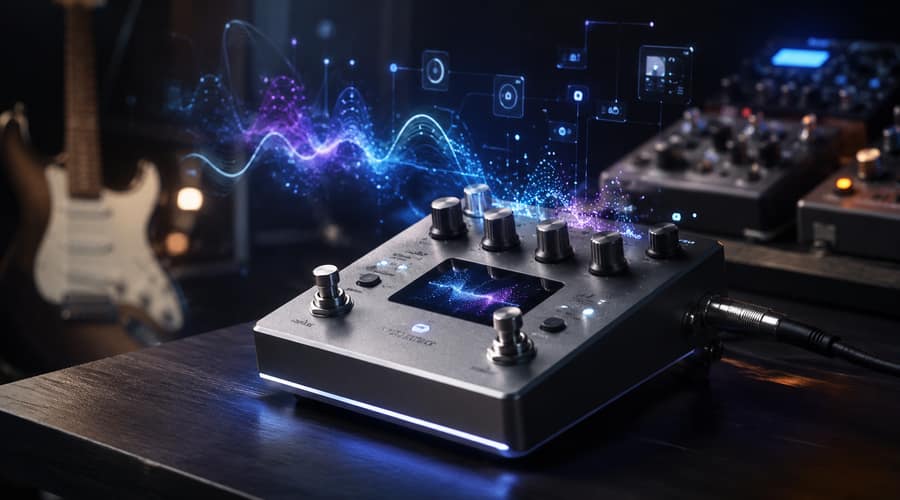
Polyend has turned the guitar pedal into a prompt-driven hardware experiment. The $299 Endless is not polished enough to replace a serious pedalboard yet, but it shows where AI-native creative devices are heading.
Polyend Endless is a strange little product because the most important part of it is not really inside the box. The pedal itself is a stereo digital effects unit with three assignable knobs, two footswitches, a 48 kHz, 24-bit audio path, and a 720 MHz ARM Cortex-M7 processor. What makes it different is Playground, Polyend's browser-based tool that turns plain-language requests into audio effects that can be loaded onto the pedal over USB-C.
That matters because most guitar pedals arrive with a fixed purpose. A delay delays. A fuzz distorts. A reverb creates space. Endless arrives with no built-in identity. Users can download free community effects, write their own DSP code in C++ through Polyend's open-source SDK, or ask Playground to generate something from a prompt. In theory, the same box can become a tape echo, a granular texture machine, a synth-style filter, or some odd studio effect that does not fit neatly into a standard category.
As MusicRadar reported when the device was unveiled at NAMM 2026, Endless launched at $299 and ships with Playground tokens, while generation costs depend on the complexity of the request. A simple delay may cost only a small amount to generate, while a complex granular looper can consume more. Polyend's current product page says each pedal includes 2,000 Playground tokens, which gives new buyers some room to experiment before the pay-per-generation model becomes part of the decision.
The promise is real, but the workflow is not effortless
The idea is easy to like. Musicians often describe sounds in language long before they know how to build them. A guitarist might want a tremolo that feels broken, a reverse delay that blooms after each chord, or a bass effect inspired by a vintage synth. Playground tries to close the gap between that instinct and working DSP code.
The friction starts when the first result is not quite right. Generating an effect can take several minutes, and refining it means going back to the browser, adjusting the prompt, downloading another file, and loading it again. Guitar World's recent review found the concept ambitious but not seamless, noting that one more complex effect took about 16 minutes to move from concept to finished result. That is acceptable for studio experimentation. It is much harder to imagine on stage, in rehearsal, or in a fast writing session where the player wants to twist a knob and keep moving.
There is also a practical distinction that buyers should understand. The AI does not live inside the pedal. Playground runs as a separate service that generates the code, while Endless loads and runs the finished effect. That keeps the hardware cheaper and simpler, but it also means the most futuristic part of the product depends on Polyend's cloud service, pricing, and long-term support.
The token model is the business story
The most controversial part of Endless may not be the AI at all. It is the economics. Free community effects soften the blow, and the open SDK gives coders a way around Playground entirely, but most non-technical players will experience Endless as a pedal attached to a token system.
That is not automatically bad. Cloud generation costs money, and a pay-per-use model is cleaner than forcing every owner into a subscription. But musicians are used to buying gear that keeps working the same way after purchase. A stompbox that asks for more credits when the first attempt fails changes that relationship. It turns sound design into something closer to a software service.
Polyend appears aware of the tension. Founder Piotr Raczynski has framed the system as a tool for creating instruments, not as a shortcut that makes music for the player. That positioning is important. The better argument for Endless is not that AI can replace taste, technique, or experimentation. It is that AI can help build stranger tools for people who already know what they want to hear.
The hardware still has limits. Endless runs one effect at a time. Loading a new effect requires USB-C rather than wireless transfer. The three-knob interface is elegant, but it also means every effect needs careful labeling and mapping. Polyend's magnetic faceplates are a clever answer to that problem, because users can change the control layout visually when they change the effect. Even so, this is a device for patient creators more than plug-and-play players.
Why startups should pay attention
Endless is useful beyond the guitar market because it shows the tradeoffs AI hardware startups keep running into. Put the model in the cloud and the device can stay affordable, but the user inherits service dependency. Charge per generation and costs stay aligned with usage, but the product starts to feel less like owned hardware. Open the platform to developers and the community can expand the library, but mainstream buyers still need the guided experience to work well.
That is the real lesson. Endless is not likely to make conventional pedals obsolete. Touring musicians will still want reliability, speed, and dedicated controls. Boutique builders will still win on feel, character, and simplicity. But Polyend has put a working prompt-to-hardware loop into a niche creative product, and that is a meaningful step.
The next version of this idea may look different. It may have wireless loading, more knobs, an onboard screen, better preset management, and faster generation. It may come from Polyend or from a rival that learns from the rough edges. For now, Endless is best understood as version 1.0 of a new category: user-programmable creative hardware with AI as the toolmaker. The question is not whether every musician needs one today. It is whether the next generation of devices will make custom tools feel as immediate as turning a pedal on.
Also read: Spotify brings ElevenLabs AI voices to author platform • Spotify Studio turns your data into personal podcasts • Anti-AI sentiment becomes infrastructure constraint