Rivian is not just refusing CarPlay. It is arguing that AI will change what drivers expect from the software layer inside a car.
Rivian has found a sharper answer to one of the most persistent complaints about its vehicles: it does not want Apple CarPlay or Android Auto because it believes the next interface in the car will be an AI assistant that understands the vehicle, the driver and the trip.
That is a much bigger claim than saying Rivian has built a nice infotainment screen. It puts the electric truck maker on one side of a fight that now runs through the entire auto industry. On one side are Apple and Google, whose phone projection systems have become default expectations for many buyers. On the other side are automakers that want to own the dashboard because the dashboard is no longer just a screen. It is the control surface for software, services, data and eventually autonomy.
As The Verge's Decoder interview with Rivian chief software officer Wassym Bensaid made clear, Rivian sees CarPlay and Android Auto as a compromise from an older software era. Bensaid said Rivian had debated whether to use a third party AI system or build its own integration layer, and decided it needed to control the platform that connects foundation models to the car operating system.
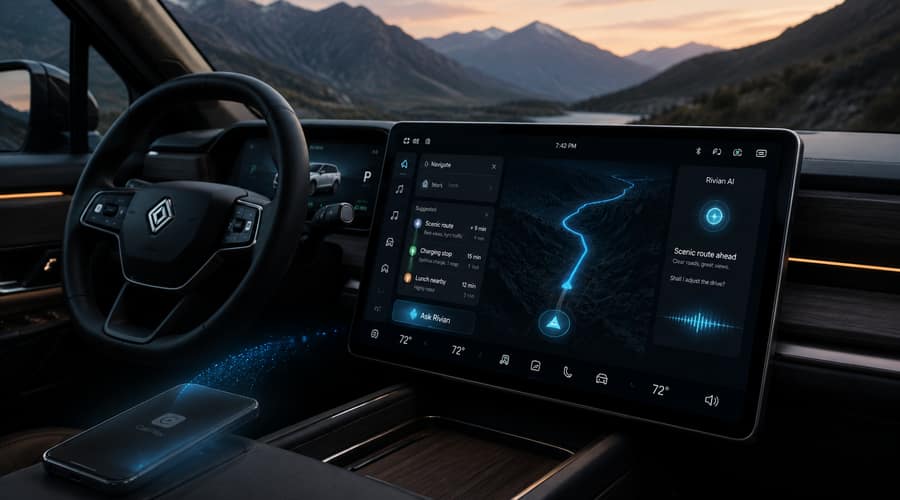
That is the important part. Rivian Assistant is not being presented as a chatbot sitting on top of the dashboard. In Rivian's view, it is meant to become the connective layer between the driver and the car itself, handling vehicle settings, navigation, media, calling, messaging, calendar context and personal preferences. Rivian's May 2026 software notes say the assistant can control climate, navigation, media and vehicle settings, reference the owner's guide, answer follow up questions and use opt in memory for things like regular destinations and restaurant preferences.
CarPlay and Android Auto solved a very real problem. Most car software was slow, ugly and outdated before the vehicle left the dealer lot. Phone projection let drivers bring the apps they already trusted into a machine that automakers were not updating fast enough.
Rivian's argument is that this bargain starts to weaken when the car itself becomes deeply software controlled. If the navigation system understands battery state, drive mode, route efficiency and charging stops, a mirrored phone app is no longer enough. If an assistant can change the ride height, set a destination from a calendar event and remember the driver's habits, the value moves from app projection to system integration.
This is why Rivian's stance looks more like Tesla than like Ford or Hyundai. Tesla never embraced CarPlay, largely because it wanted the whole user experience to live inside its own software stack. Rivian is taking the same broad position, but with a more explicit AI pitch. Tesla's public software identity has often centered on autonomy and driver assistance. Rivian is now talking more directly about the everyday interface: what you say, what the car understands and how much of your digital life it can coordinate.
There is a business reason for that. Rivian's technology is no longer only about Rivian vehicles. Through its Volkswagen joint venture, RV Tech, the company is helping build electrical architecture and operating system technology for future Volkswagen Group electric vehicles. Bensaid said the joint venture has about 1,500 people and will support brands from Audi to Porsche to Volkswagen. That gives Rivian's software choices a much larger audience than its own R1T, R1S and upcoming R2.
Apple and Google still have the customer relationship
The risk for Rivian is simple. Drivers do not want to be told that a future assistant will eventually replace a feature they already use today. They want their maps, playlists, messages and preferred apps to work now. Rivian says its own surveys show CarPlay demand among customers has fallen from more than 70 percent around the early R1 launch period to less than 25 percent recently, but that still leaves a meaningful group of buyers who see missing phone projection as a flaw, not a philosophy.
There is also a practical limit to voice. In the same interview, Rivian's assistant could not perform some safety related functions, including wiper controls, because those areas are regulated or require guardrails. That is sensible. It also shows why the replacement story is not clean. A good assistant can reduce friction, but it cannot make every screen, button or app disappear without creating new frustration.
For Apple, the immediate financial threat is often overstated. Standard CarPlay is not believed to be a licensing goldmine in the way an App Store fee is. The real prize is strategic. If Apple controls the in-car experience, it keeps the iPhone central during one of the most valuable hours of a user's day. If automakers succeed with their own assistants, Apple becomes one service among many inside someone else's operating system.
Google is in a slightly different position because it already supplies pieces of the vehicle software stack through Android Automotive and services like Maps and Gemini. Rivian itself says its assistant uses internal models for local tasks and Google models for some cloud and grounding functions. That means the future may not be car companies versus tech companies. It may be car companies deciding which parts of the stack they must own and which parts they can rent.
The test will not be whether Rivian can make a convincing argument on a podcast. The test will be whether drivers stop asking for CarPlay because Rivian's own system is genuinely better in daily use. If AI can make the car feel more personal, more useful and less distracting, Rivian will look early. If it becomes another subscription feature that sometimes misunderstands simple requests, Apple and Google will remain hard to displace.
Also read: Stable Audio Studio brings local AI sound generation into focus • Congress is preparing truck drivers for the autonomous freight era • Meta is preparing an AI pendant for the wearable race