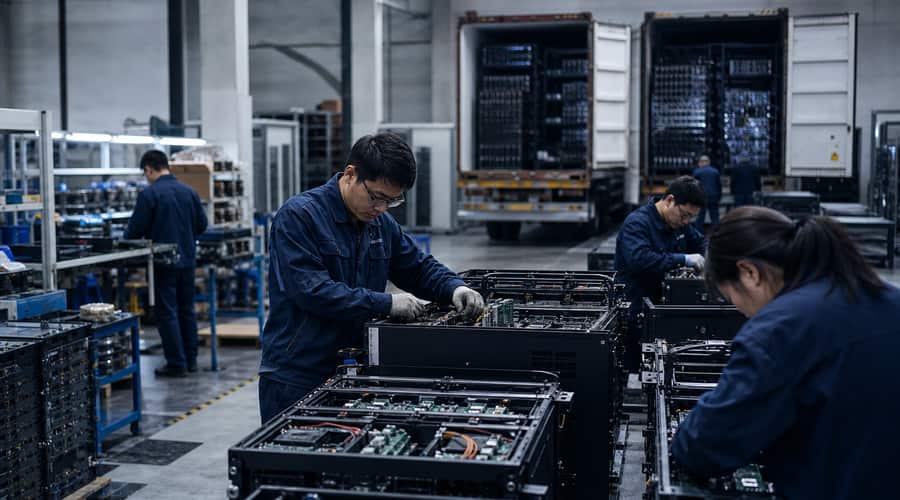
Cerebras is not being treated like a routine chip IPO. The company's upsized offering shows how scarce AI compute has turned credible hardware suppliers into public-market tests of the entire infrastructure boom.
Cerebras is heading toward Nasdaq with unusually strong demand, and that matters because the company is selling more than a fresh chip story. It is selling the idea that AI buyers need alternatives to a market still dominated by Nvidia, where capacity, cost and deployment speed have become strategic problems for every large model company.
According to Reuters, Cerebras moved to raise both the size and price of its initial public offering, lifting the deal to 30 million shares at $150 to $160 each after earlier marketing at 28 million shares and $115 to $125. At the top of the new range, the company could raise about $4.8 billion. The Wall Street Journal has also reported that the stock is expected to begin trading Thursday under the ticker CBRS.
That is a remarkable turn for a company that withdrew an earlier IPO attempt and spent years trying to convince the market that wafer-scale chips could compete with the GPU-centered world Nvidia built. Now the argument has changed. Investors are not just buying a chip company. They are buying possible relief from a compute bottleneck that has become one of the defining business constraints of the AI boom.
Cerebras takes a very different approach from Nvidia. Its wafer-scale engine uses an entire silicon wafer as one giant processor, a design meant to move data quickly across a huge surface instead of stitching together smaller chips in the usual way. That architecture is not easy to manufacture or sell. But if it works at scale, it gives customers another way to handle the flood of inference demand as AI products move from demos to daily usage.
This is where the pressure starts to show. The AI industry has spent the last two years talking about models, but the market is increasingly rewarding companies that control compute, power, networking and deployment capacity. OpenAI, Amazon Web Services and other large buyers do not just need better chips. They need enough available systems to serve millions of queries reliably, at prices that do not break the economics of the product.
The valuation question is harder than the demand story
Cerebras has real numbers behind the offering. Its filing showed $510 million in 2025 revenue, up from $290.3 million in 2024, helped by demand for AI infrastructure and new commercial relationships. The company has also announced major relationships with OpenAI and AWS, two customer names that immediately change how investors view any AI infrastructure supplier.
But investors should separate demand from durability. A hot IPO book can prove that buyers want exposure to AI hardware. It does not prove that Cerebras can convert today's scarcity premium into long-term market share. The company still faces the hard parts of hardware: supply chains, manufacturing yields, customer concentration, capital intensity and the constant risk that Nvidia, AMD or a cloud provider finds a cheaper route to the same performance.
The net income line also needs context. Cerebras reported a sharp swing from prior losses, but several analyses of the filing have pointed out that operating results and accounting gains tell different stories. That does not make the listing weak. It makes it more important to read the IPO as a bet on future scale rather than a simple profit story.
When an IPO can be repriced sharply higher before trading begins, the market is telling us that AI compute has crossed into a new phase. Scarcity itself is becoming a valuation driver. The danger is that scarcity can look like product-market fit when it is really a temporary shortage.
Right now, anyone who can offer credible AI capacity has an audience. The longer test is whether Cerebras can keep that audience when supply improves, customers become more disciplined and enterprises ask harder questions about cost per query instead of raw performance.
What comes next is simple to watch but difficult to judge. If CBRS prices above range and trades strongly, other AI hardware companies will see a wider window. If the stock struggles after a hot book, it will remind the market that even in AI, infrastructure excitement eventually has to meet execution.
Also read: Tower Semiconductor turns AI demand into capacity commitments • AI is rewriting utility leverage in Lake Tahoe's power fight • Ontario's AI scribe audit puts clinical procurement on notice