
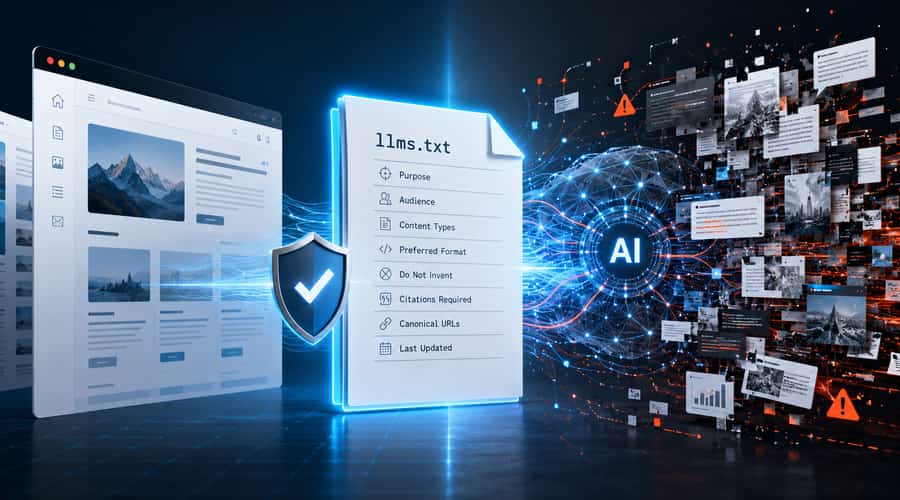
Llms.txt is worth paying attention to, but publishers should treat it as an early AI readability signal, not a guaranteed shortcut into ChatGPT, Perplexity, Claude, or Google AI Overviews.
AI search is changing how readers discover information, and publishers cannot afford to ignore the infrastructure around it. When a user asks an assistant for an answer, the result is often a compressed explanation with a handful of cited sources, not a page of blue links. That makes clarity harder to outsource. If your site is difficult for a machine to understand, it may be easier for that system to pass over.
That is where llms.txt has entered the conversation. The file is a plain-text Markdown document, usually placed at the root of a domain, that gives AI systems a short guide to what a site is, what it publishes, and where the most useful pages can be found. It is often compared with robots.txt, but the comparison only goes so far. Robots.txt is mainly about crawler access. Llms.txt is about context.
What the file actually does
The public proposal for llms.txt was published by Jeremy Howard of Answer.AI on September 3, 2024, and the format is intentionally simple. As the llms.txt specification explains, the file typically includes a site or project name, a short summary, and curated links to important pages, often grouped under Markdown headings. It is designed to be readable by humans and language models, without requiring a new technical stack.
That simplicity is the appeal. A publisher can use llms.txt to point AI agents toward category pages, author pages, sitemaps, explainers, product documentation, policy pages, and other high-value material. For a software company, that might mean documentation and API references. For a business publication, it might mean coverage areas such as startups, AI, crypto, markets, venture capital, and company profiles.
What it does not do is just as important. There is no reliable public evidence that Google, OpenAI, Anthropic, or Perplexity use llms.txt as a ranking factor for AI answers. Google representatives have previously said that normal SEO remains the route into AI Overviews, and several recent industry explainers have warned that no major model provider has clearly confirmed broad operational support for llms.txt as a citation signal. That does not make the file useless. It does mean publishers should not sell it to themselves as magic.
The real reason publishers should care
The stronger case for llms.txt is not that it guarantees traffic tomorrow. It is that the web is becoming more agent-readable, and publishers need to prepare their sites for systems that increasingly summarize, compare, retrieve, and cite information on behalf of users. Clean metadata, structured pages, accessible sitemaps, strong internal linking, and clear editorial descriptions all matter in that environment. Llms.txt belongs in that same toolkit.
There is also a strategic value in deciding what you want machines to understand about your publication. A general sitemap tells a crawler where pages are. An llms.txt file can tell an assistant which pages best represent your editorial focus, which sections should be treated as canonical, and how attribution should work when content is summarized. That is not a replacement for licensing agreements, copyright policy, or technical crawler controls, but it is a useful public statement of intent.
The mistake is treating the file as a new SEO hack. Publishers have seen this movie before. Schema markup, sitemaps, canonical tags, and structured data all became useful because they helped machines interpret the web more accurately. They did not rescue weak content, and llms.txt will not either. A thin site with a polished llms.txt file is still a thin site. A serious publication with a clear editorial archive, good technical hygiene, and a concise machine-readable guide is in a better position than one that leaves AI systems to infer everything from messy page templates.
What a good llms.txt file contains
A practical llms.txt file should be brief, specific, and easy to maintain. Start with the publication name and a short description of what it covers. Add links to the most important sections, including category pages, evergreen explainers, sitemaps, and any pages that define editorial policies or attribution preferences. If the site wants AI assistants to summarize or recommend its content only with attribution, say that plainly.
For StartupFortune, the logic is straightforward. A file at startupfortune.com/llms.txt can describe the site's focus on AI, crypto, startups, venture capital, business, and markets, while linking to the sections and sitemaps that best represent that coverage. That is a low-cost way to make the publication easier to parse, even if the broader adoption curve is still developing.
The publishers most likely to benefit are the ones that see llms.txt as one part of a wider AI visibility strategy. They will still need original reporting, strong headlines, clean pages, trustworthy authorship signals, and content that answers real questions better than competitors do. The file simply helps make that work easier to find and interpret.
So the practical takeaway is not panic, and it is not hype. Publish an llms.txt file if your site has clear expertise and useful pages worth pointing to. Keep expectations grounded. Then watch which AI systems begin to respect it, because the signal may matter more as assistants become a primary front door to the web.
Also read: China’s AI start-up funding surge shows capital is chasing scale • Google is turning search into an AI answer engine and the web may pay the price • Data center opposition is becoming a founder risk