Nexchip Semiconductor's $890 million Hong Kong debut is not a bet on frontier AI chips. It is a public test of whether investors still believe China's older chip strategy has room to run.
Nexchip Semiconductor Corp began trading in Hong Kong on Friday after selling 216.2 million shares at HK$32.30 each, the top of its offering range. Bloomberg reported that the Hefei-based wafer foundry raised about $890 million, while The Wall Street Journal had put the deal at HK$6.98 billion before pricing. The Hong Kong shares were priced at a 57% discount to Nexchip's Shanghai-listed stock, which closed Thursday at 65.21 yuan.
That's a big gap. It is also the story. A state-backed Chinese chipmaker didn't need to sell investors a dream about beating Nvidia at the sharpest edge of the market. It only had to show that the older, less glamorous parts of the semiconductor stack still have money behind them.
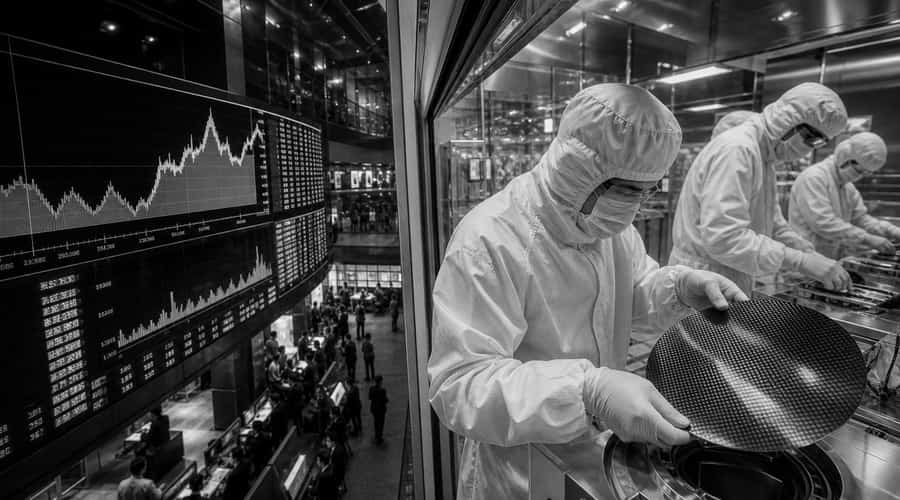
Nexchip isn't chasing the AI accelerator race. It makes display driver chips, the silicon that controls what shows up on phone and television screens, along with power management chips and microcontrollers, plus CMOS image sensors. Its historic business sits around mature process nodes, the chips that rarely make headlines but still turn up inside cars, appliances and consumer electronics.
The company has weight in that lane. Founded in 2015 as a joint venture between Hefei's government-owned investment arm and Taiwan's Powerchip Technology, Nexchip has become China's third-largest pure-play foundry by revenue, behind SMIC and Hua Hong Semiconductor. It listed on Shanghai's STAR Market in 2023. Hong Kong is a fresh test, and it comes at a useful moment for Beijing.
The money is going into older chips that still matter
The IPO proceeds have a specific destination. About 53.6% is earmarked for research and development on a 22 nanometer chipmaking platform, a step up from the company's current mature-node base. Another portion is tied to production capacity linked to AI-related demand, mostly the power management and display chips that sit around AI hardware rather than the processors doing the heavy compute.
That distinction matters. Everyone talks about GPUs. You can't build useful electronics with GPUs alone.
Nexchip is also putting 35.5 billion yuan, about $5.1 billion, into a Phase IV facility in Hefei's Xinzhan High Tech Zone. The plant is expected to produce 55,000 wafers a month at the 28 and 40 nanometer nodes once it is fully running, with equipment installation due to start in the fourth quarter of 2026 and full production targeted for the second quarter of 2028.
Those dates are not small print. If you're watching China's semiconductor strategy, they show how long this buildout really takes. Export controls can land in a single government notice. Fab capacity arrives in years, with tools installed quarter by quarter and usable output coming later.
Hong Kong has reopened for Chinese chip stories
Nexchip's debut also lands during the busiest stretch for Hong Kong listings in years. Deloitte has forecast roughly 160 Hong Kong IPOs in 2026 raising at least HK$300 billion, and Hong Kong was already near the top of global IPO tables after a strong first quarter. The timing is blunt. Chinese technology companies are using Hong Kong again because investors are listening again.
Chip companies are helping carry that wave. ChangXin Memory Technologies, China's largest DRAM maker, is preparing a Shanghai STAR Market listing that could raise about $4.3 billion, with subscriptions expected to open July 16 and trading expected around July 24. The Wall Street Journal recently reported that CXMT's first-quarter profit rose 17-fold as Chinese memory makers become a more serious concern for Samsung, Micron and SK Hynix.
SK Hynix is a different case, but it belongs in the same investor mood. Barron's reported that the South Korean memory maker is set to begin Nasdaq trading through American depositary receipts under the ticker SKHY, with demand more than seven times oversubscribed. That is not the same as Nexchip's Hong Kong listing. Demand is the signal.
Look at the spread. Nexchip is selling mature foundry capacity in Hong Kong. CXMT is raising money for DRAM in Shanghai. SK Hynix is giving US investors another listed route into memory. Different exchanges and companies, same appetite: investors want exposure to the physical infrastructure behind the AI buildout, not only the models and cloud software sitting on top of it.
US export controls are aimed hardest at the advanced end of the chip stack, including sub-10 nanometer logic and leading-edge tools, plus the high bandwidth memory used with data center GPUs. They bite far less at 28, 40 or 55 nanometers, which is exactly where Nexchip has spent most of its life.
That's not an accident. China's Big Fund, launched in 2014, and the Made in China 2025 program that followed a year later both pushed for a domestic semiconductor supply chain that could better withstand American pressure. The old target was 70% chip self-sufficiency. China is nowhere near independent across the whole stack, but mature-node capacity is one of the places where the strategy is easiest to see.
Nexchip isn't catching TSMC or Samsung on cutting-edge logic. Frankly, that's not the bet. The bet is that chips nobody brags about, the ones that make screens light up and batteries behave, are exactly the ones Washington can't choke off as easily.
An $890 million Hong Kong raise priced at the top of the range says investors still buy that argument. The harder proof comes later, in Hefei, when the new tools are installed and those 28 and 40 nanometer wafers start coming off the line.
Also read: Anthropic Resets Claude Code Usage Limits Again After a Rough Week of Outages, AI Data Centers Are Quietly Pumping Pollution Into the Cities Built to Host Them, and Singapore's AGONG Durian Uses Blockchain to Prove Every Fruit Is Genuine