The Copper Scroll, a Dead Sea document listing 64 locations where dozens of tons of gold and silver were allegedly hidden, has gone viral again , and it's worth understanding why this ancient artifact still commands serious attention.
A TIL post circulating across social platforms this week has reintroduced millions of people to one of archaeology's most tantalizing anomalies: a scroll discovered in 1952 that reads less like religious scripture and more like a treasure map written by someone who really did not want to forget where they buried everything. The document in question, formally designated 3Q15 and known as the Copper Scroll, was found in Cave 3 at Qumran and is unlike anything else recovered from the Dead Sea region , in material, in content, and in the questions it refuses to answer.
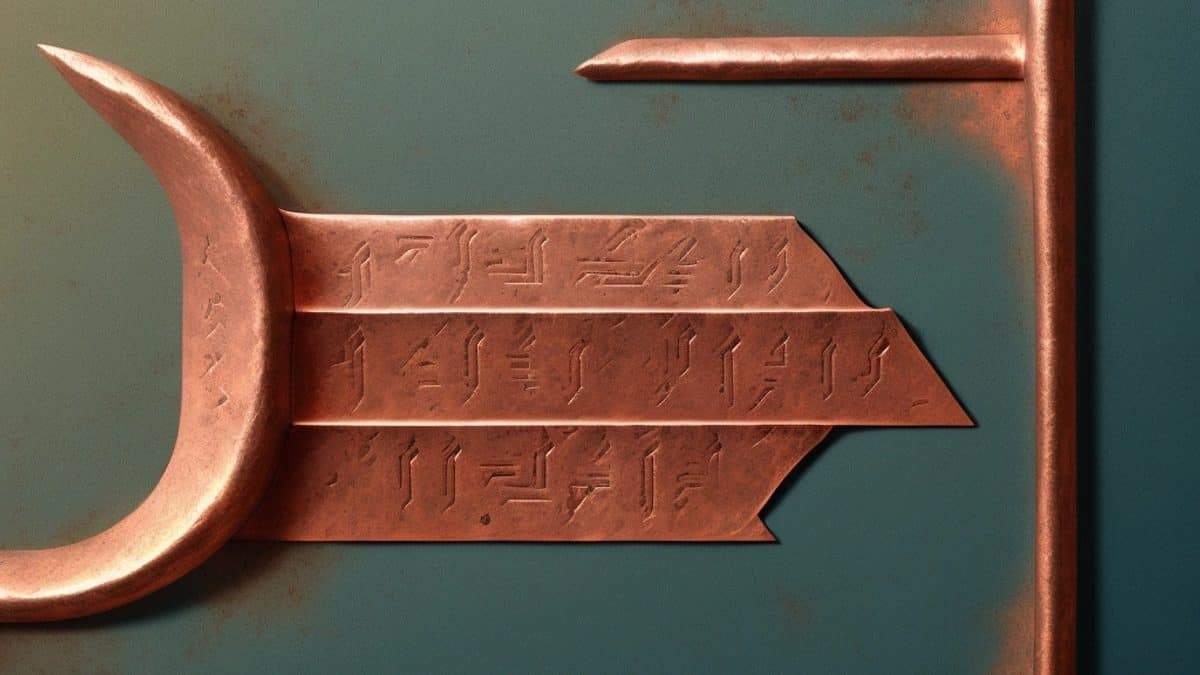
Where the other Dead Sea Scrolls were written on parchment or papyrus and contain biblical texts or sectarian religious documents, this one was engraved on thin sheets of copper. That alone signals intent. You engrave things on metal when you want them to last, when the information is too valuable to risk on organic material. The scroll's brittleness meant researchers had to cut it into strips just to read it, a process that took years after its discovery before the text could be fully examined.
The inventory lists 64 specific hiding places, each with directional references to landmarks , cisterns, tunnels, reservoirs, threshing floors , and a precise accounting of what was buried there. The total haul described exceeds 4,600 talents of precious metals. A talent in this period weighed roughly 30 kilograms, which puts the theoretical combined weight somewhere north of 138 metric tons of gold and silver. At current spot prices, that figure runs well into the billions of dollars.
The text identifies the wealth as belonging to either the Congregation of Israel or the Priestly Treasury, depending on how certain passages are read. The dominant scholarly theory, advanced by researchers including John Marco Allegro and Norman Golb, holds that this was the wealth of the Second Temple in Jerusalem, concealed before the Roman destruction of 70 CE. The Jewish Revolt had made the outcome increasingly clear to those inside the city, and hiding the temple treasury would have been a logical act of preservation in the face of inevitable siege. A competing theory attributes the hoard to the Essenes, the ascetic Jewish sect most commonly associated with the Qumran settlement itself.
Why no one has found it, and what that means
The honest answer is that the directions in the scroll are precise in a way that is now almost entirely useless. Landmarks that made perfect sense to a first-century reader , a specific cistern near a particular valley, a burial chamber beneath a recognizable courtyard , have either been destroyed, built over, renamed, or swallowed by two thousand years of geological and political change across one of the most contested pieces of land on earth. Multiple expeditions have searched seriously. None have returned with treasure.
Most archaeologists working in the field today take the position that the hoard was either recovered in antiquity, lost to destruction, or described in a way that was deliberately ambiguous to anyone not already familiar with the specific locations. A few hold that the scroll may have been partly symbolic or formulaic rather than a literal accounting. The treasure hunt, in other words, is probably over , it just hasn't stopped being interesting.
For precious metals investors and commodity watchers, the renewed attention is a cultural moment rather than a market signal. No discovery is imminent, no excavation is underway with credible recovery prospects, and the scroll itself has been housed at the Jordan Museum in Amman since 1966. What the viral cycle does reflect, usefully, is the deep psychological grip that gold and silver hold on the human imagination , not merely as financial instruments but as objects worth hiding, protecting, and dying for. That instinct is as present in 2026 as it was in 70 CE, which is perhaps the most relevant thing the Copper Scroll has to say to anyone watching the commodity markets right now.
Also read: Gold prices recover from weekly lows as Iran peace talk hopes cool inflation anxiety • Gold prices recover from weekly lows as Iran peace talk hopes cool inflation anxiety • Gold Hits $3,200 an Ounce: Why Investors Are Piling Into Safe Havens Right Now