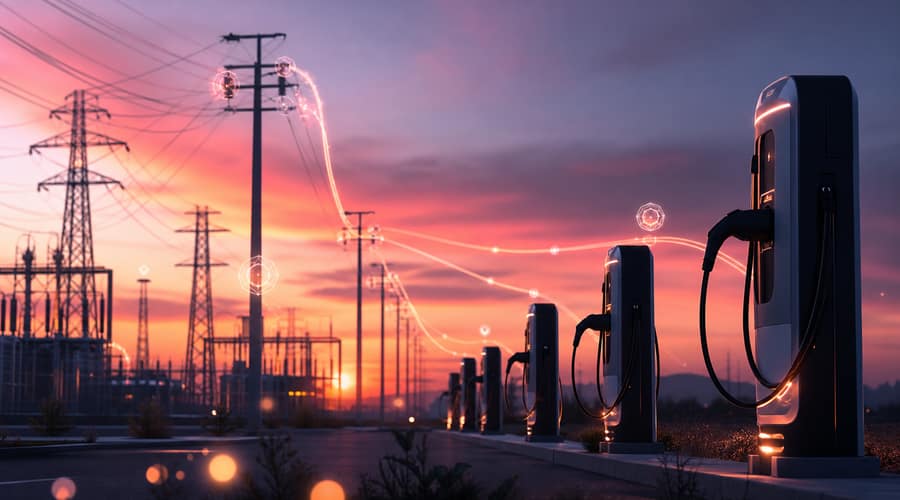
EV chargers are turning into grid-edge computers, and researchers are now testing AI agents to watch them from the inside.
The new security question around electric-vehicle charging is not whether a broken charger annoys a driver. It is whether thousands of networked chargers, all talking to central systems and the power grid, become a weak layer in the energy system itself.
Researchers at the University of Malaga's NICS lab in Spain have put forward one answer: place AI agents at chargers and other charging-network components, let them compare what they are seeing, and keep a tamper-resistant record of their actions. Wired reported on June 13 that the work, led by infrastructure-security researcher Cristina Alcaraz and published in the International Journal of Critical Infrastructure Protection, was tested in simulated environments using the Open Charge Point Protocol, better known as OCPP.
OCPP is the plain but important part of this story. It is the protocol that lets charging stations communicate with a central management system, handling things such as authentication, load control, consumption monitoring and diagnostics. A public charger is not just a socket on a wall. It is a payment device, a network device, a piece of electrical equipment and, in many cases, a remote asset controlled by software.
The Malaga system treats that reality seriously. Each agent observes a local part of the network, such as a charger, a communication link or another connected device. Then the agents share their observations through a consensus model based on opinion dynamics, a mathematical way of describing how individual views can shift as information moves through a group. The point is not to make one charger clever in isolation. The point is to stop one bad reading from becoming a false alarm, and to stop one local warning from being missed because the central dashboard lacks context.
This is arriving at the right moment. According to the International Energy Agency's Global EV Outlook 2025, more than 1.3 million public charging points were added worldwide in 2024, an increase of more than 30 percent from the year before. In the United States, Axios reported from Paren data that charging networks added more than 18,000 DC fast-charging ports in 2025, taking the national total above 70,000 public fast chargers.
Those numbers change the risk profile. A handful of unreliable chargers is a customer-service problem. Tens of thousands of fast chargers, tied into payments, fleet schedules, utility demand management and eventually vehicle-to-grid systems, are infrastructure. EVgo alone added about 1,100 ports in 2025 across its own network and the chargers it operates for Pilot Flying J travel centers, according to the same Axios report. That is a lot of new equipment to monitor, patch and defend.
There is already evidence that the security layer is uneven. A 2024 academic measurement study of 325 publicly deployed CCS DC charging stations across four European countries found that only 12 percent implemented TLS, leaving most of the chargers examined exposed to attacks that researchers said had already been demonstrated years earlier. That does not mean every charger is about to be compromised. It does mean the industry has been building physical deployment faster than it has been proving security maturity.
The Malaga work is interesting because it does not pretend the answer is only a better dashboard in the cloud. In the simulations described by Wired, the agents were exposed to component failures, communication-link errors and situations that required several parts of the charging network to respond together. The agents detected device-level faults and wider behavioral patterns, while the consensus model reduced false positives by comparing observations from different places in the network.
The startup opportunity is operational, not glamorous
For startups, the immediate opening is not a consumer app. It is the dull, valuable work of helping charger operators, utilities and fleet owners know which fault is local, which one is spreading, and which one deserves a truck roll. A false alarm can waste labor. A missed alarm can take chargers offline or, in a worse case, let an attacker manipulate equipment sitting at the edge of the distribution grid.
The blockchain part deserves a colder reading. The researchers use a distributed ledger to record agent transactions so the system has traceability and integrity. That can be useful when operators need to reconstruct what happened after a fault or a suspected intrusion. But blockchain is not magic security. It adds another system to integrate, maintain and explain to buyers who already have procurement checklists, uptime guarantees and utility rules to satisfy.
The better way to read it is as an audit layer, not the main event. The main event is distributed detection. If AI agents can sit close to the charger, compare local events with neighboring stations and feed a central system a cleaner diagnosis, then operators get something more practical than another alert stream. They get a map of what is actually going wrong.
That is where the market could move. Charging operators are under pressure to add ports, improve reliability and support newer standards such as automated Plug and Charge experiences. Security will have to become part of that reliability story, not a separate compliance exercise bolted on after deployment. A charger that is online but cannot be trusted is not reliable in any useful sense.
The Malaga research is still a proposal tested in simulation, not a commercial product running across a national network. That distinction matters. But it points in the direction the sector is already heading: more chargers, more software, more grid interaction and less room for security tools that only understand one device at a time.
Also read: China puts financial data closer to the center of state control • Insta360 is pushing DJI into a creator camera patent fight • Tesla’s Autopilot problem now has a ten dollar face